Videos & Webinars
Learn more about spectroscopic ellipsometry by viewing educational videos and discover some of the applications with our collection of webinars.
Spectroscopic ellipsometry is a surface-sensitive, non-destructive, non-intrusive optical technique widely used for thin layers and surface characterization. It is based simply on the change in the polarization state of light as it is reflected obliquely from a thin film sample. Depending on the type of material, spectroscopic ellipsometers can measure thickness from a few Å to tens of microns. It is also an excellent technique for multi-layers measurement.
Spectroscopic ellipsometry allows a range of thin film properties to be characterized, like layer thickness, optical properties (n,k), optical band gap, interface and roughness thickness, film composition, uniformity by depth and area, and more.
Materials suitable for spectroscopic ellipsometry include semiconductors, dielectrics, polymers, organics, and metals. Ellipsometry can also be used to study solid-liquid or liquid-liquid interfaces.
HORIBA spectroscopic ellipsometers use innovative technology to perform high frequency polarization modulation measurements without any mechanical movement, thus giving a faster, wider range and higher precision of characterization when compared to conventional ellipsometers.
Ellipsometry is a well-known, yet sometimes not well understood, characterization techniques for thin films. Based on light polarization and indirect determination of parameters, ellipsometry enables obtaining thin film thickness and optical parameters, roughness, porosity or even compositional information about simple layers & complex stacks. Very useful in the fields of semiconductors, PV, optical coatings and every application using thin films, ellipsometry reached for some years now an instrumental maturity which enables to open its use to non-expert users. Come and (re)discover the basics of this powerful technique for your materials characterization needs!
Watch it nowWith their ~20 % efficiency, hybrid perovskite solar cells are the new promising candidate for next generation photovoltaics. Thanks to the wide HORIBA portfolio, different techniques can be used to gain in depth knowledge on the optoelectronic properties and mechanisms of this class of materials. In this application note we decided to use spectroscopic ellipsometry, steady-state and time-resolved fluorescence and Glow Discharge Optical Emission Spectroscopy to investigate the properties of CH3NH3PbI3 thin films deposited on a spin-coated PEDOT:PSS. The impact of the exposure to air was addressed.
Read moreDiscover the webinar from Dr Arnaud Etcheberry (ILV, Versailles, France)
View the webinar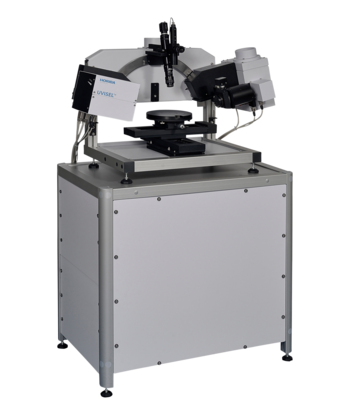
Spectroscopic Ellipsometer from FUV to NIR: 190 to 2100 nm
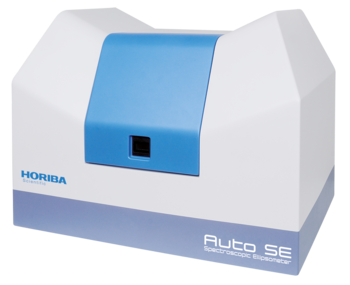
Spectroscopic Ellipsometer for Simple Thin Film Measurement
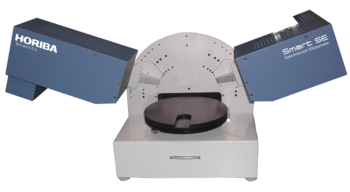
Powerful and Cost Effective Spectroscopic Ellipsometer
Máte nějaké dotazy nebo požadavky? Pomocí tohoto formuláře kontaktujte naše specialisty.