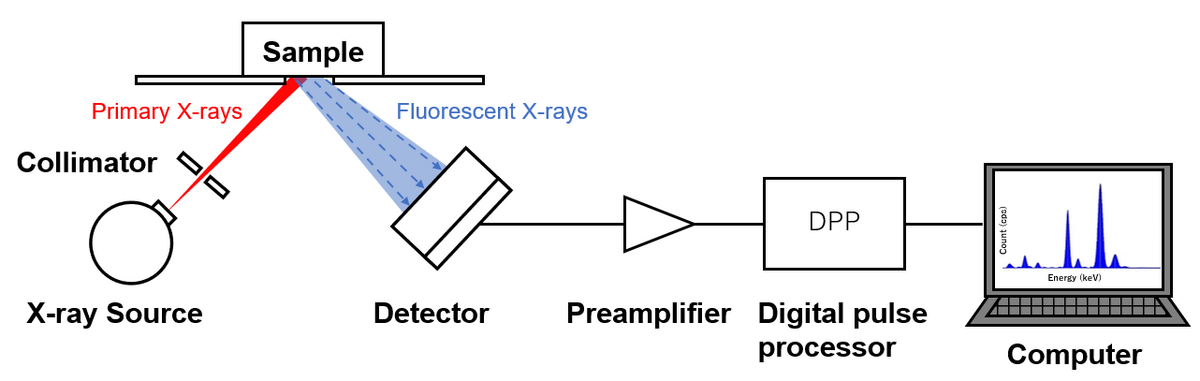


Diese Seite stellt die wichtigsten Komponenten des energiedispersiven Röntgenfluoreszenzanalysators vor (EDXRF). Der EDXRF-Analysator besteht aus den folgenden Schlüsselkomponenten, und die folgende Abbildung zeigt ein schematisches Diagramm der einfachsten Tisch-EDXRF-Analysatoren.
Ganz klar. Schaltplan eines einfachen Tisch-EDXRF-Analysators
Alle XRF-Spektrometer benötigen eine Röntgenquellen, die üblicherweise von einem In-situ-Röntgengenerator oder, seltener, von einem Radioisotopmaterial bereitgestellt werden.
Ein typischer Röntgengenerator leitet einen elektrischen Strom durch einen Glühfaden, wodurch Elektronen emittiert werden. Diese Elektronen werden dann durch eine hohe Spannung (meist irgendwo zwischen 20 und 100 kV) in Richtung einer Anode (Ziel) befördert. Die Verzögerung der Elektronen, wenn sie die Anode treffen, bewirkt eine breite Röntgenstrahlen-Kontinuum. Diese Strahlung ist als Bremsstrahlung bekannt. Zusätzlich verursacht ein Bruchteil der Elektronen charakteristische Röntgenfluoreszenz aus dem Anodenmaterial.
Somit besteht die Röntgenemission eines Generators sowohl aus der breiten, relativ schwachen Bremsstrahlung, überlagert mit sehr intensiven als auch scharfen charakteristischen Fluoreszenzlinien des Zielmaterials.
Ein dünnes Berylliumfenster wird verwendet, um die Röntgenstrahlen aus dem Generator und auf die Probe zu lassen.
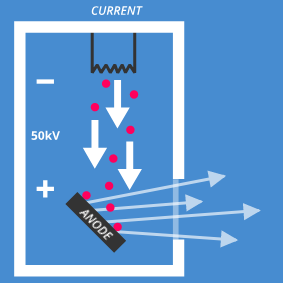
Das Zielmaterial, der Glühfadenstrom und die Beschleunigungsspannung haben alle einen erheblichen Einfluss auf die Endausgabe eines Röntgengenerators.
Ziel (Anode)
Das Zielmaterial ist eine feste Komponente des Generators – Generatoren mit verschiedenen Zielmaterialien sind verfügbar (z. B. Mo, Rh, W), aber diese sind nicht innerhalb einer einzigen Generatoreinheit schaltbar. Ein wesentlicher Teil der Ausgangsleistung des Generators entsteht durch die charakteristische Röntgenfluoreszenz des Zielmaterials. Da die Fluoreszenzausbeute mit der Atommasse zunimmt, wird durch die Verwendung von Zielmaterialien mit höherer Atommasse eine erhöhte Leistung bei einer festgelegten Spannung/Strom festgestellt. Außerdem variieren die Energien der Fluoreszenzlinien je nach verwendetem Material, wodurch verschiedene Zielmaterialien zu einer mehr oder weniger effizienten Anregung bestimmter Elemente in der Probe führen können.
Aktuell
Der Filamentstrom steuert die Anzahl der Elektronen, die das Zielmaterial bombardieren. Dadurch wirkt sich der Strom direkt auf die Röntgenausgangsintensität sowohl für die Bremsstrahlung als auch für die charakteristische Strahlung aus.
Spannung
Die Bremsstrahlungsstrahlung zeigt einen hohen Energieabbruch, da die Energie der Strahlung die angelegte Spannung nicht überschreiten kann. Durch Änderung dieser Spannung kann der Bremsstrahlungsabbruch (und das gesamte Kontinuumsprofil) modifiziert werden. Die charakteristische Strahlung des Anodenmaterials kann nur erzeugt werden, wenn die Beschleunigungsspannung (und damit die Energie der einschlagenden Elektronen) oberhalb der Absorptionsgrenze dieses Materials liegt. Wenn die Spannung also unter die Absorptionsgrenze reduziert wird, sind die charakteristischen Linien nicht mehr vorhanden.
Wie bereits erwähnt, hat ein Benutzer in der Regel keine Kontrolle über das im Generator verwendete Zielmaterial, obwohl Generatoren mit anderen Materialien verfügbar sind. Der Röhrenstrom und die Spannung sind jedoch wichtige Variablen in einem XRF-Experiment.
Der Strom steuert die Intensität der vom Generator ausgesendeten Röntgenstrahlen und wird hauptsächlich so eingestellt, dass das Signalpegel am Detektor optimiert wird.
Die Spannung hat einen wichtigen Einfluss auf das spektrale Profil des Generatorausgangs. Bei niedrigen Spannungen (z. B. 15 kV oder niedriger) wird die Bremsstrahlung bei relativ niedrigen Energien zentriert, und die charakteristische Fluoreszenz ist auf die niederenergetische L- (und M-)Linien beschränkt. Bei hohen Spannungen (z. B. 40 kV oder mehr) ist die Bremsstrahlung intensiver und zentriert bei höheren Energien, und die charakteristische Fluoreszenz umfasst die hochenergetischen K-Linien des Zielmaterials.
Der effizienteste XRF wird stimuliert, wenn der einfallende Röntgenstrahl energiemäßig nahe an der Absorptionskante des Elements/der Elemente in der Probe liegt. So ist es durch Anpassung der Generatorspannung möglich, die Effizienz der Fluoreszenz in der Probe bis zu einem gewissen Grad abzustimmen.
Die Energie des Röntgenstrahls hat ebenfalls einen starken Einfluss auf das Eindringen der Röntgenstrahlen in die Probe. Je niedriger die Energie, desto weniger Durchdringung. Auch hier ist durch Anpassung der Generatorspannung eine gewisse Kontrolle über die einfallende Röntgenstrahldurchdringung und damit die Probeaufnahmetiefe möglich.
1984 schlug ein russischer Wissenschaftler, Muradin Kumakhov, vor, dass glatte, feste Oberflächen durch vollständige Außenreflexion zur Formung, Steuerung und Führung von Röntgenstrahlen verwendet werden könnten. Dies führte zur Entwicklung einer Reihe von Röntgenoptiken, mit denen parallele und fokussierte Strahlen gebildet und Röntgenstrahlen mit hoher Effizienz übertragen werden können.
In einem Mikro-XRF-Spektrometer ist es notwendig, einen intensiven, schmalen Röntgenstrahl zu erzeugen. Dazu gibt es zwei Hauptmethoden, die unten zusammengefasst werden und auf den folgenden Seiten ausführlicher behandelt werden.
Kollimatoren
Die Röntgenstrahlen des Generators werden durch eine kleine Öffnung geleitet, meist im Bereich von wenigen Millimetern bis zu einigen hundert Mikrometern Durchmesser. Der Einsatz von Kollimatoren zur Erzeugung schmaler Röntgenstrahlen ist unkompliziert, kann jedoch mit abnehmendem Strahldurchmesser an Intensität verlieren.
Das Durchleiten eines relativ großen Röntgenstrahls durch eine kleine Öffnung führt dazu, dass die meisten primären Röntgenstrahlen vom Material um die Apertur blockiert werden. Röntgenstrahlen passieren nur die Öffnung selbst und erzeugen einen Strahl mit einem Durchmesser, der dem der Apertur nahekommt.
Mit der Verengung der Blende steigt jedoch der Anteil der blockierten Röntgenstrahlen dramatisch an. Dadurch werden auf diese Weise erzeugte Strahlen mit Durchmessern unter 500 μm niedrig in der Intensität, und Durchmesser unter 100 μm werden aufgrund dieses Problems unbrauchbar.
Heute werden Kollimatoren erfolgreich für die Analyse mit hoher räumlicher Auflösung (Strahldurchmesser < 20 μm) an Synchrotronquellen eingesetzt, wobei die extrem hohen Strahlintensitäten bedeuten, dass Intensitätsverluste kein Problem darstellen. Für Tischinstrumente mit weniger hellen Röntgenquellen werden Kollimatoren nicht für ultrahohe räumliche Auflösungen verwendet.
Monokapillare Optik
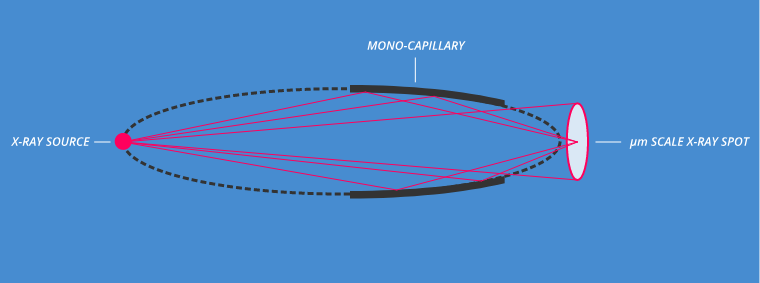
Wie Kumakhov herausfand, werden Röntgenstrahlen sehr effizient von Glasoberflächen reflektiert, wenn der Einfallwinkel niedrig ist. Durch die Herstellung sorgfältig geformter Glasoptik ist es somit möglich, diese gesamte äußere Reflexion zu nutzen, um Röntgenstrahlen zu fokussieren, zu kollimieren und zu lenken.
Der feste Winkel von der Röntgenquelle zur Kapillare ist relativ groß, was bedeutet, dass die Kopplung zwischen beiden effizient ist. Dadurch können sehr hohe Röntgenintensitäten in die Kapillare geleitet werden, und da die Reflexion selbst sehr effizient ist, können Kapillaren verwendet werden, um hochintensive Mikrostrahlen mit Durchmessern von nur 10 μm zu erzeugen. Das HORIBA X-ray Guide Tube (XGT) ist ein Beispiel für den erfolgreichen Einsatz von Monokapillaren und ist tatsächlich einzigartig, da es eine räumliche Auflösung von 10 μm auf einem Tischsystem ermöglicht.
Neben ihrer Intensität zeigen Strahlen, die mit Monokapillarglasoptik erzeugt werden, nahezu perfekte Kollimation, was sie ideal für die Mikro-XRF-Analyse macht.
Polykapillare Optik
Kumakhov zeigte außerdem, wie Kapillaroptik gebündelt werden kann, um sogenannte polykapillare Optik zu bilden. Auf diese Weise erzeugte Strahlen bieten Vorteile in der Intensität, sind aber stark fokussiert (daher werden diese Optiken oft als Kumakhov-Linsen bezeichnet). Fokussierte Punkte mit Durchmessern bis zu 40 - 50 μm sind möglich.
Für räumlich aufgelöste XRF-Analysen sind fokussierte Strahlen nicht ideal. Röntgenstrahlen dringen in die Probe ein (je nach Probe mehrere Mikrometer bis zu mehreren Millimetern), sodass zwar kleine Punktgrößen am Fokuspunkt erzeugt werden, aber unscharfe Strahlen fluoreszierende Röntgenstrahlen aus viel größeren Analysebereichen hervorrufen.
Außerdem bedeutet die fokussierte Natur des Strahls, dass die Mikro-XRF-Abbildung grober Proben schwierig ist – scharfe Bereiche profitieren von kleinen Punktgrößen, aber Bereiche mit Höhenunterschieden werden durch viel größere unscharfe Fleckgrößen verschwommen.
Es gibt eine Reihe von Detektoren für energiedispersive Röntgenspektroskopie. Diese lassen sich in drei Haupttypen unterteilen:
Festkörperhalbleiter
Diese basieren üblicherweise auf Silizium- oder Germaniumchips. Die Röntgenstrahlen gelangen durch ein dünnes Berylliumfenster und erzeugen Elektron-Loch-Paare im Halbleiterbereich des Detektors. Die Anzahl der gebildeten Elektron-Loch-Paare hängt von der Energie des einfallenden Röntgenstrahls ab. Je höher die Röntgenenergie, desto größer die Anzahl der Elektronenlochpaare. Eine hohe Spannung wird angelegt, um die Elektronen an den hinteren Teil des Detektors zu ziehen, wo sie gemeinsam als negativer Impuls aufgezeichnet werden. Ein Mehrkanal-Analysator (MCA) zählt dann diese Pulse und sortiert sie nach Größe (was der Röntgenenergie entspricht).
Um eine akzeptable Energieauflösung zu gewährleisten, werden Festkörperdetektoren typischerweise mit flüssigem Stickstoff gekühlt, was eine typische Auflösung von < 165 eV ergibt.
In vielen Fällen ist diese Kühlung auch entscheidend, um die korrekte Dopantenverteilung im Halbleiter aufrechtzuerhalten, und die Erwärmung kann ernsthafte Schäden am Detektor verursachen. Neue Generationen hochreiner Detektoren (zum Beispiel die Xerophy™ von HORIBA) beseitigen diese Bedenken jedoch und ermöglichen es, die Detektoren bei Bedarf wiederholt temperaturzuschalten – eine Kühlung ist nur während der Erkennung erforderlich.
Silizium-Drift-Detektoren (SDD)
Wie ihr Name schon andeutet, basieren Silizium-Driftdetektoren ebenfalls auf einem Siliziumdetektor, unterscheiden sich jedoch etwas von den oben besprochenen typischen Festkörperdetektoren. Konzentrische Elektroden werden auf der Rückseite des Siliziums platziert, die die Elektronen (die durch Röntgenabsorption entstehen) stetig zum Zentrum des Chips ziehen. Wie zuvor werden die Elektronen als negativer Puls gesammelt und durch eine MCA gezählt.
Was den SDD unterscheidet, ist, dass sehr gute Energieauflösungen (~ 150 eV) ausschließlich durch Peltier-Kühlung (typischerweise bis zu -20 bis -30 °C) erzielt werden können. Außerdem können mehrere einfallende Röntgenstrahlen nacheinander detektiert werden, da Elektronen, die durch Röntgenabsorption in verschiedenen Bereichen des Detektors entstehen, unterschiedliche Driftzeiten zur Anode haben. Dadurch können deutlich höhere Zählraten toleriert werden.
Im Gegensatz zu den Festkörperdetektoren zeigen SDDs eine relativ geringe Empfindlichkeit für hochenergetische Röntgenstrahlen.
PIN-Dioden
Wie der Name schon sagt, verwendet ein Pindiodendetektor ein deutlich kleineres Detektorelement – wie bei den beiden oben beschriebenen Varianten basieren sie jedoch typischerweise auf einem Silizium-Halbleitermaterial für die Detektion. Die geringe Größe des Halbleiterelements ermöglicht eine peltiere Kühlung, aber die geringere Dicke beeinträchtigt die Empfindlichkeit, insbesondere bei den schwereren Elementen.
Haben Sie Fragen oder Wünsche? Nutzen Sie dieses Formular, um mit unseren Spezialisten in Kontakt zu treten.