Particle Characterization
Laser Diffraction Principles
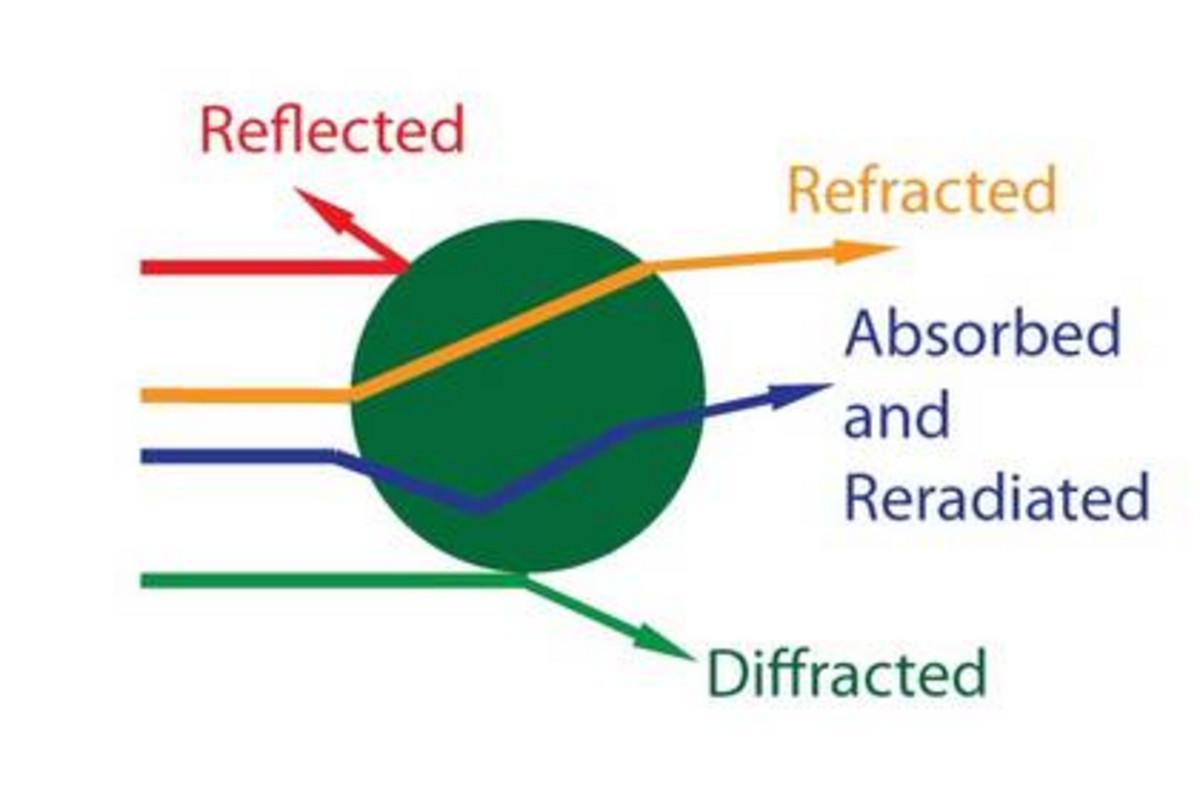
At the very heart of the laser diffraction technique is the relationship between light and surfaces (which can be freely interchanged with "particle" for our purposes). When light strikes a surface it is either
- Diffracted
- Refracted
- Reflected
- Absorbed
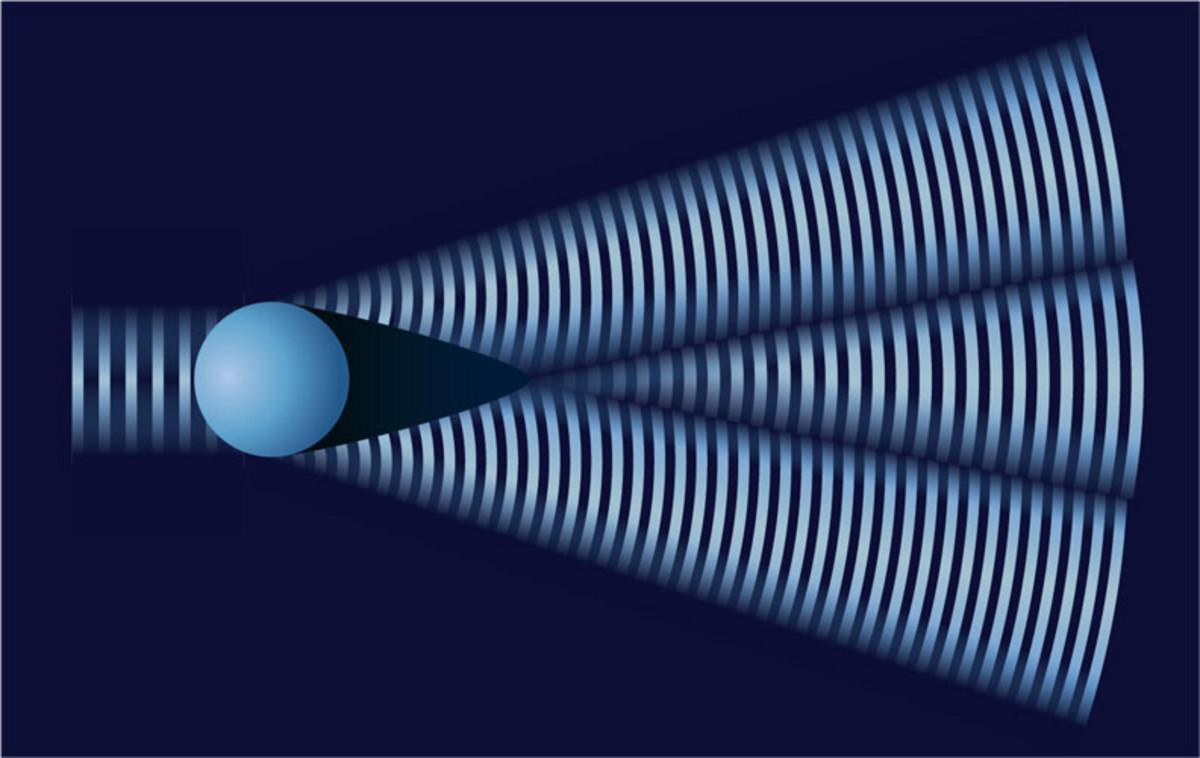
Diffraction is also known as "edge diffraction" as that is where it occurs. Refraction occurs as light changes angle traveling throught the particle.
We can obtain information about the size of a particle using the angle and intensity of scattered light. Diffracted and refracted light is useful for this purpose; absorbed and reflected light works against this purpose and must be taken into account during measurement and size calculation.
For particles larger than a certain size the vast majority of light is scattered by diffraction. The scattered light is at relatively high intensity and low angle for these larger particles. The "certain size" is determined as a multiple of the wavelength of light used for the measurement and typically approximated at 20 microns. Particles larger than this size communicate useful size information through diffraction and not refraction. This means the measurement will not benefit from the use of a refractive index to accurately interpret refracted light.
Learn about how to choose a refractive index with the Method Expert
For particles smaller than 20 microns refracted light becomes increasingly important to calculate an accurate particle size. The scattered light is at relatively low intensity and wide angle for these smaller particles. The use of a refractive index and the Mie scattering theory directly affects accuracy in this size range. All HORIBA laser diffraction analyzers use the Mie scattering solution by default and allow the user to input custom refractive index values.
Features of a Laser Diffraction Analyzer: Optical System
The basic workflow of a laser diffraction particle size analysis breaks down into two parts:
- Measure scattered light angle and intensity
- Transform that scattering data into a particle size distribution
Measurement quality is all about the analyzer itself: quality of components, engineering refinement, and a fundamental design which reflects basic principles. The core technologies are all mature, but as with many things higher quality leads to superior performance. A typical laser diffraction optical system will include:
- Two light sources at different wavelengths
- 80+ photodetectors covering an approximate angular range of 0-170 degrees
- Very high quality lenses, mirrors, and glass measurement cell
The LA-950 particle size analyzer represents the eighth generation laser diffraction instrument designed by HORIBA. Hundreds of refinements to the basic design have been included to improve performance and usability. These refinements include:
- Maintenance-free, dust-free sealed optical bench
- Maximum stability and alignment with post-less, cast aluminum mountings
- Tilted measurement cell to reduce stray light noise
- Ultra long-life solid-state light sources and detectors
Acquiring the best possible scattered light data is the basis of any reliable size measurement. The "raw" scattered light data is then passed to the calculation algorithm where it will be transformed into a particle size distribution.

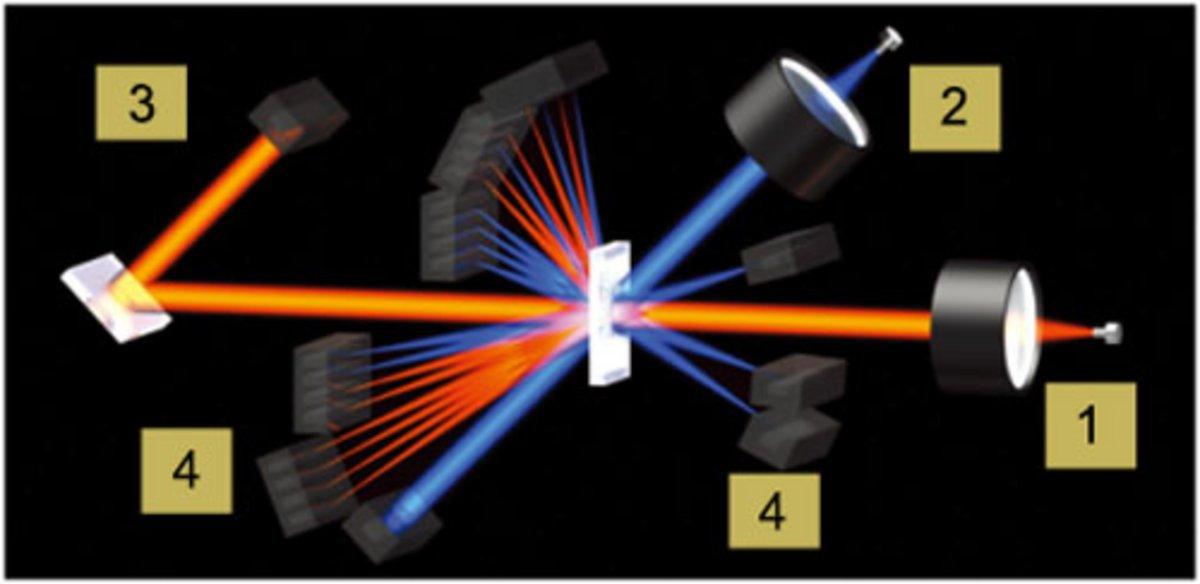
- A simplified layout of the LA-950 optical bench. 1: Red wavelength laser diode for larger particles, 2: Blue LED for smaller particles, 3: Low angle detectors for larger particles, 4: Side and back angle detector arrays and smaller particles.
More Information about Laser Diffraction
LA-Series Product Pages
Les granulomètres de la série LA utilisent la théorie de diffusion de Mie (diffraction laser ) pour mesurer la taille des particules de suspensions ou poudres sèches. La rapidité et la facilité de mise en oeuvre de cette technique en font la plus populaire pour nombre d’ applications.
- 1
Identification de l'utilisateur
Forgot Password?
Having trouble login in? Please click here and we will send a new password. If you are still having trouble, contact us at web_member@horiba.com.
Not a member yet?
Register and receive access to advanced information, including Application Data Sheets, Application Notes, Brochures, Links to External Articles, Manuals, Software Downloads, Software Updates. When you register you will also receive periodic updates by e-mail. Create a new account.