

Imidacloprid
Overview
Imidacloprid is one of neonicothinoid insecticides. It is used for multiple farm products because of its wide insecticidal activity range. This kit allows an easy, rapid (within 2 hours), sensitive, quantitative, multi-sample analysis of Imidacloprid that remains in farm products or in the environment. This kit is best applied for inspection at delivery time/prior to processing or primary screening in production sites.
Features
Comparison with instrumental analysis
While Instrumental analysis offers high accuracy, it requires complicated and time-consuming pretreatment techniques, and sophisticated instrument operation as well as large quantities of acetonitrile, hexane or acetic ether as organic solvents. The simpler pretreatment required for kit saves significant time. Additionally, only a small quantity of methanol is required as an extraction solvent for analyzing imidacloprid. 
Application examples
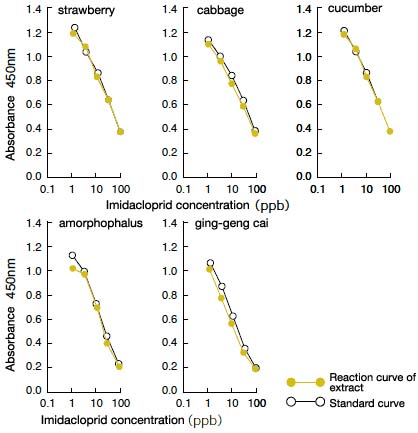
The figures show the comparison between standard curves with 10% methanol and reaction curves drawn with methanol extract of imidacloprid-added farm products (diluted to 10% methanol equivalent). The overlapping curves; demonstrate the suitability of this kit for analyzing trace imidacloprid without any interference from the original produce.
Reference
(1) Eiki Watanabe et al., J Agric. Food Chem. 52(2004)2759-2762
(2) Eiki Watanabe et al., Analtica Chemica Acta 521(2004)45-51
Manufactured by HORIBA
Specifications
The following data represent the basic kit performance. For more detailed specifications, please contact us.
Standard curve

Cross-reactivity
Neonicotinoid insecticides | Reactivity (%) |
|---|---|
Imidacloprid | 100 |
Acetaprimid | 0.4 |
Dinotefuran | < 0.1 |
Thiacloprid | 1.3 |
Thiamethoxam | < 0.1 |
Nitenpyram | < 0.1 |
Other insecticides/fungicides | Reactivity (%) |
|---|---|
Acephate | < 0.1 |
Iminoctadine albesilate | < 0.1 |
Captan | < 0.1 |
Chlorothalonil | < 0.1 |
Diethofencarb | < 0.1 |
Fenpropathrin | < 0.1 |
Buprofezin | < 0.1 |
Permethrin | < 0.1 |
Mepanipyrim | < 0.1 |
Correlation with instrumental analysis (apple)
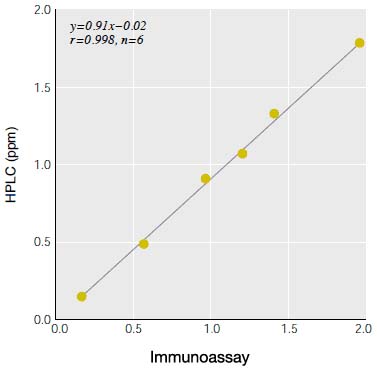
Data provision: Dr. Eiki Watanabe, National Institute for Agro-Environmental Sciences
Within-run reproducibility (tomato)
Samples | Average (ppb) | SD | CV(%) |
|---|---|---|---|
A | 66.5 | 2.8 | 4.2 |
B | 27.0 | 2.3 | 8.4 |
n=8
Between-analysis reproducibility (tomato)
Samples | Average (ppb) | SD | CV(%) |
|---|---|---|---|
A | 78.4 | 3.9 | 5.0 |
B | 26.8 | 2.9 | 10.8 |
n=3
Daily reproducibility (tomato)
Samples | Average (ppb) | SD | CV(%) |
|---|---|---|---|
A | 63.5 | 2.7 | 4.3 |
B | 25.5 | 1.9 | 7.3 |
n=3
Recovery test (tomato)
Concentration of addition(ppm) | Recovery ratio(%) |
|---|---|
0.5 | 67.9±1.1 |
2.5 | 94.1±12.4 |
5.0 | 96.2±5.7 |
n=3
Results of within-run reproducibility, daily reproducibility, between-analysis reproducibility and recovery test show that this kit can quantitatively analyze imidacloprid in produce.
Main kit components/shelf-life
Contents (form) | Volume | Quantity |
|---|---|---|
Antibody coated plate (dry form) | 8 rows x 12 columns | 1 piece |
Standard reagent L (freeze-dried: 2ppb) | 1mL (after dissolution) | 2 vials |
Standard reagent H (freeze-dried: 100ppb) | 1mL (after dissolution) | 2 vials |
Enzyme-labeled Imidacloprid reagent (freeze-dried) | 6mL (after dissolution) | 2 vials |
Washing reagent (solution: 10 times concentrated) | 50mL | 1 vial |
Chromogenic reagent (solution) | 13mL | 1 vial |
Stop reagent (solution) | 13mL | 1 vial |
Shelf life: | 9 months after production | Storage at 2 to 8°C |
|---|