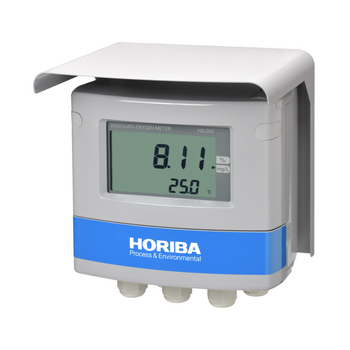
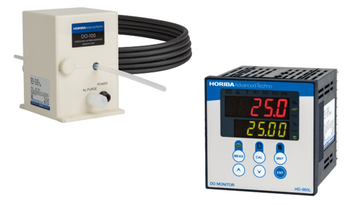
Structure of membrane-type (polarograph) DO meter
The polarograph method is a method for measuring dissolved oxygen (DO). It is an electrochemical technique for measuring oxygen concentration. It uses a membrane with excellent oxygen permeability and adds voltage to a working electrode situated within a solution to cause a reduction reaction in the oxygen. DO concentration within the solution is then measured based on the current value.
A polarograph-type DO electrode is made up of a pair of electrodes from different materials, a membrane, and internal solution. The oxygen contained in the solution is passed through a membrane with excellent oxygen permeability and absorbed into the internal fluid. The absorbed oxygen undergoes a reduction reaction at the working electrode, generating an electric current between the electrodes. This current is proportional to the DO concentration in the sample, so DO concentration is calculated with an external ammeter.
Structure of membrane-type (polarograph) DO meter