
Schematic diagram of electrodes and glass membrane

Schematic diagram of potential difference across a glass membrane
The glass electrode method is a pH measurement technique that uses a glass electrode (working electrode) with a glass response membrane responsive to hydrogen ions and a reference electrode that exhibits a constant potential for any sample. The interior (internal solution) and exterior (sample) of the glass electrode are separated by a glass response membrane. At each surface of the response membrane, a potential corresponding to the hydrogen ion concentration in the internal solution and sample is generated. By detecting the potential difference across both sides of the response membrane, the hydrogen ion concentration of the sample—that is, its pH—can be measured.
Schematic diagram of electrodes and glass membrane
Schematic diagram of potential difference across a glass membrane
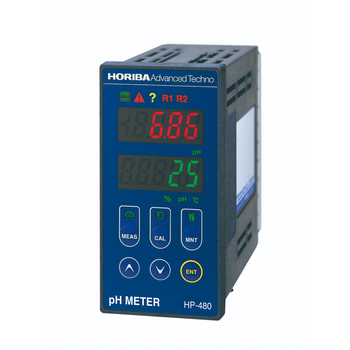
Panel-mount type pH meter
