PDF
0.97
MB
Continuous Measurement of Calcium Ion Concentrations in Hydrofluoric Acid Wastewater Treatment Processes

Hydrofluoric acid is widely used in manufacturing semiconductors and electronic components, and significant quantities are present in industrial wastewater generated during production. While fluorine contained in hydrofluoric acid can be useful, excessive intake poses health hazards to humans. For this reason, the Ministry of the Environment has established a standard for the concentration of fluorine in wastewater.
One method for treating hydrofluoric acid wastewater is coagulation-sedimentation. This involves injecting calcium-based chemicals such as slaked lime to precipitate calcium fluoride, which is insoluble. While this method often involves fixed chemical dosing, the fluorine concentration in wastewater fluctuates due to differences in the manufacturing process and the types and concentrations of chemicals used, which can lead to either insufficient chemical dosing or excessive injection.
Another issue arises when calcium-based chemicals are over-injected to ensure fluoride removal, leading to reduced treatment efficiency due to scale buildup, increased equipment load, and higher operational costs.
Continuous measurement using a calcium ion meter is an effective solution to these issues.
By measuring not only the fluoride ion concentration but also the calcium ion concentration,
・It is possible to confirm whether chemical injection is appropriate
・There are the advantages of grasping the excess or deficiency of chemicals at an early stage and reducing treatment variability for stable operations.
In order to appropriately manage the amount of calcium-based chemicals injected, it is essential to monitor the concentration of fluoride ions in the adjustment tank at a prior stage. Furthermore, monitoring the concentration of calcium ions in the sedimentation tank at a later stage makes it possible to confirm whether the amount of calcium-based chemicals injected was appropriate.
In this way, continuously monitoring not only the fluoride ion concentration but also the calcium ion concentration makes it possible to appropriately grasp wastewater treatment status and to inject chemicals efficiently. As a result, running costs and the environmental impact can be expected to be reduced.
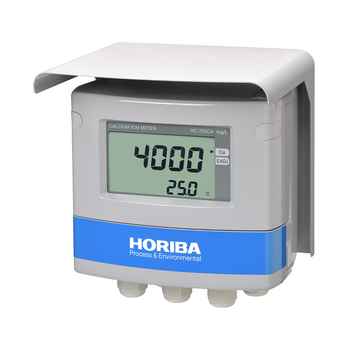
HORIBA’s Calcium Ion Meter uses the ion electrode method to make possible the stable monitoring of the calcium ion concentration.
Provides data from continuous measurement of the calcium ion concentration in the hydrofluoric acid wastewater treatment process at a semiconductor plant. Details are provided in the following document.