
Figure 1 : Shape Factors
A perfect sphere can have its size described using a single numerical value: its diameter. In contrast, for non-spherical particles like those shown in Figure 1, it is necessary to use multiple measurements of length and width to express their size (in this case, projections in the horizontal and vertical directions are shown). While these measurements can more accurately represent particle size, they also add complexity. Therefore, it is common practice to assume that all particles are spherical. A commonly used value is the “equivalent spherical diameter,” which is the diameter of a sphere with the same volume as the particle.
Particle size distributions are generally obtained through calculations based on physical measurements, such as light scattering or sedimentation velocity, under the assumption that the particles are spherical. Although this method is not perfectly accurate, the spherical assumption rarely causes issues in most industrial processes, and is widely used. However, in cases where individual particles have a very high aspect ratio—such as fibers, needles, or plate-like particles—or when those shapes play a critical role, this assumption may become inadequate.
Particle shape can cause discrepancies when particles are measured using different particle size distribution analyzers based on different principles. Each measurement technique detects particle size using its own physical mechanism. For example, in sieving, the particle diameter is determined by whether the particle can pass through a mesh opening, which tends to emphasize the particle's thickness. In sedimentation methods, flake-like or plate-like particles tend to orient themselves to maximize drag while settling, which shifts the measured particle size toward a smaller value.
Image analysis methods, including static image analysis under a microscope and dynamic image analysis, can represent particle size using multiple parameters. In image analysis systems, non-spherical particles, like those in Figure 1, can be described using the longest and shortest diameters (length and thickness), perimeter, projected area, or the diameter of a circle with the same area as the projected area (circle equivalent diameter). When drawing particle size distributions, the most commonly used metric in image analysis systems is the circle equivalent diameter. For elongated or fibrous particles, length or other parameters may be used instead of the circle equivalent diameter.
Many particle size distribution measurement principles assume that all particles are spherical and use the “equivalent spherical diameter.”
Image analysis is the only method that can represent particle size using multiple values.

Simultaneous Multispectral Nanoparticle Tracking Analysis (NTA)
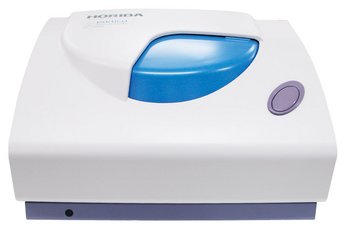
Nanoparticle Analyzer
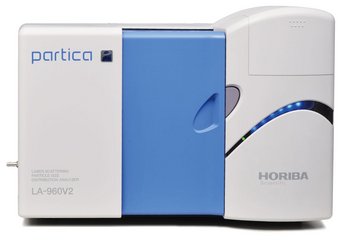
Laser Scattering Particle Size Distribution Analyzer
Do you have any questions or requests? Use this form to contact our specialists.
