Raman

Why Choose HORIBA Raman Solutions?

Discover what our customers are saying about HORIBA’s Raman Spectroscopy solutions! From authentic testimonials to hands-on success stories, their voices highlight how our instruments empower real-world research and innovation. In the Science in Action Series, you’ll find inspiring examples where Raman technology helps solve practical challenges, advance scientific understanding, and open new possibilities across a wide range of applications.

Testimonials | Science in Action articles | Contact us

Testimonials

 University of La SAPIENZA, Rome, Italy - Claudia Fasolato, Research Scientist:
The LabRAM Soleil is so compact, well-illuminated and versatile that you can measure any kind of sample with it!
It’s the ideal tool for our physics and biophysics research group, where we’re working on a wide variety of applications from nano-objects to perovskites and biological samples.

 VIBRA-SANTÉ HUB, Center for Interdisciplinary Research on Medicines, Liege, Belgium – Eric Ziemons, Director:
With a multimodal Raman microscope as easy to set up as the LabRAM Soleil, we were quickly up to speed. We were able to study our pharmaceutical samples safely and without risk of contamination as it has Class 1 capability built in. It’s the ideal tool for the analyst of the future! 

 IFREMER, Brest, France – Maria El Rakwe, Research scientist:
We really like the LabRAM Soleil’s optimized design, which speeds up analysis of microplastics. It has helped us to improve our profitability, no matter what kind of environmental sample we’re looking at (notably water). 

Science in Action articles

open
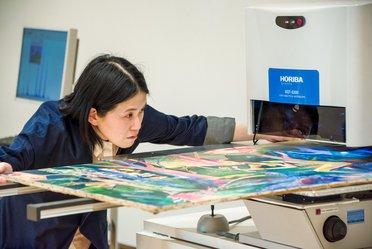
"Tokaido 53rd Nouchi Mizuguchi Choemon" (Kaei 5/1852), by Utagawa Toyokuni
Raman and X-ray fluorescence spectroscopies reveal the mysteries behind ancient Japanese art form
Yuya Shimoi, Shimoi Woodblock Printing Co., Ltd., Kamakura | Art
Yuya Shimoi, an Ukiyo-e reproduction specialist from Shimoi Woodblock Printing Co. in Kamakura, collaborates with HORIBA’s Hakaru LAB in Tokyo to scientifically analyze original Edo period Ukiyo-e pigments. He uses energy-dispersive micro XRF (HORIBA XGT 5200) to non destructively determine elemental compositions of mineral pigments, and confocal Raman microscopy (LabRAM HR Evolution) to identify organic plant based dyes. This dual spectroscopic approach reveals materials like turmeric, safflower, lead-white, and oyster shell powder—unveiling mysteries about traditional paint usage and supporting faithful reproductions.
open
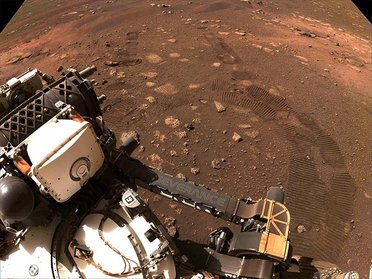
Perseverance Roving on Mars. (Courtesy of NASA/JPL-Caltech)
Perseverance lands to pursue answers to life on Mars using XRF
Dr. Andrew Czaja, University of Cincinnati | Geology
Dr. Andrew Czaja of the University of Cincinnati assists NASA’s Mars 2020 Perseverance mission by selecting promising rock samples from Jezero Crater that may preserve signs of ancient life. On Mars, PIXL (XRF) and SHERLOC (UV Raman) instruments measure elemental and organic signatures in situ. Back on Earth, Czaja plans to analyze returned Martian samples using a HORIBA T64000 Raman spectrometer to detect organic carbon and potential microbial textures. His work aims to identify biosignatures and inform future assessments of past Martian life.
open
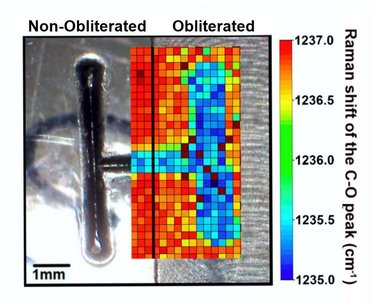
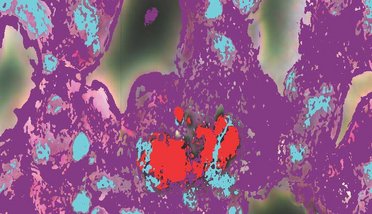
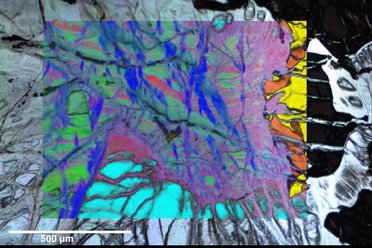
Superimposed image of the pixels, showing the Raman information extracted and analyzed.
Raman breakthrough recovers erased serial numbers from plastic guns
Dr. Andreas Ruediger, Institut national de la recherche scientifique, Université du Québec | Forensics
Dr. Andreas Ruediger at INRS Université du Québec employs Raman spectroscopy to recover serial numbers ground off polymer firearms. Mechanical embossing induces subsurface residual strain that persists even after grinding. His team captured spectral imaging showing Raman peak shifts (up to ~1 cm⁻¹) and broadening correlating with strain. Combined imaging and histogram analysis enabled visualization and statistical confirmation of obliterated characters up to hundreds of micrometers deep. This nondestructive approach offers promising forensic tools for law enforcement.
open
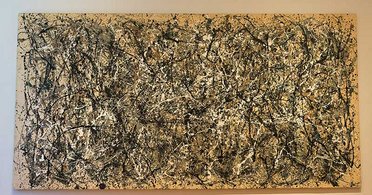
Jackson Pollock painting
Can Raman microscopy reveal art forgeries?
Jennifer Mass, PhD., Scientific Analysis of Fine Art, LLC. | Art
This HORIBA feature explores how Raman microscopy can help expose art forgeries by non-destructively analyzing the molecular makeup of pigments and materials. By capturing detailed Raman spectra of authentic and suspect artworks, scientists can identify inconsistencies in chemical fingerprints that indicate restoration, aging discrepancies, or fraudulent compositions. With diligence, appropriate instrumentation, and expert interpretation, Raman microscopy empowers specialists to discern genuine works from forgeries, potentially reducing the prevalence of counterfeit art in the market.
open
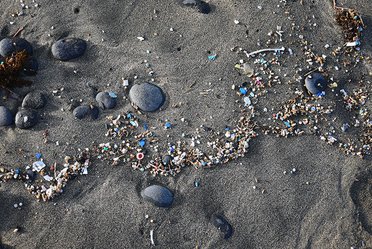
Microplastics from waste
What are microplastics?
HORIBA Science Team | Environment
This HORIBA Science in Action entry defines microplastics as plastic fragments ≤ 5 mm, either purposefully manufactured (primary) or deriving from breakdown of larger plastic debris (secondary) The article highlights the ubiquity of microplastics—in oceans, soils, rainwater, food, salt, sugar, beer, and honey. It distinguishes primary particles intentionally released (e.g., in cosmetics) from secondary ones formed via environmental degradation, emphasizing the diverse and pervasive nature of this pollutant.
open
Where do primary microplastics come from?
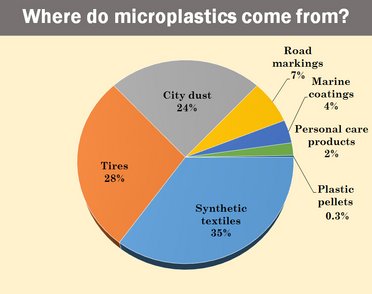
Where do microplastics come from?
HORIBA Science Team | Environment
Microplastics – tiny plastic particles smaller than 5 mm – from that shirt or car tires are seeping into our biosphere. We ingest, inhale and absorb these particles through our skin.
open
Microplastics explained videos
Microplastics explained
HORIBA Science Team | Environment
This HORIBA Science in Action article explores microplastics—tiny plastic particles (≤ 5 mm) either manufactured or formed through degradation—that are contaminating oceans, drinking water, rain, salt, and even the air we breathe. They serve as carriers for pollutants, bacteria, and viruses, entering wildlife and human food chains. Raman spectroscopy plays a crucial role in identifying the chemical composition and origins of these particles, supporting the development of policies and monitoring procedures to limit microplastic contamination.
open
Is this the next breakthrough in medicine?
Dr. Wei Min, Kavli Institute for Brain Science, Columbia University | Life Sciences
Dr. Wei Min of Columbia University is pioneering the application of Raman spectroscopy—particularly stimulated Raman scattering—for biomedical imaging to visualize metabolism and molecular dynamics in living tissues. He uses supermultiplexed optical imaging, deploying dozens of distinct Raman probes simultaneously to map diverse biomarkers within cells and tissues. This label-free, high-throughput method holds promise for earlier disease diagnosis, better understanding of metabolic disorders (like cancer, obesity, neurodegeneration), and enhanced drug development by revealing molecular processes in unprecedented detail.
open
Targeting Toxic Waste With Minerals
Targeting toxic waste with minerals
Dr. Aaron Celestian, Natural History Museum of Los Angeles County | Environment
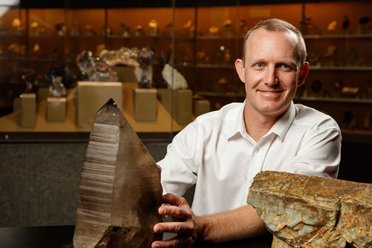
Aaron Celestian’s research employs Raman spectroscopy and XRF to evaluate minerals used for treating toxic waste. By analyzing their chemical composition and structure, he identifies which minerals most effectively immobilize or neutralize contaminants. This scientific approach helps determine optimal materials for environmental remediation, guiding efforts to restore polluted sites. Spectroscopic data enable selection of mineral-based solutions that can "heal our world" by targeting specific toxic compounds through evidence-based mineral waste treatment strategies.
open
Lednev lab
Raman spectroscopy breakthroughs make CSI real
Prof. Igor K. Lednev, Department of Chemistry, University at Albany (SUNY) | Forensics
Prof. Igor K. Lednev at SUNY Albany develops Raman spectroscopy for forensic use, enabling non-destructive identification of body fluids (blood, semen, saliva, sweat) using a universal chemical fingerprint, unlike presumptive biochemical tests. His team also measures the age of bloodstains to time crime events. Lednev is working to translate lab workflows to handheld Raman devices that law enforcement could deploy on-site, allowing rapid, low-cost sample triage.
open
Andrew Whitley
Man of science follows business path
Dr. Andrew Whitley, Vice President of Sales and Business Development, HORIBA
Dr. Andrew Whitley, Vice President of Sales and Business Development at HORIBA Scientific, merges technical expertise with business acumen. A classically trained chemist (PhD in vibrational spectroscopy, University of Durham), he champions applied Raman and fluorescence spectroscopy, leveraging his FACSS Charles Mann Award winning body of work to foster new applications and broaden HORIBA’s reach. Choosing a business-focused path rather than bench research, he empowers researchers globally by tailoring instrumentation solutions and enabling success.

Request for Information

Do you have any questions or requests? Use this form to contact our specialists.
* These fields are mandatory.

Corporate