Operating Example

Nitrogen removal is one of the major objectives of organic wastewater treatment and is conducted using a biological reaction process. A majority of the nitrogen in wastewater that flows in exists as ammonia nitrogen. Ammonia nitrogen becomes nitrate nitrogen though nitrification in an aeration tank. Nitrate nitrogen becomes nitrogen gas through denitrification in an anaerobic tank and is released into the atmosphere. Optimizing the operation of this process can reduce costs, including the cost of electricity, and bring about a stable treatment process.
The water quality of raw water is invisible, so it was necessary to make adjustments to the aeration amount to ensure sufficient amounts of oxygen. In addition, to promote the denitrification process in the anaerobic tank, stable measurements of the nitrate nitrogen concentration were needed as an indicator when adding BOD.
HORIBA’s Ammonia/Nitrate Nitrogen Meter measures ammonia nitrogen at the stage prior to the aeration tank and provides an indicator for control for the aeration airflow rate. In addition, measuring the concentration of nitrate nitrogen after the aeration tank contributes to accurate control of the aeration airflow rate. The concentration of nitrate nitrogen after the aeration tank also serves as an indicator for amount of BOD components to be added to the anaerobic tank, making it possible to optimize the amount of chemicals used. These figures can also be expected to be utilized going forward to reduce dinitrogen monoxide, which occurs in the biological reaction process and has a very high global warming factor.
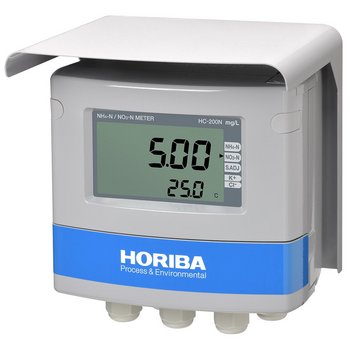
Ammonia/Nitrate Nitrogen Meter