
PDF
1.45
MB
Case Study of Raw Water Tank pH Management in Machine Factory Wastewater Treatment


There are two primary purposes for measuring pH in raw water tanks. The first is anomality detection. By measuring the pH in raw water tanks abnormalities in the factory can be detected early, enabling prompt response. For example, significant deviations from the normal pH value may indicate the presence of harmful substances in the wastewater, requiring immediate investigation. The second purpose is to control neutralization. In many wastewater treatment processes, pH is adjusted to maintain an appropriate pH range in the neutralization tank. Neutralization can be controlled adequately by automatically adjusting the amount of chemicals added based on pH measurements in the raw water tank.
Because the raw water tank is the first stage of the treatment process, attempting continuous measurement can contaminate the pH-responsive glass membrane with organic compounds and microorganisms and clog the reference electrode junction. To ensure stable and accurate measurements, regular cleaning and calibration are necessary. This presents challenges in terms of operator workload and safety risks.
The organic wastewater treatment facility at a certain machinery factory operates 24 hours a day. The pH electrode measuring inflow water in the raw water tank became heavily soiled, making it necessary for workers to manually wipe and clean, three times daily. A demonstration experiment was conducted at this site using a gel-filled self-cleaning pH electrode.
The glass surface of the conventional electrode (a) was completely soiled, resulting in only a minimal response even when immersed in a standard solution. By contrast, the self-cleaning pH electrode (b) maintained a clean glass surface and liquid junction area, responding quickly to the standard solution. At this time, the reading for the 6.86 standard solution was 6.83, showing a difference of only 0.03. The sensitivity between the 4.01 and 9.18 standard solutions was 96.0%, and the sensitivity between the 6.86 and 4.01 standard solutions was maintained at 97.5%. This demonstration experiment confirmed that pH measurement with the accuracy required to operate the facilities is possible without the need for maintenance during the test period.
Photo 1: Electrode condition after 43 days of continuous measurement
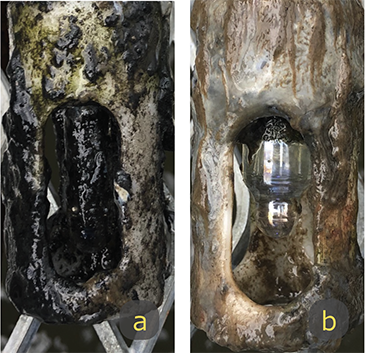
a) Existing electrode
b) Gel-filled Self-cleaning pH Electrode
Source: Analytical Chemistry - Product Development of Gel-filled Self-Cleaning pH Electrodes
Authors: Yuji Nishio, Tatsuoki Muroga, Hiroto Takami, Tadanori Hashimoto, Atsushi Ishihara
The Japan Society for Analytical Chemistry. Vol. 73, No. 4∙5, pp. 171-183 (2024)
Measuring pH in the raw water tank enables anomality detection and neutralization control. However, continuous measurement can require frequent maintenance tasks like cleaning organic contaminants and calibration. Self-cleaning pH electrodes with photocatalytic self-cleaning functions, decompose organic contaminants, enabling accurate and stable continuous pH measurement.