


Steady-state fluorescence spectroscopy is a foundational optical analytical technique that measures the time-averaged photoluminescence emitted by a sample under constant optical illumination. When target fluorophores absorb light from a continuous excitation source, excited electrons relax to the lowest excited state before returning to the ground state, emitting photons at longer wavelengths. This process yields a distinct spectral profile that reflects the electronic energy levels and chemical composition of the sample.
This non-destructive characterization method delivers critical quantitative data regarding fluorophore concentration, molecular structure, and local solvent environments. By combining excitation scanning with continuous emission detection, transitioning to multidimensional optical fingerprinting, researchers evaluate fundamental photophysical dynamics across biophysics, organic chemistry, nanomaterial synthesis, and environmental screening.
Steady-state fluorescence spectroscopy is an optical characterization technique that records the time-averaged photoluminescence intensity emitted by a sample illuminated by a continuous light source. By holding excitation light steady, diffraction monochromators isolate emission wavelengths, enabling precise characterization of fluorophore identity, molecular concentration, and electronic transition energies without altering the sample matrix.
An excitation spectrum measures changes in photoluminescence intensity across varying illumination wavelengths while keeping emission detection fixed, directly mirroring the sample's optical absorption profile. Conversely, an emission spectrum records light intensity across emitted wavelengths while keeping excitation fixed, revealing the vibrational energy levels and Stokes shift of the excited-state fluorophore.
Measuring absolute fluorescence quantum yield requires continuous illumination inside an integrating sphere to capture total absorbed and emitted photons across all angles. Steady-state excitation provides the stable photon flux necessary to calculate the ratio of emitted-to-absorbed photons, establishing a definitive metric for the radiative efficiency of synthetic dyes, quantum dots, and photovoltaic thin films.
Steady-state fluorescence spectroscopy provides rapid, high-throughput acquisition of full emission spectra and Excitation-Emission Matrices (EEMs) using standard continuous light sources like xenon arc lamps. While time-resolved methods quantify decay lifetimes, steady-state measurements excel at routine quantitative determination, concentration screening, spectral fingerprinting, and evaluating steady-state energy transfer efficiencies across diverse liquid and solid samples.
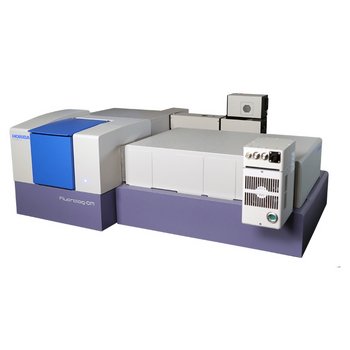
Modular Research Fluorometer for Lifetime and Steady State Measurements
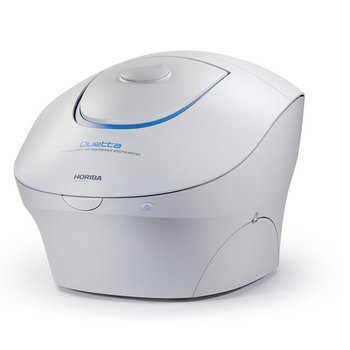
Full Spectra in Milliseconds for Industry and Academia
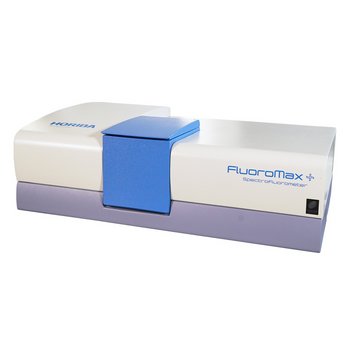
Steady State and Lifetime Benchtop Spectrofluorometer
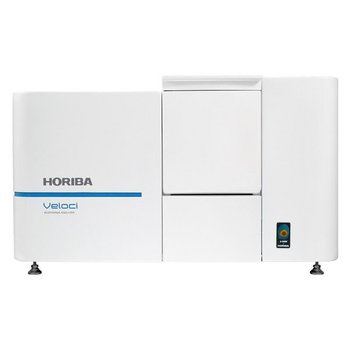
A-TEEM Spectroscopy
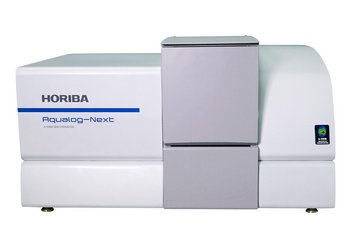
Unlock Unprecedented Insights into Water Quality and Environmental Health
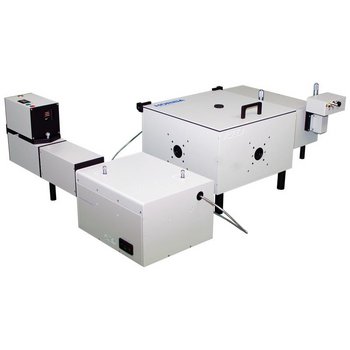
DeltaRAM-X based millisecond ratio fluorescence QuantaMaster spectrofluorometer
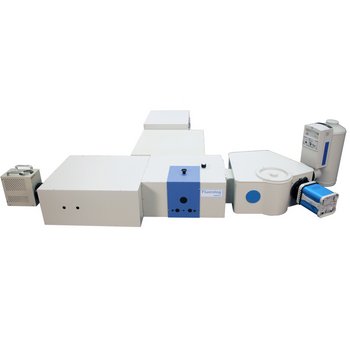
Steady State and Lifetime Nanotechnology EEM Spectrofluorometer
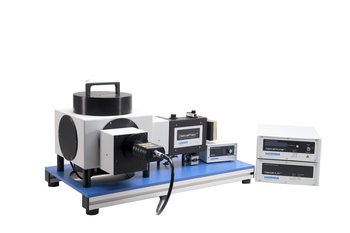
TCSPC Lifetime Kit
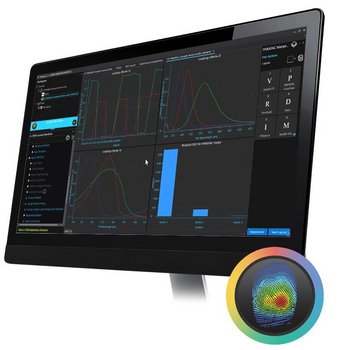
Your Guide to Multivariate Analysis
Sie haben Fragen oder Wünsche? Nutzen Sie dieses Formular, um mit unseren Spezialisten in Kontakt zu treten.