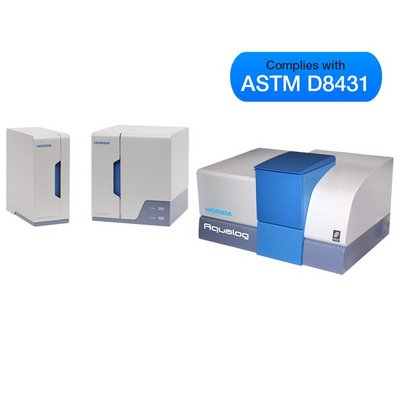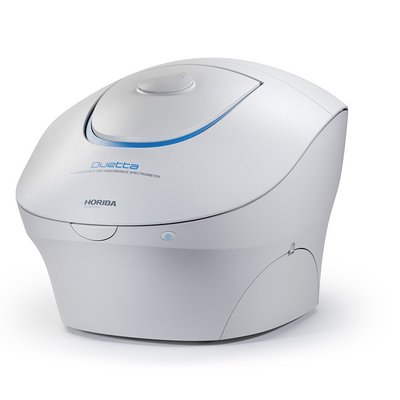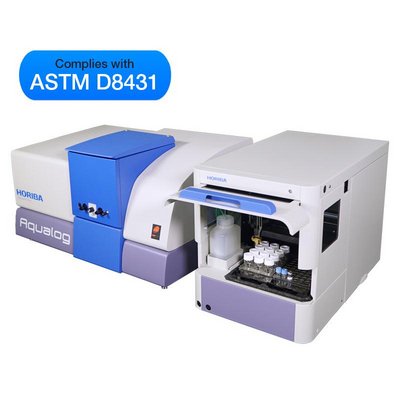
A-TEEM spectroscopy refers to the ability to simultaneously acquire Absorbance, Transmittance and a fluorescence Excitation Emission Matrix (A-TEEM) of a particular sample. HORIBA pioneered this technique with the patented Aqualog and Duetta system, which combines A-TEEM spectroscopy with simultaneous multichannel CCD detection to provide extremely fast results.
A-TEEM spectrometers can be used for fluorescence EEMs or for absorbance measurements for multi-component analysis, but its real power is derived from the fact that the EEMs collected by the instrument are corrected for inner filter effect. This means they are true and accurate representations of the molecules of interest over a much broader and more useable concentration range (typically up to ~2 absorbance units). Therefore, these EEMs allow for much more precise fingerprinting than is possible with an EEM collected from a traditional scanning fluorometer. A-TEEM spectroscopy is now bringing the fluorescence technique into the true analytical market and it has been demonstrated that it can, in some cases, replace traditional instruments like an HPLC or mass spectrometer as a simpler, faster and less expensive analytical tool.
To access the true power of fluorescence A-TEEM spectroscopy, one needs to employ multivariate software methods such as Principal Components Analysis (PCA), Classical Least Squared (CLS) method and Parallel Factor Analysis (PARAFAC).
Most components of CDOM have broad overlapping fluorescence excitation and emission spectra in the UV and visible range. Many sample measurements are used to create a model and then use chemometrics to get scores of each component in an individual sample. The very unique thing about a fluorescence EEM is that it can be used as a molecular fingerprint. Changes in the emission spectrum, the excitation spectrum, or both can be tracked very easily using this 3D fluorescence method for water analysis as well as many other applications.