
Static Light Scattering (SLS) / Laser Diffraction Particle Size Distribution Analysis
Laser Diffraction Technology

Light scattering has long been used to investigate the size of various objects. Gustav Mie (he of the Mie Scattering Theory) studied gold nanoparticles like those in the image below as part of his doctoral thesis. Previously confined to custom-built setups in labs, several innovations took laser diffraction from the darkroom to research labs and production floors across the world.
How Laser Diffraction Works
So how does laser diffraction work? At its very most basic, laser diffraction is about the relationship between particle size and the angle and intensity of scattered light. Light scatters more intensely and at smaller angles off of large particles than small particles. Every analyzer, from the very first commercial prototype to the state of the art LA-960 utilizes this principle. In fact, the analyzer itself does not measure particle size -- it measures the angle and intensity of light scattered from the particles in your sample. That information is then passed to an algorithm designed to use Mie Scattering Theory which transforms the scattered light data into particle size information.

Both the hardware and software required to make a particle size measurement have gone through many revisions in order to improve accuracy, precision, reliability, and ease of use. The LA-960 represents the tenth generation of HORIBA laser diffraction analyzers; each different and better than the last. Read on to discover what important factors go into making this measurement routine and trustworthy.
Laser Diffraction Principles

At the very heart of the laser diffraction technique is the relationship between light and surfaces (which can be freely interchanged with "particle" for our purposes). When light strikes a surface it is either
- Diffracted
- Refracted
- Reflected
- Absorbed
Diffraction is also known as "edge diffraction" as that is where it occurs. Refraction occurs as light changes angle traveling throught the particle.
We can obtain information about the size of a particle using the angle and intensity of scattered light. Diffracted and refracted light is useful for this purpose; absorbed and reflected light works against this purpose and must be taken into account during measurement and size calculation.
For particles larger than a certain size the vast majority of light is scattered by diffraction. The scattered light is at relatively high intensity and low angle for these larger particles. The "certain size" is determined as a multiple of the wavelength of light used for the measurement and typically approximated at 20 microns. Particles larger than this size communicate useful size information through diffraction and not refraction. This means the measurement will not benefit from the use of a refractive index to accurately interpret refracted light.
For particles smaller than 20 microns refracted light becomes increasingly important to calculate an accurate particle size. The scattered light is at relatively low intensity and wide angle for these smaller particles. The use of a refractive index and the Mie scattering theory directly affects accuracy in this size range. All HORIBA laser diffraction analyzers use the Mie scattering solution by default and allow the user to input custom refractive index values.
Features of a Laser Diffraction Analyzer: Optical System

The basic workflow of a laser diffraction particle size analysis breaks down into two parts:
- Measure scattered light angle and intensity
- Transform that scattering data into a particle size distribution
Measurement quality is all about the analyzer itself: quality of components, engineering refinement, and a fundamental design which reflects basic principles. The core technologies are all mature, but as with many things higher quality leads to superior performance. A typical laser diffraction optical system will include:
- Two light sources at different wavelengths
- 80+ photodetectors covering an approximate angular range of 0-170 degrees
- Very high quality lenses, mirrors, and glass measurement cell
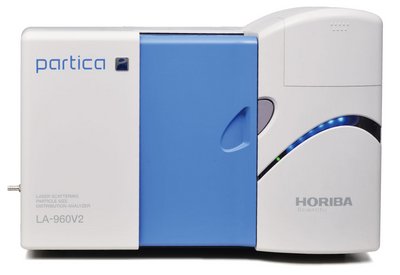
The LA-960V2 particle size analyzer represents the tenth generation laser diffraction instrument designed by HORIBA. Hundreds of refinements to the basic design have been included to improve performance and usability. These refinements include:
- Maintenance-free, dust-free sealed optical bench
- Maximum stability and alignment with post-less, cast aluminum mountings
- Tilted measurement cell to reduce stray light noise
- Ultra long-life solid-state light sources and detectors
Acquiring the best possible scattered light data is the basis of any reliable size measurement. The "raw" scattered light data is then passed to the calculation algorithm where it will be transformed into a particle size distribution.
For more information about acquiring an instrument, click here.
Technical Notes
Distribution Bases
Particle size results are generally displayed as a volume-based distribution. Depending on the instrument type used or the intended application of the data, other distribution bases may be selected.

The LA-960V2 Laser Diffraction Technique
The LA-960V2 combines the most popular modern sizing technique with state of the art refinements to measure wet and dry samples measuring 10 nanometers to 3 millimeters. The central idea in laser diffraction is that a particle will scatter light at an angle determined by that particle’s size.

Laser Diffraction Data Correlation
Particle size analysis may be slightly different than other analytical techniques in so far as result correlation from one system to another is concerned. This technical note investigates the sources of result differences and makes recommendations to analysts attempting to improve data correlation.

LA-960V2 Repeatability & Reproducibility Studies
Repeatability, reproducibility, and instrument to instrument agreement are important performance characteristics of any analytical instrument. This technical note presents multiple data sets that prove the excellent performance customers can expect from the HORIBA LA-960V2 particle size analyzer.

Algorithm Iterations
Laser diffraction particle size analyzers use advanced mathematical algorithms to convert a measured scattered light intensity distribution into a distribution of particle sizes. Multiple iterations of the data over the algorithm are used to provide final results.

Effect of Concentration on Laser Diffraction Measurements
Proper method development when using laser diffraction requires investigating the effect of changing system or measurement parameters on calculated results. One of the measurement parameters that should be examined is sample concentration.

Praseodymium: Sample Dispersion Case Study
Praseodymium has several commercial applications including being used as a pigment and as a varistor. Based on the information known about this sample, experiments were designed to investigate how reported particle size changed as a function of pH, pump speed, and ultrasound.

Refractive Index
Refractive index is a physical property of a material that can have a significant effect on light scattering particle size measurements. As such it is important to have an understanding of what refractive index is and how to make the correct selection for the material to be analyzed.

Light Transmitance Values
The amount of light transmitted through the cell serves as a measure of particle concentration. Understanding how different materials interact with the incident light and affect the T% is important to proper method development.

Mixed Standards Accuracy Study for LA-960V2
The Partica LA-960V2 is a laser diffraction particle size distribution analyzer known for its wide dynamic range, speed, accuracy, and precision. This has lead to a number of class-leading performance specifications that can easily be demonstrated in its particle size and shape measurement results.

Optimizing Measurement of small Particles
Early static light scattering particle size analyzers were of limited range and the designs from different manufacturers was similar. With the drive to widen the measurement range, different approaches have been taken, particularly for the measurement of the sub-micron range.

Optimizing Detectors
Claims are made by some manufacturers of particle size analyzers using the Static Light Scattering (SLS) technique (also know as Low-Angle Laser Light Scattering (LALLS) or laser diffraction), that a greater number of detectors will provide increased accuracy and resolution.

Setting Particle Size Specifications
The creation of a meaningful and product-appropriate particle size specification requires knowledge of its effect on product performance in addition to an understanding of how results should be interpreted for a given technique.

Chi Square and R Parameter Calculations
The LA-960 software provides two different calculations to quantify both the quality of the raw data and the calculation of the reported particle size distribution. The equations for Chi square and residual R parameter are shown below.

Wet Method Development for Laser Diffraction
Developing an appropriate testing method for measuring particle size distribution in liquids using laser diffraction requires a strutured approach.

Utilizing USP 429 Laser Diffraction Measurements
Pharmaceutical companies are beginning to refer to the USP <429> test as a guideline when using laser diffraction for partical size analysis.

Refractive Index Selection for Particle Size Analysis by Laser Diffraction
Laser diffration is one of the most widely used methods for partical size analysis for micron and submicron size powders an dispersions.

Minimizing Sample Quantity for Particle Size Analysis
Particle size analysis is only one of several required analytical tests for R&D formulators. New product formulations can often cost thousands of dollars per gram to manufacture. Considering that many tests destroy the sample material, formulators greatly benefit from minimizing the amount of sample required.
Browse Products
Požadavek na informaci
Máte nějaké dotazy nebo požadavky? Pomocí tohoto formuláře kontaktujte naše specialisty.