PDF
0.3
MB

Ensuring Quality and Compliance of Labile Blood Products
Improve quality control of labile blood products with advanced hematology solutions. Enhance compliance, efficiency, and transfusion safety.

Blood systems worldwide face a persistent gap between supply and clinical demand, increasing the pressure to maximize the value of every donated unit. In this environment, quality control (QC) of labile blood products (LBPs) plays a central role in both transfusion safety and operational performance.
However, conventional hematology analyzers - primarily designed for whole blood - can fall short when applied to concentrated blood products, creating measurement inaccuracies, extra manual steps, and avoidable product losses.
By aligning analytical approaches with the specific characteristics of LBPs, laboratories can strengthen compliance, improve efficiency, and preserve more usable units for patients. Advanced hematology systems designed for concentrated blood matrices offer a practical way to deliver more accurate results, streamline workflows, and unlock greater value from donated blood components.
Despite ongoing efforts to improve blood collection worldwide, a significant gap remains between donation levels and clinical needs. This imbalance is compounded by uneven donation distribution, with a large share of blood collected in high-income countries that represent only a small proportion of the global population.
Recognized annually on June 14, World Blood Donor Day highlights the importance of voluntary blood donation and global solidarity in addressing these disparities.
In this constrained environment, improving the quality, compliance, and usability of every donated unit has become a strategic priority.
In blood bank laboratories, quality control of labile blood products (LBPs) is essential to safe, effective transfusion practice. Whole blood is routinely processed into specific components tailored to clinical needs:
For laboratories managing these products, QC is more than a regulatory obligation - it is a powerful lever for protecting patients, improving operational confidence, and maximizing the clinical value of every donation.
Effective QC enables laboratories to:
Quality control of blood components is governed by stringent international and national standards that define acceptance criteria for safety, purity, and potency.
| Regulatory Body | Key Quality COntrol Expectations & Standards for RBC and PLT Concentrate |
| WHO Guidelines | Mandates Patient Blood Management (PBM), Hemovigilance, and 100% screening for transfusion-transmitted infections (TTIs) |
| AABB Standards | Requires leukoreduction (residual WBC < 5 *10^6 per unit) RCC: Adequate HGB (> 42.5 g/unit) PC: Apheresis platelets (~3.0 *10^11 per unit) |
| French Regulation | RCC: Minimum 40 g of Hb per RCC unit, Hematocrit between 50% and 70%, Volume around 284 ± 28 mL PC: PLT content > 2 × 10¹¹ per unit |
As expectations for transfusion safety, traceability, and consistency continue to rise, quality control laboratories must meet stricter requirements while maintaining speed, reliability, and efficiency across product types.
Limitations of Conventional Hematology Analyzers Designed for Whole Blood
Most standard hematology analyzers are optimized for whole blood and are not inherently suited to the high cellular concentrations found in labile blood products. This mismatch creates several analytical challenges:
These limitations highlight the need for analytical approaches specifically designed for concentrated blood products.
These analytical limitations do more than affect test performance - they create real operational and economic consequences for blood bank laboratories:
Notably, challenges related to hematocrit accuracy in RCCs can contribute to product losses when units are incorrectly classified as non-compliant with regulatory thresholds.
The result is a direct impact on laboratory productivity, resource utilization, and the ability to deliver compliant blood products when they are needed most.
To overcome these challenges, laboratories need analytical solutions built specifically for the realities of concentrated blood products.
These approaches rely on:
By matching analytical performance to the true nature of labile blood products, laboratories can improve result reliability, reduce avoidable manual handling, and support compliance with greater confidence.
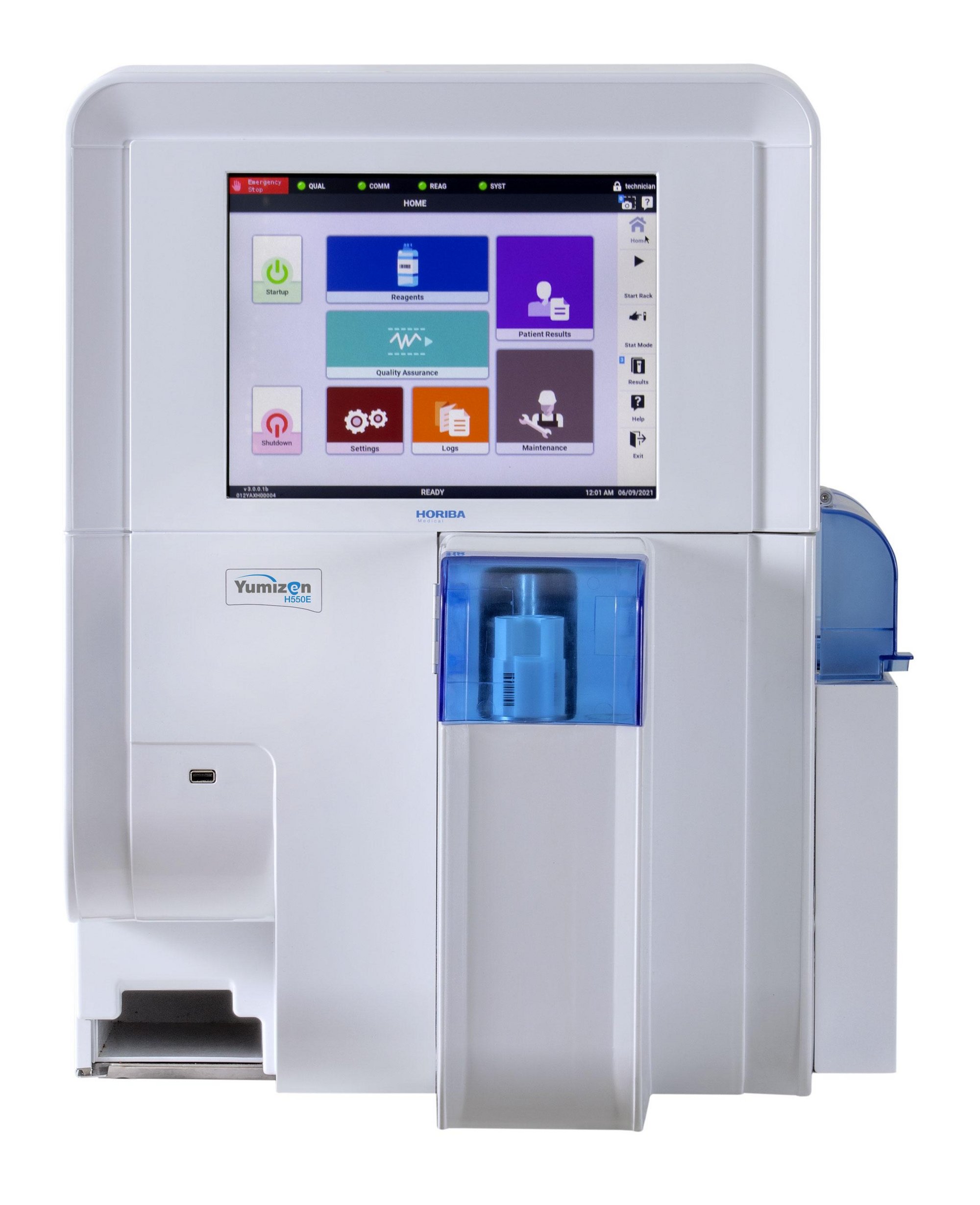
A strong example of this approach is the Concentrated Blood Product profile (CBPp) available on the HORIBA Yumizen H550 and H550E (with ESR) platforms. Using a 20 µL sample, the Yumizen H550 moves seamlessly between standard whole-blood analysis and dedicated blood bank algorithms, giving laboratories a more efficient way to manage RCCs, PCs, and WBC concentrates within a single workflow.
The CBPp is designed to address key analytical and operational challenges:
· Algorithmic interference correction: automatically suppresses WBC interference on RBC counts, correcting the HCT and HGB underestimations typical of standard analyzers
· Elimination of predilution: direct measurement of RCCs without manual preparation steps. Refined HCT calculations directly resulted in a 50% reduction in product losses during evaluations at EFS Nantes by preventing false non-compliance flags (HCT < 50\%).
· Extended platelet linearity: features a Limit of Quantification (LoQ) reaching up to 4,000 × 10³/mm³, eliminating routine dilutions for dense platelet units.
· Validated performance & EQA compliance: rigorously proven under CLSI guidelines and EU IVDR 2017/746 regulations. It also integrates seamlessly with EUROCELL Diagnostics External Quality Assessment programs.
In practice, the Yumizen H550 CBPp mode applied to RCCs has helped reduce product losses linked to hematocrit non-compliance below 50%.
This example shows how purpose-built analytical innovation can help blood bank laboratories turn quality control into a source of greater efficiency, stronger compliance, and better use of every donation.
In a world where blood resources remain under constant pressure, every donation must go as far as possible for patients and providers alike.
World Blood Donor Day reminds us that the value of each donation depends not only on collection, but also on preserving its quality and usability throughout the transfusion chain.
By strengthening quality control processes and adopting analytical approaches tailored to labile blood products, laboratories can:
Ultimately, bridging the gap between donation and transfusion relies on accurate, reliable, and efficient analytical practices.
Tiene alguna pregunta o solicitud? Utilice este formulario para ponerse en contacto con nuestros especialistas.