PDF
0.53
MB

Turbidity Monitoring in Desalination Plants

Desalination of seawater is one solution that can address global freshwater scarcity. However, it is prone to membrane fouling, which hinders desalination efficiency. To mitigate this, pretreatment on raw feed water can be done to remove foulants, and its effectiveness can be monitored via turbidity measurements. A sample of 99.7 NTU was able to reach 2 NTU after ultrafiltration, proving to be highly effective.
Water is the most vital resource on Earth as it is fundamental to all life, sustains ecosystems, powers economies and regulates climate. Yet, accessible freshwater is scarce, as 1 in 4 people globally still lack access to safe drinking water1. With rapid industrialization and population growth, this water scarcity issue is only expected to exacerbate. As such, there is the need to explore alternative methods to enhance the water supply to meet increasing demand. One way of doing this is via the desalination of seawater2. It has received the most consideration and is increasingly seen as a viable option to address domestic and municipal needs.
Desalination is the process of removing salt from water to produce water that meets the quality requirements of various uses and applications.
Desalination is the process of removing salt from water to produce water that meets the quality requirements of various uses and applications. Currently, around 95 million cubic meters of desalinated water is produced per day for human use across nearly 16,000 desalination plants worldwide, with reverse osmosis (RO) technology accounting for approximately 70% of desalination usage. While the RO process has several notable advantages such as high recovery rates, high rejection to solutes and moderate energy requirements compared to thermal distillation, it also faces significant drawbacks such as membrane fouling3.
Membrane fouling refers to the unwanted buildup of deposits like minerals, organic matter, or microbes on or within the semi-permeable membranes4. This buildup can cause basic membrane functions to deteriorate over time and affect its performance, thereby decreasing efficiency and increasing costs for cleaning or replacement. To mitigate this, pretreatment can be done on the raw feed water before it passes through the RO membranes, to minimise the amount of contaminants being introduced into the process. Some examples of pretreatment include the addition of chemicals to either enhance the solubility of minerals or to inhibit the growth of microbes, and employing filtration methods – either through microfiltration (MF) and ultrafiltration (UF) membranes, or multimedia sand filtration (SF) to remove undesired deposits5. The efficiency of the raw feed water pretreatment can be monitored via turbidity measurements.
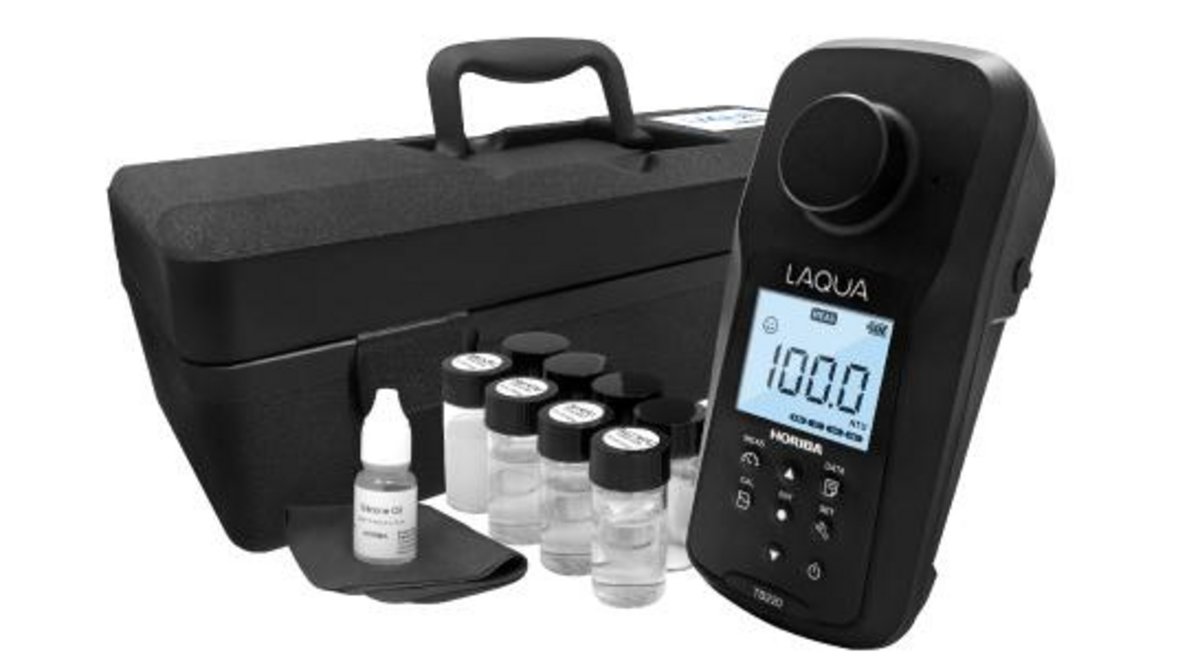
Turbidity is an important water quality indicator, as it can provide insights into desalination pretreatment. Quantified in terms of Nephelometric Turbidity Units (NTU), turbidity measurements can be used to evaluate the efficacy of feed water pretreatments by comparing the results before and after. HORIBA’s newest portable turbidity meter, the TB220, can provide quick and reliable turbidity measurements in the field, so that decisive action can be taken if it is discovered that the raw feed water pretreatment is not working to remove unwanted deposits.
Leveraging on a ratiometric measurement principle, the TB220 gives stable, accurate, and repeatable turbidity measurements, including measurements taken in the low-turbidity range. It also compensates for issues such as optical noise and other potential sources of interference coming from the sample or the environment. The result is a reliable turbidity measurement that you can trust.
Calibrate the TB220 before use, in accordance with the manufacturer’s instructions, using the standard solutions provided to ensure measurement accuracy. To verify the calibration, perform a readback using any of the calibration standards after calibration is done and ensure that the reading falls within ±2% (±0.02 NTU if 0.02 NTU standard is used).
The turbidity of raw feed water entering a particular desalination plant was monitored and studied over the course of a year, and a historical analysis was carried out. It was discovered that the overall average turbidity was 4.8 NTU, with certain months in the year having a higher average turbidity of 23.2 NTU, and the highest recorded turbidity value being 99.7 NTU.
Multimedia sand filtration (SF) and Ultra-filtration (UF) membranes are two examples of raw feed water pretreatments. To investigate its efficiency, seawater samples were collected, and 3 different levels of initial turbidity were obtained by adding clay colloidal particles into the collected seawater. These turbidity levels were chosen in order to mimic the turbidity of water samples entering the desalination plant during various times of the year based on historic data – 4.8 NTU being the average value, 23.2 NTU representing months where the average was higher, and 99.7 NTU being the maximum value recorded.
Turbidity of these samples were measured before and after each pretreatment process.
Using the TB220, accurate measurements can be obtained within a short amount of time, and its portable and compact design allows for convenience during on-site testing.
Table 1 below summarizes the turbidity levels before and after pretreatment.
Table 1: Summary of Turbidity Values Before and After Pretreatment*
| Multimedia Sand Filtration (SF) | Ultra-Filtration (UF) | |||
| Before (NTU) | After (NTU) | Before (NTU) | After (NTU) | |
| Sample 1 | 4.8 | 4.8 | 4.8 | 2 |
| Sample 2 | 23.2 | 4 | 23.2 | 1 |
| Sample 3 | 99.7 | 12 | 99.7 | 2 |
*source: Hafiz et al., 2020
From Table 1, it can be observed that both pretreatment processes (SF and UF) show effectiveness in reducing the turbidity of raw feed seawater, with it being more effective on more turbid solutions. The UF membranes can remove particles larger than 5-20nm, whereas SF can only remove particles larger than 15-20um5. Hence, UF is better able to remove unwanted deposits as compared to SF, and this can be seen by the lower final turbidity of samples after UF.
A lower final turbidity is more desirable, as this indicates lesser impurities and contaminants in the raw feed water before the desalination process. In turn, this also means that the desalination membranes can function for a longer period and maintain its efficiency, before cleaning or replacement is required. Lesser energy is also required to pump the raw feed water into the system if the membranes are not fouled by impurities. This leads to better cost savings over time.
| 1 | World Health Organization & UNICEF. (2025, August 26).1 in 4 people globally still lack access to safe drinking water – WHO, UNICEF. World Health Organization., Retrieved from https://www.who.int/news/item/26-08-2025-1-in-4-people-globally-still-lack-access-to-safe-drinking-water---who--unicef |
| 2 | Jones, E., Qadir, M., van Vliet, M. T. H., Smakhtin, V., & Kang, S.-m. (2019). The state of desalination and brine production: A global outlook. Science of the Total Environment, 657, 1343–1356., Retrieved from https://doi.org/10.1016/j.scitotenv.2018.12.076 |
| 3 | Tayeh, Y. A. (2024)., A comprehensive review of reverse osmosis desalination: Technology, water sources, membrane processes, fouling, and cleaning. Desalination and Water Treatment, 320, 100882. Retrieved from https://doi.org/10.1016/j.dwt.2024.100882 |
| 4 | Goh, P. S., Lau, W. J., Othman, M. H. D., & Ismail, A. F. (2018). Membrane fouling in desalination and its mitigation strategies. Desalination, 425, 130–155. Retrieved from https://doi.org/10.1016/j.desal.2017.10.018 |
| 5 | Hafiz, M. A., Hawari, A. H., Yasir, A. T., Alfahel, R., Hassan, M. K., & Altaee, A. (2020)., Impact of high turbidity on reverse osmosis: Evaluation of pretreatment processes. Desalination and Water Treatment, 208, 96–103., Retrieved from https://doi.org/10.5004/dwt.2020.26476 |
Revision 0, 3 March 2025