Modern Jet A production demands tight control of compositional variables that drive critical product specifications (smoke point, flash point, freeze point) and overall product stability. Analysis via laboratory methods (e.g. ASTM D1322, D56/D93, D5972/D2386, D1655 compliance) ensures certification, but lags the overall production process of Jet A. HORIBA Process Instruments’ brand of Process Raman analyzers provides continuous, online composition-based measurements that provide critical Jet A quality properties in real time. The result is faster feedback to unit operations, reduced property variability, fewer off-spec events, a reduced laboratory burden while maintaining conformance to certification testing and an increase in overall production efficiency.
Jet A is cut primarily from the kerosene fraction upstream, then hydrotreated and in some specific refinery configurations, selectively blended to meet ASTM D1655 requirements. Key quality drivers include total aromatics, polycyclic/naphthalenic contents, sulfur impurities, and distillation profile.
Control Pain Points for Jet A Production:
Process Raman is a non-invasive optical method that measures molecular vibrational fingerprints. Just like humans have fingerprints that are self-identifying, molecules also have clearly defined and well-known fingerprints with Raman spectroscopy. In Jet A fuels, diagnostically rich spectroscopic
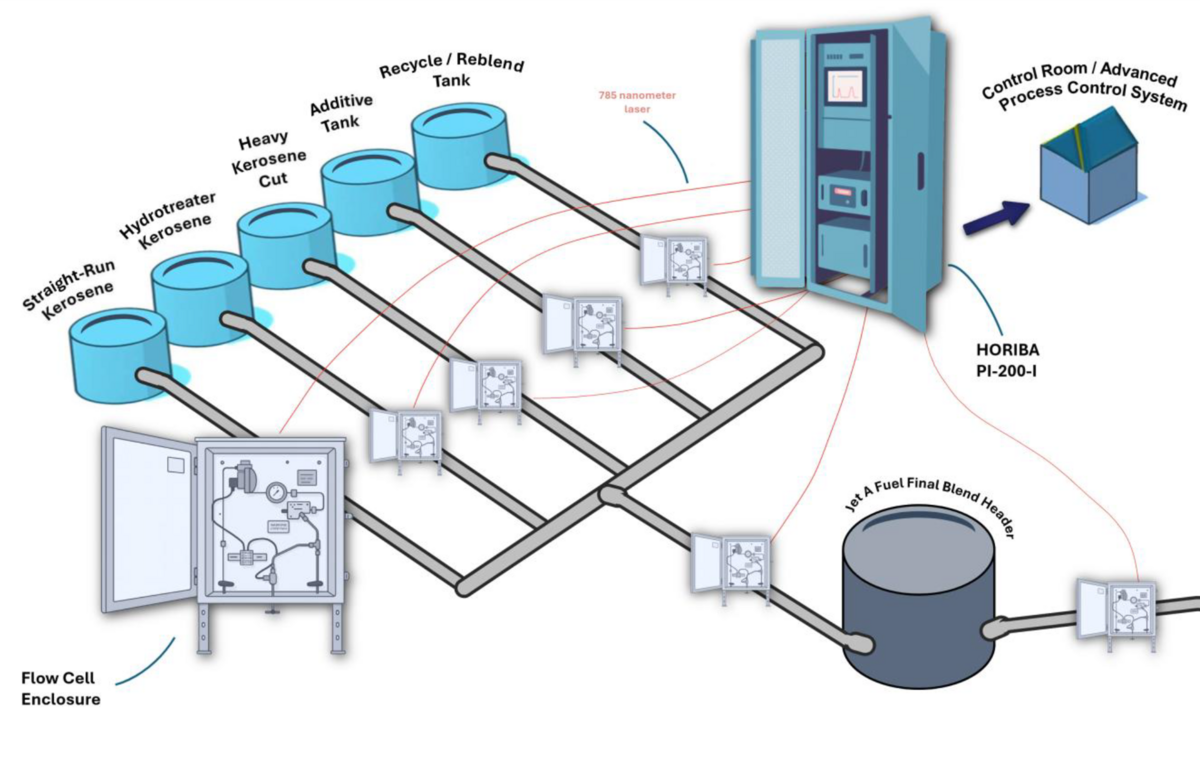
features for aromatic, aliphatic, isoparaffinic, etc. classes of molecules can be used to quantitatively track fuel composition and important fuel properties through its processing in a refinery. These spectral features in Raman spectroscopy are stable and linear over refinery operating ranges. Raman spectroscopy is mainly insensitive to temperature changes, water presence, bubbles, particulate matter, etc. allowing minimal sample preparation or conditioning. HORIBA Process Raman unites continuously collected Raman spectra with chemometric models calibrated to site-specific reference data. Each HORIBA PI-200 system is calibrated and modeled using site-specific reference data, ensuring consistency with your refinery’s own measurements. This enables direct concentrations (e.g. total aromatics, naphthalene indexes) and fuel properties (smoke point, flash point, etc.) to be predicted from compositional Raman fingerprints. HORIBA Process Raman outputs are communicated to the refinery’s DCS/PLC via standard protocols to accomplish advanced process control in Jet A fuel production. With rapid, industry-leading measurements of 30-90 seconds for Jet A streams, HORIBA Process Raman’s analyzers follow process changes in real time, continuously, 24-7. Common installation points for process measurement in Jet A applications are the hydrotreater outlet, kerosene side-draws, Jet A blend headers/rundowns, and product tank recirculation lines.
Figure 1: In-Line Process Raman Monitoring of Jet A Fuel Streams
HORIBA Process Raman analyzers are better thought of as a long-term control asset for Jet A production than just another analytical instrument.
Figure 2: Real Results from HORIBA Process Raman for Jet A Customers
By transforming Jet A production from a sampled to a continuously measured process, HORIBA’s PI-200 Raman analyzer enables predictive control of key quality properties. The result is reduced variability, minimized giveaway, and fewer reblends while maintaining ASTM compliance. Over time, the analyzer’s stability further reduces laboratory sampling frequency and frees resources, all while sustaining full Jet A certification confidence.

Multi-channel Process Raman Analyzer
Masz pytania lub prośby? Skorzystaj z tego formularza, aby skontaktować się z naszymi specjalistami.