As noted earlier, zeolites offer tremendous potential for addressing environmental challenges by leveraging their unique properties. In our research, we are developing zeolite-based adsorption columns and working toward real-world deployment of technologies that concentrate and decompose greenhouse gases. Because this material can be recycled repeatedly, it is attracting attention as a breakthrough solution with the potential to effectively reduce environmental impact.
For example, CO₂ captured and concentrated using zeolites can be supplied to agricultural greenhouses to promote crop growth or utilized in chemical production processes. Research is also underway on technologies that combine captured CO₂ with hydrogen to produce value-added products. While the cost of hydrogen remains a challenge today, overcoming this barrier would further expand the pathway to practical implementation.
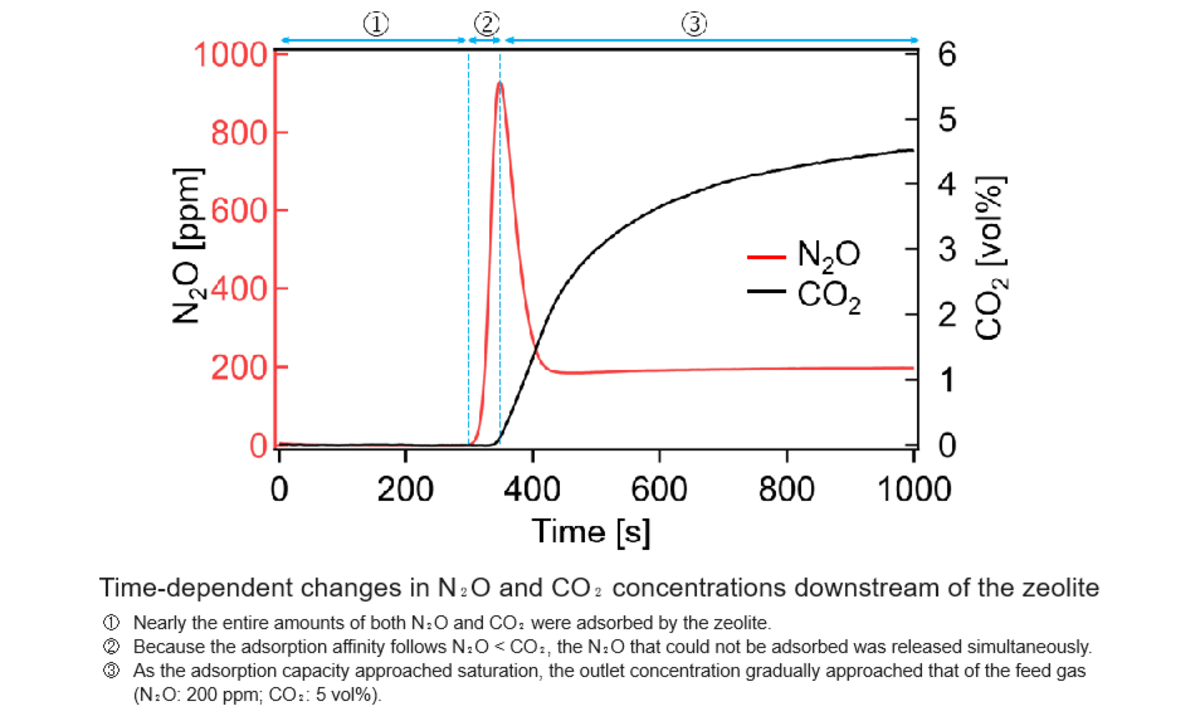
Beyond CO₂, we strategically apply zeolite-based adsorption and catalytic technologies to reduce other greenhouse gases such as methane (CH₄) and nitrous oxide (N₂O). Our goal is to build systems that concentrate these gases and decompose them on-site. In particular, for N₂O - which has a particularly high global warming potential - we have developed a technology that decomposes the concentrated gas in situ, marking a crucial step toward practical solutions for greenhouse-gas mitigation.
Zeolites also hold significant promise in the nitrogen cycle. For instance, by improving the performance of exhaust-gas catalysts, it is possible to make decomposition processes more efficient and develop technologies that drastically reduce environmental burden compared with conventional, energy-intensive methods. Through these efforts, we continue to take on highly challenging areas where unmet needs remain substantial.
Moreover, zeolites are expanding their impact not only in environmental applications but also in the energy domain. As catalysts, zeolites can support technology development for a hydrogen-based society and enable new chemical processes that convert methanol and other feedstocks into value-added products. These technologies are expected to meet next-generation energy demands and will likely become essential elements in realizing a sustainable society.
The broad range of capabilities unlocked by zeolites is indispensable for solving today’s pressing challenges - protecting the environment and improving energy efficiency. We will further advance our fundamental research and accelerate the practical implementation of these technologies to bring zeolites to society as an innovative material that leads to a more sustainable future.