
Centrifugal Sedimentation
Particle Size Distribution Measurement by Centrifugation
The centrifugal sedimentation method is a method for determining the particle size from the speed of particles moving by centrifugal force (settling velocity). When a centrifugal force is applied to particles, larger particles settle faster and smaller particles settle slower. The settling velocity is calculated from the distance traveled by the particle (from the initial position to the detection position as shown in the figure below) and the time required for the movement. It is possible to measure particles while classifying them.

Stokes' Law

The settling velocity is related to the particle size by the Stokes’ law. The acceleration g is determined by the specification of the instrument. By assigning the parameters of particle density, solvent density, and solvent viscosity of the sample to the Stokes’ law, the particle size can be determined from the settling velocity.
| Large | Small |
Density difference between particles and solvent | Settling fast | Settling slow |
The settling velocity is faster for particles of the same size when the difference in density between the particle and the solvent is large, and slower when the difference in density between the particle and the solvent is small.
Differences Between Line-Start Mode and Homogeneous Mode
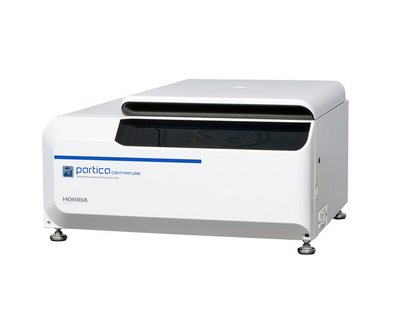
The Partica CENTRIFUGE CN-300 is capable of two different methods of measurement: Line-Start mode and Homogeneous mode.

A sample is (automatically) introduced into the density gradient solution, and the particle size is calculated from the settling time required to reach the detector. This mode enables you to measure a very small quantity of high concentration sample with high resolution.
Required amount of sample: Approx. 10 μL
Solvent: Density gradient solution

Settling starts from a uniformly distributed sample and the particle size distribution is calculated based on the information of particles passing through the detection zone. This mode is suited for measurement of low concentration samples.
Required amount of sample: Approx. 1.5 mL
Solvent: Not required
Gradient Acceleration
The Partica CENTRIFUGE continuously measures particle size from the start of acceleration until the maximum speed is maintained. This gradient acceleration allows a wide range of particle size distributions from small to large particles to be obtained without setting the rotation speed in a single measurement. Therefore, it enables the detection of even the small number of large particles and aggregation.

Measurement example of black pigment for inkjet printers
Browse Products
Request for Information
Do you have any questions or requests? Use this form to contact our specialists.