
PDF
0.77
MB
Case Study of Wastewater pH Management Flowing into Biological Reaction Tank in Beverage Plant


Biological reaction is a process that uses activated sludge containing microorganisms to treat organic contaminants, serving as one of the primary steps in wastewater treatment. If the pH of the wastewater becomes significantly acidic or alkaline, the capacity of microbial treatment decreases. To maximize treatment capacity, the pH must be adjusted to a level suitable for microbial activity. The pH is adjusted by continuously measuring the pH of the influent water and injecting chemicals to achieve the appropriate pH.
However, organic contamination often builds up on electrodes in wastewater treatment processes. This fouling causes deviations in measurements, leading to unnecessary chemical addition costs and frequent maintenance, resulting in work overload.
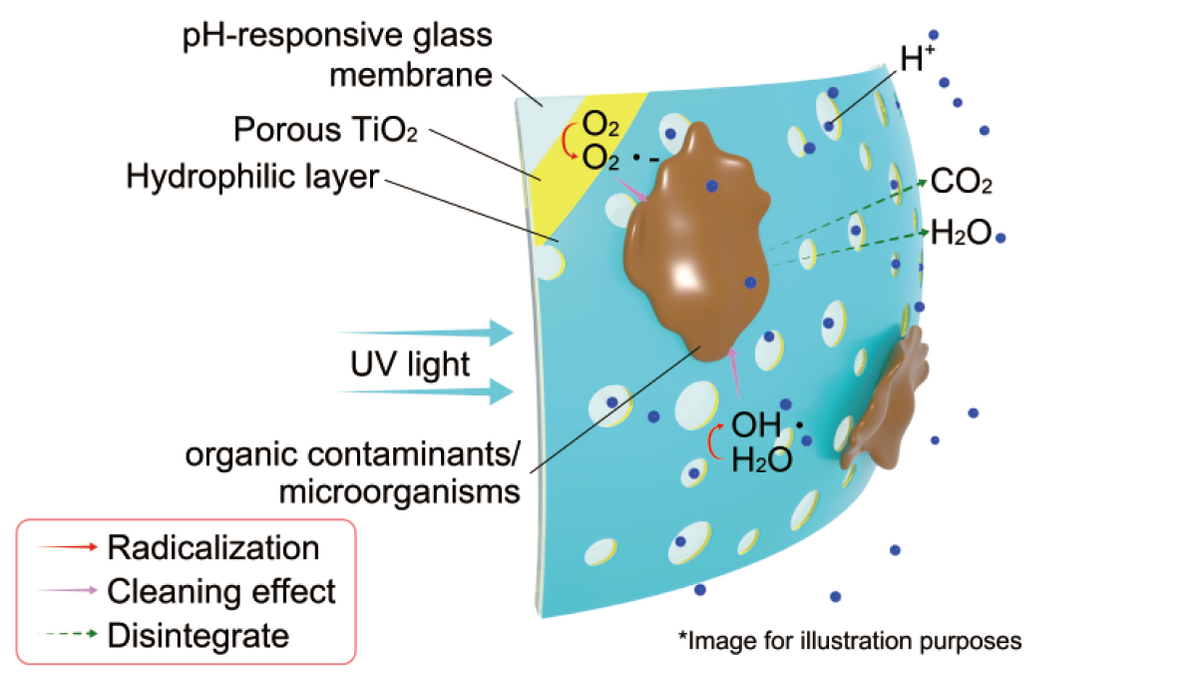
When organic contamination affects measurements, an electrode resistant to organic fouling is essential for stable, continuous measurement. HORIBA's gel-filled self-cleaning pH electrode features a pH-responsive glass membrane coated with porous TiO2 with UV light irradiated from within the electrode. The photo-induced hydrophilicity of the activated TiO2 creates a water coating (hydrophilic layer) on the surface, preventing organic contamination.
The activated TiO2 also radicalizes H2O and O2, decomposing organic contamination
that has adhered to the electrode's exterior.
Figure 1: Self-cleaning mechanism
 On-site Challenges
In the biological treatment process at a certain beverage plant, the pH of wastewater flowing into the anaerobic treatment tank was continuously measured, and chemicals were automatically injected if the pH fell below 7. However, even when sufficient reagents were injected and the actual pH was above 7, the indicator frequently showed acidic readings due to organic contamination. To prevent this, on-site workers were required to do maintenance twice a week. Despite this, excessive chemical injections still resulted in millions of yen in unnecessary reagent costs annually.
Evaluation Results
Using a self-cleaning pH electrode in the same anaerobic treatment tank reduced errors in measurement due to organic contamination. This reduced the amount of excessively injected reagents, contributing to annual savings of several million yen. Maintenance frequency was also reduced from twice a week to once a month.
Maintaining optimal pH is essential for microorganisms in tanks for high processing capacity during biological reaction processes. Electrodes resistant to organic contamination are ideal for the required continuous pH measurement. Self-cleaning pH electrodes with photocatalytic self-cleaning functions, decompose organic contaminants, enabling accurate and stable continuous pH measurement.