
PDF
1.16
MB
Management example of the biological reaction tank in the treatment of domestic wastewater


The biological reaction tank is a process that treats organic contaminants using activated sludge containing microorganisms, and it is one of the key processes in wastewater treatment. Microorganisms exhibit high processing efficiency under optimal pH conditions. However, if the pH changes due to the progression of microbial metabolism which is caused by improper aeration, the processing efficiency decreases. Therefore, in the biological reaction tank, continuous pH monitoring is required to implement appropriate measures (such as adding neutralizing agents, etc.) when pH changes occur.
The pH monitoring in the biological reaction tank involves the installation of pH glass electrodes within the tank for continuous measurement. However, due to the components derived from wastewater and the presence of activated sludge, the electrodes are prone to contamination, leading to a significant number of processes for daily electrode maintenance.
 Challenges at the Site
At treatment facility A, the pH electrode becomes contaminated quickly due to wastewater containing various organic substances and activated sludge. The accumulation of dirt causes drift in measurement readings, leading to the need for frequent maintenance.
Evaluation Results
An evaluation of pH monitoring using the Self-cleaning pH Electrode was conducted in the biological reaction tank of treatment facility A. It was confirmed that cleanliness could be maintained around the glass response membrane for the duration of the 7-month evaluation.
| Standard solution | Measurement value at start | Measurement value (7 months later) | Differences |
|---|---|---|---|
| 6.86 | 6.86 | 6.87 | 0.01 |
| 4.01 | 4.01 | 3.96 | 0.05 |
| 9.18 | 9.18 | 9.22 | 0.04 |
*1 The effectiveness may vary depending on the customer's usage environment.
The evaluation test used pH standard solutions as references. The data shows almost no difference between at start and 7 months later. The results show that there was no decrease in sensitivity and no shift in asymmetric potential. With a Self-cleaning pH Electrode, it is possible to reduce the workload associated with continuous measurements in a biological reaction tank.
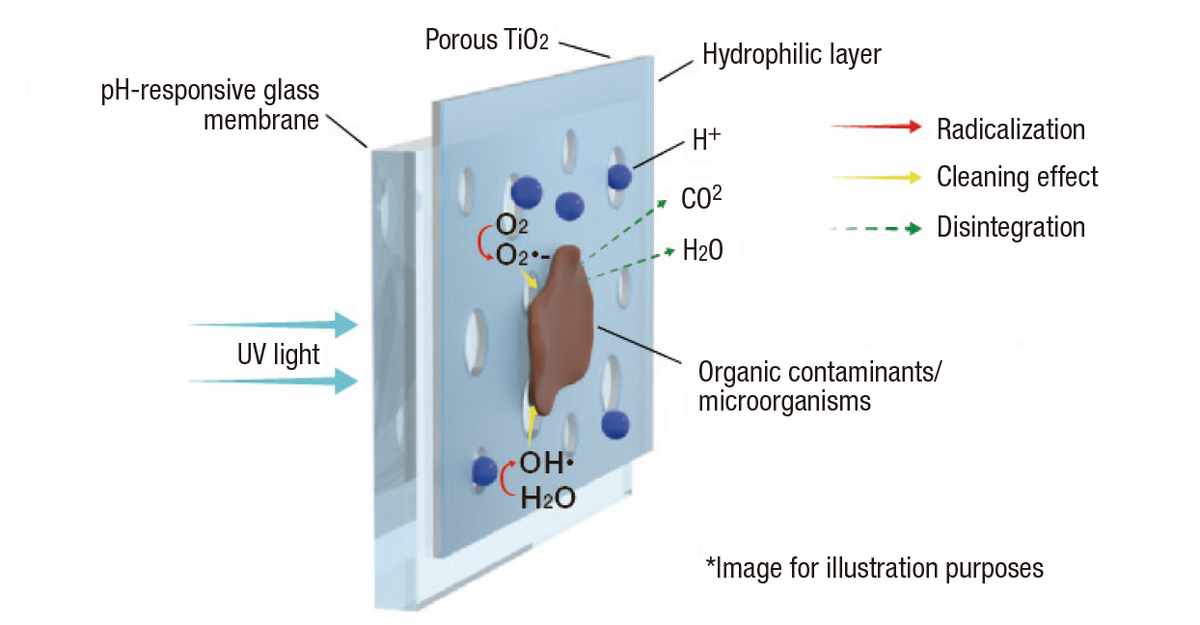
The pH-responsive glass membrane is coated with porous TiO2 and irradiated with UV light from within the electrode. This process activates the TiO2 coating, resulting in photocatalytic hydrophilicity and the formation of a water film (hydrophilic layer) on the surface, effectively preventing the adhesion of organic contaminants. Furthermore, the activated TiO2 facilitates the radicalization of water (H2O) and oxygen, enabling the disintegration of organic contaminants adhering to the external surface of the electrode.
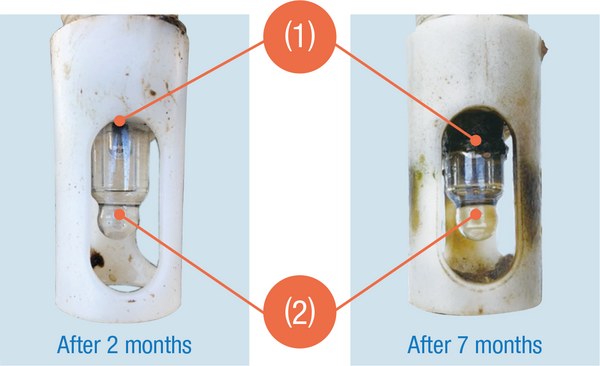
(1) No TiO2 coating
(2) With TiO2 coating
<Sample Conditions> Water temperature: 17.0−35.0 °C/pH: 6.5−7.5
Comparison between the electrode after 2 months and after 7 months. In (1) No TiO2 coating, accumulation of dirt is observed, while in (2) With TiO2 coating, it is confirmed that accumulation of dirt is almost not present.
*2 The effectiveness may vary depending on the customer's usage environment.