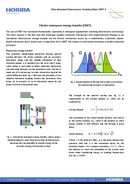
TCSPC stands for time-correlated single photon counting. It is a method of using the timing of a pulsed excitation source, like a laser or LED, with the timing of the arrival of single photons on a detector to reconstruct the lifetime decay over many events (repetition of pulses and photons detected). This technique is based on the fact that the probability of detecting a single photon at time, t after an exciting pulse is proportional to the fluorescence intensity at time t.
The repetition of a laser or LED pulsed at relatively high repetition rate (10 kHz to 100 MHz) is synchronized with the time the next photon arrives at a detector (i.e. PMT). Timing electronics in the form of a time-to-digital converter or time-to-amplitude converter (TAC) are used to record these events in succession, until sufficient statistics are collected to reconstruct the decay. The decay is then fit to an exponential function to model the lifetime decay (t). TCSPC is typically used to measure fluorescence lifetimes from the picosecond to microsecond time scale.