

Zeta Potential: Layout, Calculating, Analysis
Zeta Potential

Zeta potential is the charge on a particle at the shear plane. This value of surface charge is useful for understanding and predicting interactions between particles in suspension. Manipulating zeta potential is a method of enhancing suspension stability for formulation work, or speeding particle flocculation for water treatment for example. Measuring zeta potential by electrophoretic light scattering allows one to assess the effects of various strategies for manipulating zeta potential. Electrophoretic light scattering exploits the fact that a charged particle responds to an applied electric field.
Zeta Potential Layout for SZ-100
The particle motion due to the applied electric field is measured by light scattering. The particles are illuminated with laser light and therefore the particles scatter light. The frequency of the scattered light is a function of particle velocity due to the Doppler shift. This explains another name for this technique: laser Doppler electrophoresis. A second beam of light (the reference beam) is mixed with the scattered beam in order to sensitively extract the frequency shift in the scattered light. See the figure below showing the scattered beam mixing with the reference beam at the zeta potential detector in the lower right. The measured magnitude of the frequency shift is then used to determine the particle velocity.

Calculating Zeta Potential
From the known applied electric field and measured particle velocity, the particle mobility is readily determined. Zeta potential is then calculated from mobility by using a model, the most common of which is the Smoluchowski model. The only parameters required for determining zeta potential are liquid dielectric constant, refractive index, and viscosity. This makes the technique rapid and reliable.


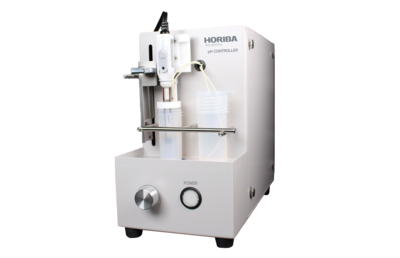
In practice, measurements are made by adding a small amount of suspension or emulsion to the measurement cell and inserting the cell into the instrument. The instrument software then automatically determines the appropriate electric field strength, adjusts the reference beam intensity to ensure the optimal signal to noise ratio, collects and analyzes the data, and presents the results to the user. Often, the effect of H+ or other ions on zeta potential is important. In the former case, a pH titration can be performed, and in the latter, the ion concentration is varied (usually on a logarithmic scale) and a series of zeta potential measurements are performed. Significant labor savings can be realized by using an automated titrator to adjust sample pH.
Zeta Potential Analysis
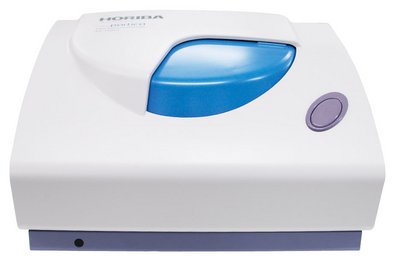
The zeta potential of a sample is most often used as an indicator of dispersion stability. Large zeta potentials predict a more stable dispersion. Fast and accurate measurement of the zeta potential with the nanoPartica SZ-100V2 can enhance understanding of aggregation and flocculation in samples and speed up the process of developing stable formulations, be they dispersions, emulsions or suspensions.
Measurement of the zeta potential, or electrostatic attraction / repulsion, is important to many industries from pharmaceuticals to mineral processing and from water treatment to additives for electronics. The SZ-100V2 enables fast, reliable and accurate measurement of the zeta potential.
For more information about acquiring an instrument, click here.
Technical Notes

Z-Average Size Determined by DLS
Dynamic light scattering (DLS) results are often expressed in terms of the Z-average. The Z-average arises when DLS data is analyzed by the use of the technique of cumulants.

Upper Size Limit of Zeta Potential Measurement
Zeta potential is a measure of the charge on suspended particles. This property is typically more important for suspensions of small particles where there is high surface area and significant particle – particle interactions.

Lifetime of Zeta Potential Cells
There are several zeta potential cell options for the SZ-100V2 including disposable plastic cells intended to last for several measurements before being replaced. This study investigates how many measurements could be made before the cell required replacement.
Browse Products
Запросить информацию
У вас есть вопросы или пожелания? Используйте эту форму, чтобы связаться с нашими специалистами.