Surface Area
Physisorption Technology
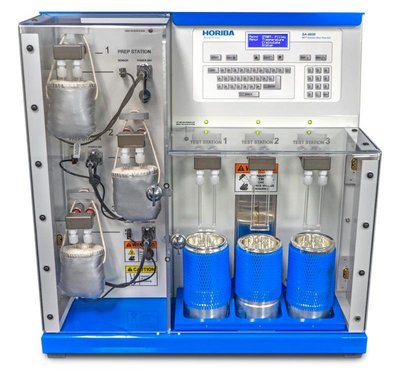
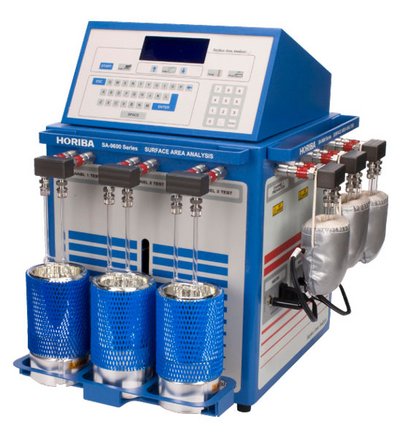
Specific surface area and pore size distribution are fundamental parameters of many solids. Properties such as porosity, strength, hardness, permeability, separation selectivity, rheology, catalytic activity, dissolution, net density, corrosion, thermal stress resistance, and other physical properties can be directly affected by the porous structure of a material. These properties can be easily investigated using the physisorption or gas adsorption technique provided by the SA-9650 Series of surface area analyzers.
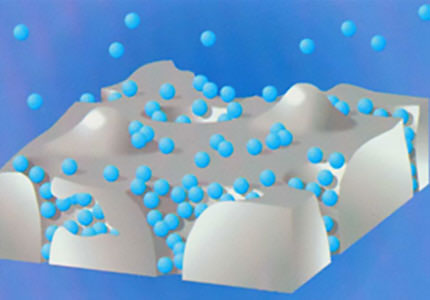
Example of gas molecules adsorbing to a surface.
BET Theory
In nature, all surfaces adsorb water or other vapors to satisfy surface energy. After preparation for gas adsorption, known as “Degassing”, is completed, that surface energy can be used to adsorb probe gas molecules. The volume of gas adsorbed on a surface is recorded and plotted versus pressure. From these raw data, several modelling methods can be used to produce useful results. One of the most frequently used and well known is the BET method, named after the developers, Stephen Brunauer, Paul Emmett and Edward Teller. In essence, the BET method permits the calculation of a “theoretical monolayer” of gas molecules. Knowing the number of moles of gas comprising that monolayer and knowing the cross-sectional area of a single gas molecule permits the determination of surface area. Carefully recording the mass of the sample permits the reporting of “specific surface area” typically in meters squared per gram.
As more gas is adsorbed, layer upon layer of gas builds up on the surface of a material. And if porosity is present, larger pores are eventually filled. Additional models can be used to determine pore size distribution from these data.
Surface pores are divided into three categories by their diameters according to the International Union of Pure and Applied Chemistry (IUPAC). Micropores which are 2 nm and smaller, mesopores which are between 2 and 50 nm, and macropores which are greater than 50 nm.
The actual measurement process of physisorption or gas adsorption, requires the sample and sample holder to be cooled, typically using liquid nitrogen, and then exposing the sample to increasing concentrations of nitrogen in a flowing carrier gas – usually helium. As the nitrogen molecules lose thermal energy, the degassed surface energy of the material can adsorb these nitrogen molecules. In a flowing gas adsorption instrument, an automatic calibration is performed followed by an adsorption cycle and then the process is completed by returning the sample to room temperature and a desorption cycle takes place.

Typical single point raw signal of Volts plotted vs Time.
Single and Multi Point Analysis
This process can be used one time for a single point measurement, or several times for a multi-point measurement. In general, a surface area result obtained by the multipoint method using nitrogen as the adsorbate may sometimes be more accurate than a single point measurement, but the SA-9650 is built to provide high sensitivity results even with single point analysis. The SA-9650 performs these measurements using the flowing gas method which has several advantages, including high speed of analysis, small footprint, higher reliability as well as lower purchase and ownership costs.
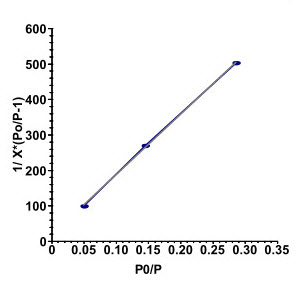
Example of a multi-point analysis.
Whether one chooses to perform single or multi-point measurements with the SA-9650, the process is completely automated requiring that an operator only select an analysis protocol, input sample identifier and sample mass. The instrument and the onboard computer (or if desired, a separate PC) does the rest. The analysis is performed, and results are calculated and displayed and/or printed and saved.
For more information about acquiring an instrument, click here.
Application Notes

Metal Powder Properties: A Case with Low Specific Surface Area
Determination of specific surface area of metal powders is an important parameter in the field of powder metallurgy. In this note, we demonstrate the use of Brunauer-Emmett-Teller (BET) technique to measure another critical metal powder property: specific surface area (SSA).

Measuring Low Specific Surface Area Standards
A feasibility study to measure low specific surface areas with the HORIBA SA-9600 was performed using Certified Reference Materials BCR 169, 170 and 172 from the European Commission Joint Research Centre. The reference materials consist of two alpha-alumina powders and one quartz powder.

Comparison of Single-Point and Multi-Point Surface Area Measurements
The Flowing Gas Technique for determining BET Surface Area has been in use for over 70 years. Many facets of the technology make it a very attractive alternative to the Static-Volumetric approach. Detection is done by measuring a gas concentration difference instead of an absolute pressure. Difference measurements are typically more accurate than many absolute measurements.

Surface Area of Graphite
Graphite is an important and widely used material. Graphite’s properties stem from its hexagonal lattice structure. It is composed of carbon atoms arranged in layers, each consisting of interconnected hexagonal rings. These layers can easily slide past one another, giving graphite its characteristic lubricity.

Surface Area of Aluminum Oxide
Aluminum oxide is one of the most abundant minerals in the Earth’s crust and has many practical applications. It is naturally occurring and most commonly found as bauxite. The extraction of aluminum from bauxite involves refining processes that ultimately lead to the production of aluminum oxide.

Surface Area of Hydroxyapatite
Hydroxyapatite is a naturally occurring mineral form of calcium apatite. Hydroxyapatite’s unique properties make it useful in various fields and applications. It is the main mineral component of vertebrate bones and teeth and is also found in some other tissues like dentin and enamel.

Surface Area of Calcium Carbonate
Calcium carbonate is used in construction materials. Limestone and marble, which are forms of calcium carbonate, are used as building stones and in the production of cement, concrete, and mortar. It is used as a filler and extender in a wide range of products...

Surface Area of Bentonite
Bentonite is a widely used natural clay material which originates from past volcanic ash deposits. For industrial purposes, two main classes of bentonite are recognized: sodium and calcium bentonite. Sodium bentonite is the more valuable, but calcium bentonite is more common.

Surface Area of Kaolinite
One of the most widely distributed and common clay minerals is Kaolinite. Kaolinite is a soft, earthy, usually white, mineral produced by the chemical weathering of aluminum silicate minerals like feldspar.

Surface Area of Calcium Hydroxide
Calcium hydroxide, also called slaked lime or hydrated lime, is typically a white, odorless powder which is widely used in the chemical industry. An inorganic compound, it is produced by a chemical reaction when calcium oxide is mixed with water and forms calcium hydroxide.
Запросить информацию
У вас есть вопросы или пожелания? Используйте эту форму, чтобы связаться с нашими специалистами.
Browse Products