HORIBA Scientific and Analytical Instruments
Explore HORIBA
Corporate
  • HORIBA Group
Markets
  • Mobility
  • Energy and Environment
  • Life Science
  • Healthcare
  • Materials
  • Semiconductor
Countries/Regions
Americas
  • Brazil / Brasil
  • United States / United States
Asia
  • China / 中国
  • India / India
  • Japan / 日本
  • Korea / 한국
  • Singapore / Singapore
  • Taiwan / 台灣
  • Thailand / ประเทศไทย
  • Vietnam / Việt Nam
Europe
  • Austria / Österreich
  • Czech Republic / Česko
  • France / France
  • Germany / Deutschland
  • Poland / Polska
  • Russia / Россия
  • Spain / España
  • Türkiye / Türkiye
  • United Kingdom / United Kingdom
Global
  • International
Search
HORIBA Scientific and Analytical Instruments

Contact us

Find us

  • A giant leap in fuel cell engineering
  • AFIS key to catching crook in unlikely match
  • The Alchemist’s Factory – A Particle Characterization Story
  • Alternative light sources and AFIS help identify murder suspects
  • An act of mercy in Baltimore
  • Astrobiologist/Geobiologist uses Earth as a lab to examine possibility of extraterrestrial life
  • A-TEEM™ and fluorescence spectroscopy may offer a better way to feed the world
  • Can Raman microscopy reveal art forgeries?
  • Carbon black lightens your wallet
  • Chilean grape and wine quality assessment with Aqualog A-TEEM analyses
  • Cleaner water through fluorescence spectroscopy and artificial intelligence
  • Companies collaborate for better water treatment
  • Cryogenics and Multimodal Microspectroscopy — Filtering out the Noise
  • Designing a new breed of nuclear reactors
  • Detecting early signs of cancer with Raman microscopy
  • Detection of smoke taint in grapes and wine
  • Developing in-situ, online monitoring tools for radioactive materials using fluorescence spectroscopy
  • Discovering the origins of life
  • Drilling deep to discover life
  • Duetta: fluorescence and absorbance - in the blink of an eye
  • Elemental analysis and a cold brew
  • Exploring biogeochemical cycles, speciation, and primary productivity in the ocean using fluorescence spectroscopy
  • Exposing Counterfeit Drugs
  • Finding ancient life through minerals on earth and beyond
  • Fine wine-making with the help of HORIBA tech
  • Fingerprint database leads to killers
  • Fluorescence sensors contribute to biological and display technologies
  • Fluorescence Spectroscopy: An Alternative to Chromatography in Enhancing the Flavor of Foods
  • Fluorescence spectroscopy becoming key to identifying pain
  • Fluorescence spectroscopy exposes carbon cycle changes
  • Fluorescence spectroscopy exposes carbon cycle changes
  • Fluorescent carbon nanodots: making foldable displays
  • Forensic light sources nab the suspects
  • Glucose Binding Molecules could revolutionize diabetes management
  • The Grape Identity Crisis and How Spectroscopy Separated History’s Most Confusing Cultivars
  • Health benefits of olive oils get boost
  • Historic carbon fluctuations could expose climate change secrets
  • How do thin films help NASA uncover the secrets to the universe?
  • How fusion breakthroughs will lead to clean renewable energy
  • How to measure temperature with light
  • How we customized a spectroscopy solution in the low UV range
  • Investigating missing carbon in Australian caves
  • Ionic Liquids as a Breakthrough for Resource Recycling Issues
  • Is this the next breakthrough in medicine?
  • Killing cancer with lanthanides and air
  • Launch of Mars 2020 to explore Mars using XRF
  • Leading the World with All-Solid-State Batteries
  • Low cost solar power on the horizon
  • Man of science follows business path
  • Making better gas turbines
  • Making carbon nanotubes more accessible
  • Making more efficient solar energy
  • Materials characterization crucial in Silicon Valley systems
  • Medical examiner department ID’s evidence with alternative light sources
  • Micro-XRF uncovers secrets to Van Gogh’s brilliance
  • Microplastics: a big problem for the environment
  • Microplastics explained
  • Mishaps and ski trip lead to laser revolution
  • Museum’s mineral studies improving life
  • MXenes are revolutionizing nanotechnology with the help of Raman Spectroscopy
  • Nano-scale research and technology leads to advanced materials development
  • Nanotechnology a pathway to efficient solar energy
  • Optimizing Wastewater Treatment in South Africa: A-TEEM Fluorescence Spectroscopy for BOD Analysis Amidst Economic Pressures
  • Mars life signs probed by spectroscopy
  • Photodynamic therapy – A non-toxic way to fight cancer
  • Photoluminescence contributes to staggering growth of photovoltaics
  • Photovoltaics and photoluminescence
  • Raman breakthrough recovers erased serial numbers from plastic guns
  • Raman and X-ray fluorescence spectroscopies reveal the mysteries behind ancient Japanese art form
  • Raman gets the goods on counterfeiters
  • Raman spectroscopy breakthroughs make CSI real
  • Research into ion transport through cell membranes aided by fluorescence spectroscopy
  • Researcher fights food fraud
  • Researcher developing (non) linear nano-optical methods to characterize heterogenous interfaces
  • Researcher traces path of potentially toxic nanoparticles
  • Scientist pioneers wastewater treatments to fight global warming effects
  • Should you be worried about nanotoxicity?
  • SPEX Forensics algorithms used to solve cold cases
  • Study validates fluorescence spectroscopy with A-TEEM for fast and precise wine authentication
  • Targeting toxic waste with minerals
  • The ARC Program: Forging Appalachia's Future Workforce
  • The baker’s son
  • The best nanoparticle
  • The mystery of gemstone colors has finally been revealed
  • The science of food
  • Thin film analysis reveals secrets to renewable energy
  • Tracing toxic heavy metals in organisms using X-ray fluorescence (XRF)
  • Understanding two-dimensional material interfaces with AFM Raman/TERS will transform computing
  • Unlocking the Secrets of the Deep Ocean’s Carbon Engine
  • Using AFM-Raman to understand defects in two-dimensional semiconductor materials
  • Using low temperatures to probe 2D materials for device applications
  • Using renewable and alternative sources for value-added products production
  • Versatile Aqualog saves chemical costs at treatment plants
  • Weeding out Over-the-Counter Frauds
  • Welcome to the dawn of a paradigm shift in technology
  • What are microplastics?
  • Where do microplastics come from?
  • Yellowstone’s treasures may hold clues to life
  1. Home
  2. Scientific
  3. Resources
  4. Researcher fights food fraud

Researcher fights food fraud

Gene Hall is a crusader. His mission is to find mislabeled food and dietary supplement products, and reveal them to the world.

The Ph.D. and professor of analytical chemistry at Rutgers University developed methodology enabling the analyses of marine and algae lipid dietary supplements. He can show how this is helping to detect food fraud.

Fish oils are popular, if genuine, because it offers an easy way for consumers to receive the associated health benefits of eating fatty fish, without eating fish. He’s documented fake fish oil in dietary supplements. Hall, through his research, has found that many products do not contain the beneficial ingredients of the natural form of omega-3 fatty acids, as indicated on the product’s labeling.
Phony marine-based dietary supplements

运用Aqualog荧光光谱仪进行分析

Hall uses analytical chemistry instrumentation, including Fourier-transform infrared spectroscopy (FTIR), energy dispersive X-ray fluorescence (EDXRF), and Raman spectroscopy from HORIBA Scientific to characterize the ingredients in these products.

His team has investigated the authenticity of marine-based dietary supplements. It took particular aim at fish oil dietary supplements, like those made from anchovy, salmon, tuna, and menhaden fish body oils. Hall said many of the products on the market which indicate they contain fish oil, do not actually contain omega-3 fatty acids in their natural triglyceride form.  Instead, the common, or usual name, “fish oil” declared as a dietary ingredient in the supplement facts panel has been chemically altered and can no longer claim “fish oil” as a dietary ingredient or dietary supplement.

Subsequently, his team found that about 80 percent of the products tested were chemically altered without notifying the consumer of a change in the common or usual name of the supplement. This is a violation of the Food and Drug Administration’s regulations, but unfortunately, the FDA does not monitor these changes.

Some substitute ingredients have been found to contain synthetic products which can damage a person’s pancreas and other vital organs. Others contain fatty acid ethyl esters, which are not recommended for pregnant women.

Krill oil is one of the most heavily misbranded and adulterated dietary supplements, Hall said.

“Many products are labeled as Krill oil, but they have no Krill oil in them,” he said.

Krill oil’s benefits are supposed to deliver polyunsaturated fatty acids. Unfortunately, the industry is hyping up the dietary supplement, but it doesn't live up to the amounts of EPA and DHA, both omega-3 fatty acids, in the Krill oil, Hall said.

“If you eat a normal diet, you get about maybe 10 times more EPA and DHA,” Hall says, “The dietary supplements - to me are useless.”

Policing the industry

All dietary supplements are FDA regulated. But Hall says it doesn’t do product testing.

“So it leaves it to private industry or the research sector,” he said. “The industry polices itself, so it's basically on the honor system, but nobody's checking the dietary supplement companies. We're one of the few labs that are actually checking these companies.”

Another product Hall’s team has looked at is salmon oil. Many products sold on the market as a dietary supplement say it has salmon oil.

“The nice feature is that you can look for this special pigment, astaxanthin ,” he said. “Natural salmon oil has this very beautiful red pigment, which fluoresces very nicely with (HORIBA’s Aqualog). “So we went out and bought a whole bunch of salmon oil dietary supplements and analyzed it on the Aqualog.”

Hall found gross mislabeling and plans to publish his results on these different adulterated dietary supplements in the near future.

Should consumers be concerned?

“Oh, absolutely,” Hall said. “Salmon oil is a very nice dietary supplement for increasing the amount of the esterified polyunsaturated fatty acid, DHA, which is good for brain development.”

Flavored drinks

His latest research looks at the ingredients of infused or flavored bottled water and sports drinks. His goal is to see if the components of the liquids are the same as those that are on the labels of the products.

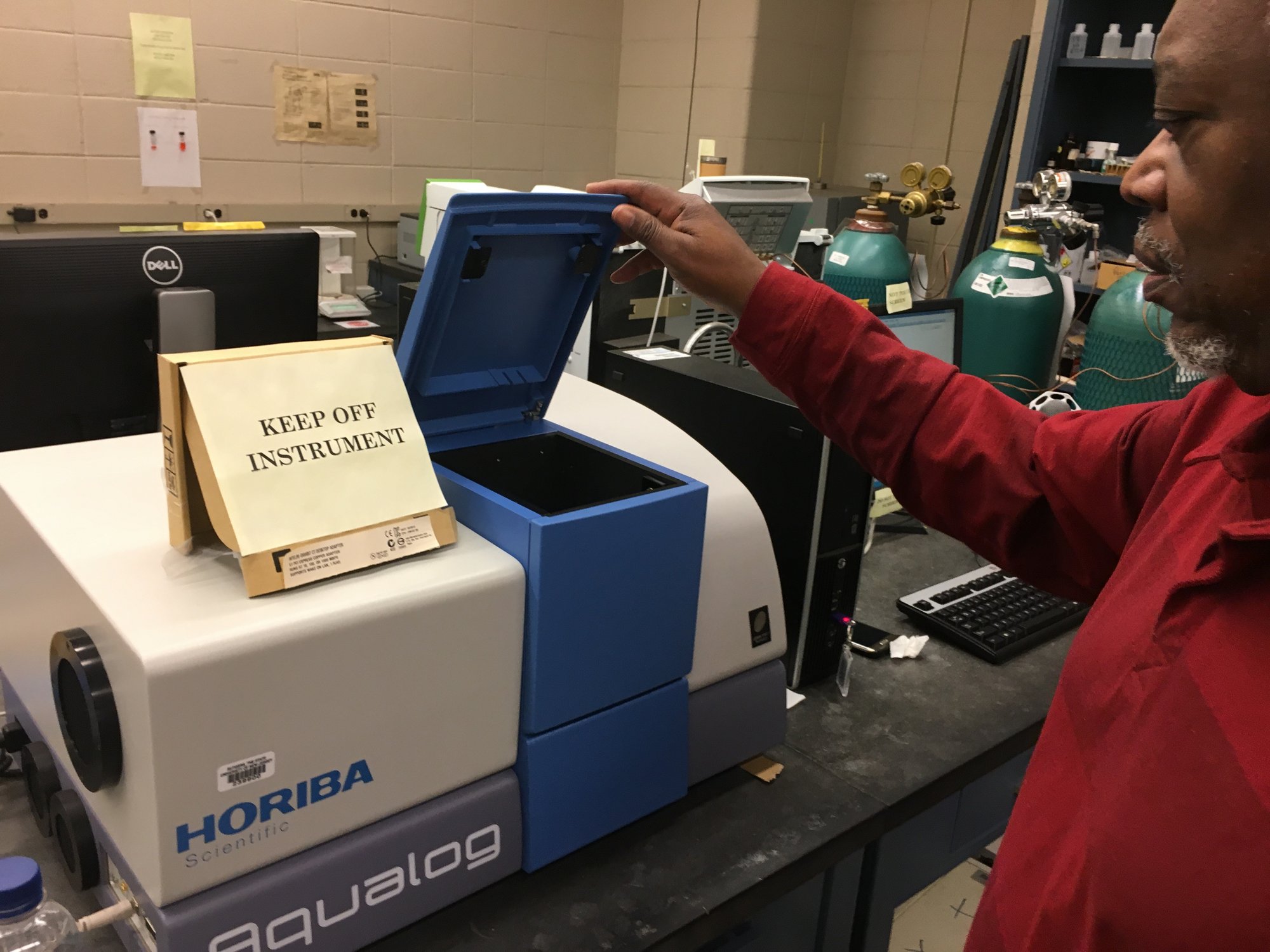
Dozens of these drinks line the tables in his Piscataway, New Jersey lab. Hall’s team has begun analyzing them using fluorescent spectroscopy. Hall uses a HORIBA Aqualog spectrofluorometer, which simultaneously measures both absorbance spectra and fluorescence Excitation-Emission Matrices, giving the researcher a fingerprint of the sample they are studying in fast succession.

“We wanted to see if there’s a difference in the fluorescent structure of the various flavors from the same manufacturer,” he said. “It would tell you if they are using the same ingredients or it would tell me that the labels are not correct on the bottle.”

The Aqualog can excite one wavelength and then show the emission at another wavelength.

“The nice feature about the Aqualog is that you can have this simultaneous excitation and emission, and capture all that data into one nice visual interpretation,” he said. You can actually see on the computer monitor some nice features with contour plots which can allow you to visualize differences or similarities between samples. It has a unique fingerprint. If two samples are very similar, they should have the same excitation emission fingerprint based on all of the many hundreds of compounds that are present in the sample.”

Hall plans to catalog the results of his study in his current research into infused water and sports drinks.

Quality control

“We're making a library right now,” he said. “That means if I go to another store, buy the same product, but with a different lot number, I would expect to see the same fluorescence intensity. So it's another way of perhaps looking at using the method as a quality control feature.”

Hall is policing the labels by looking at the actual ingredients in the drinks and comparing them to one another.

“As a consumer, you pay for these infused water samples,” he said. And if they don't have what the label claims, the product is misbranded and you're not getting what you paid for.

Liquids contaminated with lead

Hall uses a HORIBA XRF spectrometer to determine how much lead is in various bottles, like beer bottles, wine bottles, cooking oil bottles and water bottles.

XRF spectroscopy is the technique of analyzing fluorescent X-rays in order to gain information on the elemental composition of a particular material.

Hall is finding a lot of lead in those bottles, which he says should not be there. The lead can transfer to the user of the bottle. As products sit in the bottles and become acidic, the acidic ingredients could leach the lead from the glass into the product.

“We want to find out how much lead is actually getting into the product, because the FDA and the EPA (Environmental Protection Agency) has a limit in terms of how much lead the ingredients can contain,” he said. “Again, the FDA doesn't do this kind of research. They have standards, but again, it's self-policing.”

Counterfeit consumer goods

Hall’s research goes beyond food. He has also found a reason to stay away from those inexpensive fake designer accessories you can buy on the street. Hall has identified lead in certain counterfeit designer handbags.

“(These) bags are counterfeit and use fake leather, what we call a ‘Pleather,’” he said. “And that fake leather has lead acetate as one of the ingredients.”

Follow Us 


Request for Information

Do you have any questions or requests? Use this form to contact our specialists.

* These fields are mandatory.

Products

  • All Products (A-Z)
  • Mobility
  • Energy and Environment
  • Life Science
  • Healthcare
  • Materials
  • Semiconductor

Applications

  • Drinking Water Utilities
  • Automotive Manufacturing
  • Semiconductor Manufacturing Process
  • Research and Testing Laboratories

Technology

  • Glow Discharge Spectroscopy
  • Pressure-based Flowmetry
  • Quadrupole Mass Spectrometry
  • Raman Spectroscopy

Service

  • On-Site Support
  • Spare Parts and Consumables

Company

  • News
  • Events
  • Career
  • History
  • Corporate Culture

Contact

  • Career Contact
  • Contact Form
  • Worldwide Locations
  • Investor Relations Contact

Terms and Conditions Privacy Notice Cookies HORIBA Group Social Media

© Copyright 2026 - All Rights Reserved