PDF
0.45
MB

Responsive pH Measurements in Organic Solvents

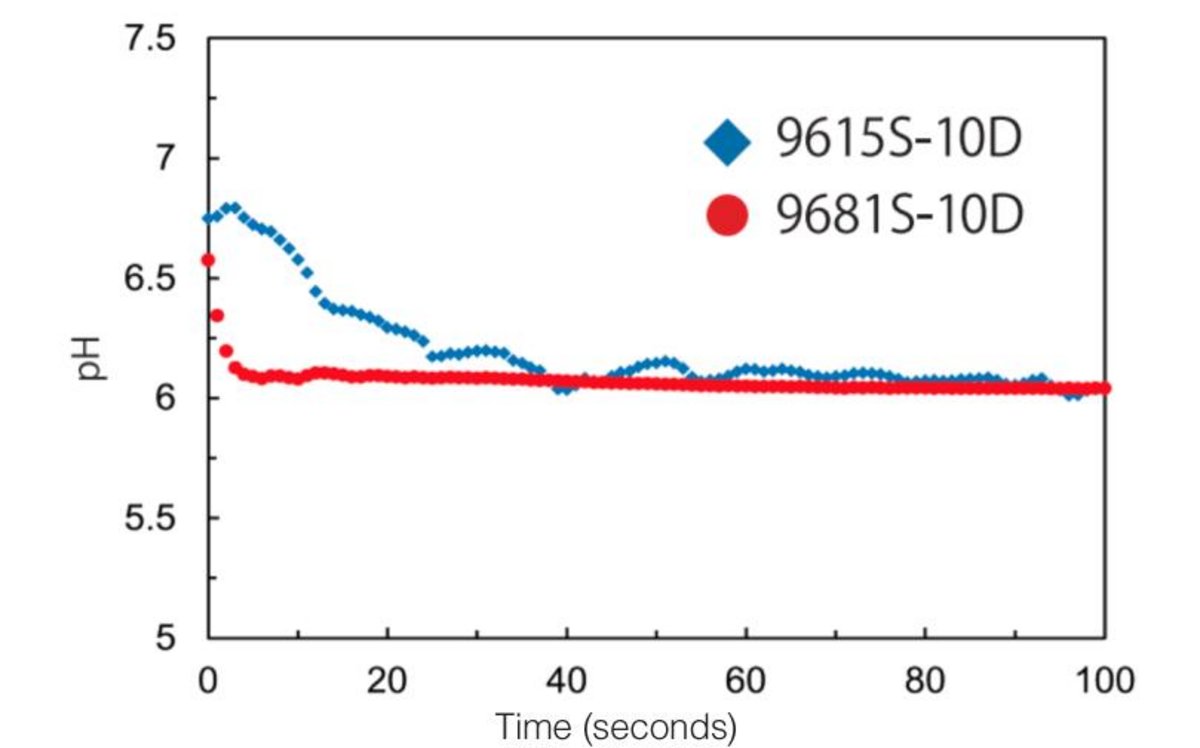
The 9681S-10D ToupH Sleeve Electrode with a sleeve junction was able to achieve stable pH reading for a solution of 30% ethanol in 20 seconds, as compared to the 9615S-10D ToupH Standard pH Electrode with a ceramic junction which still showed slight fluctuations even after 100 seconds. Additionally, for pH measurements involving organic solvents, it is recommended that the sample contains a certain amount of water.
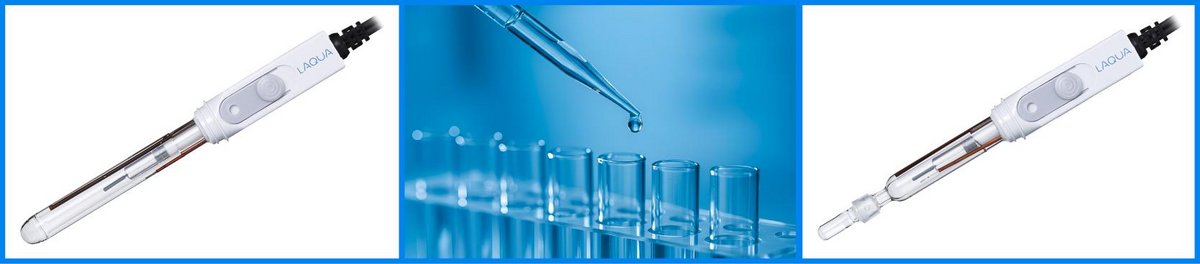
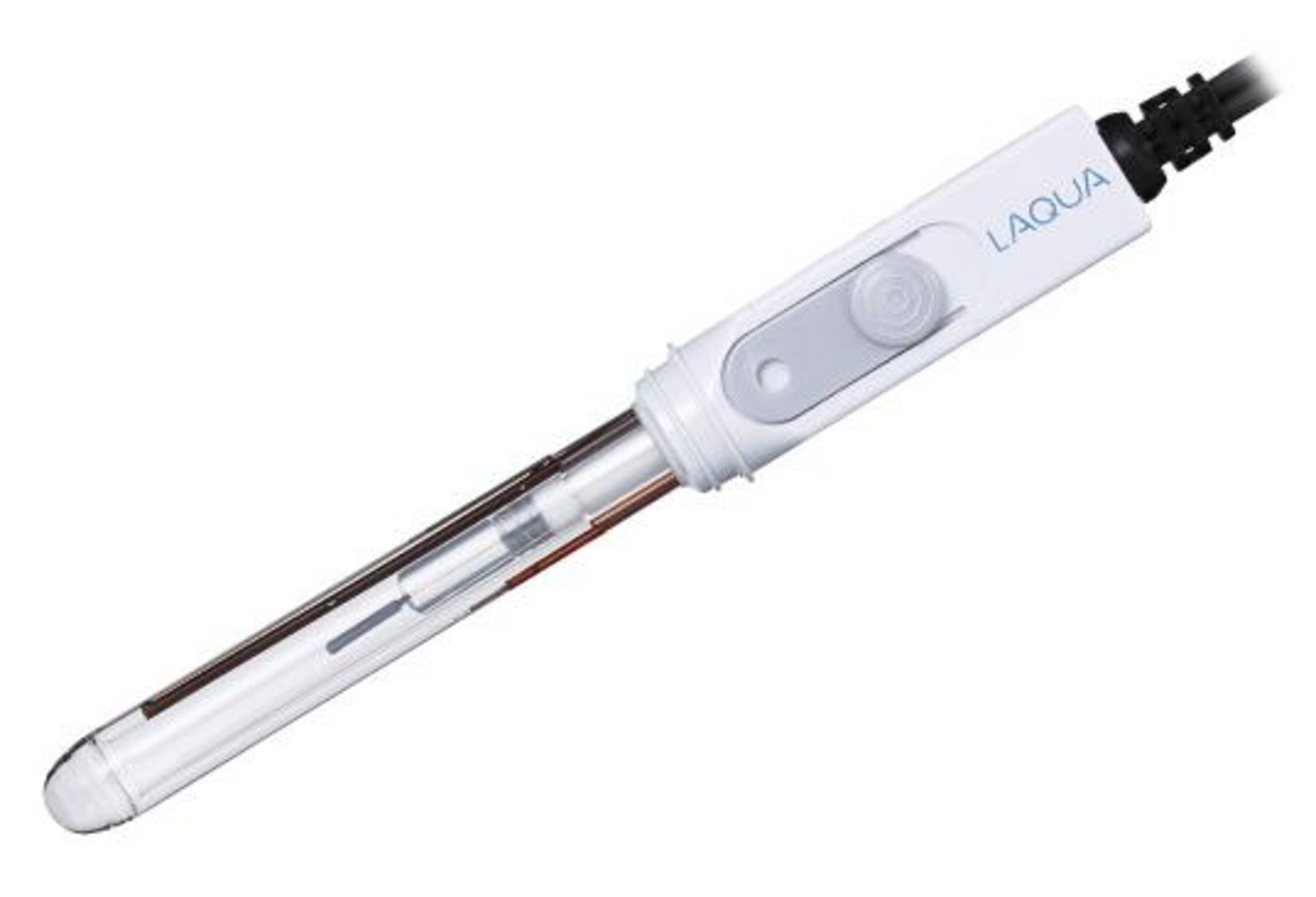
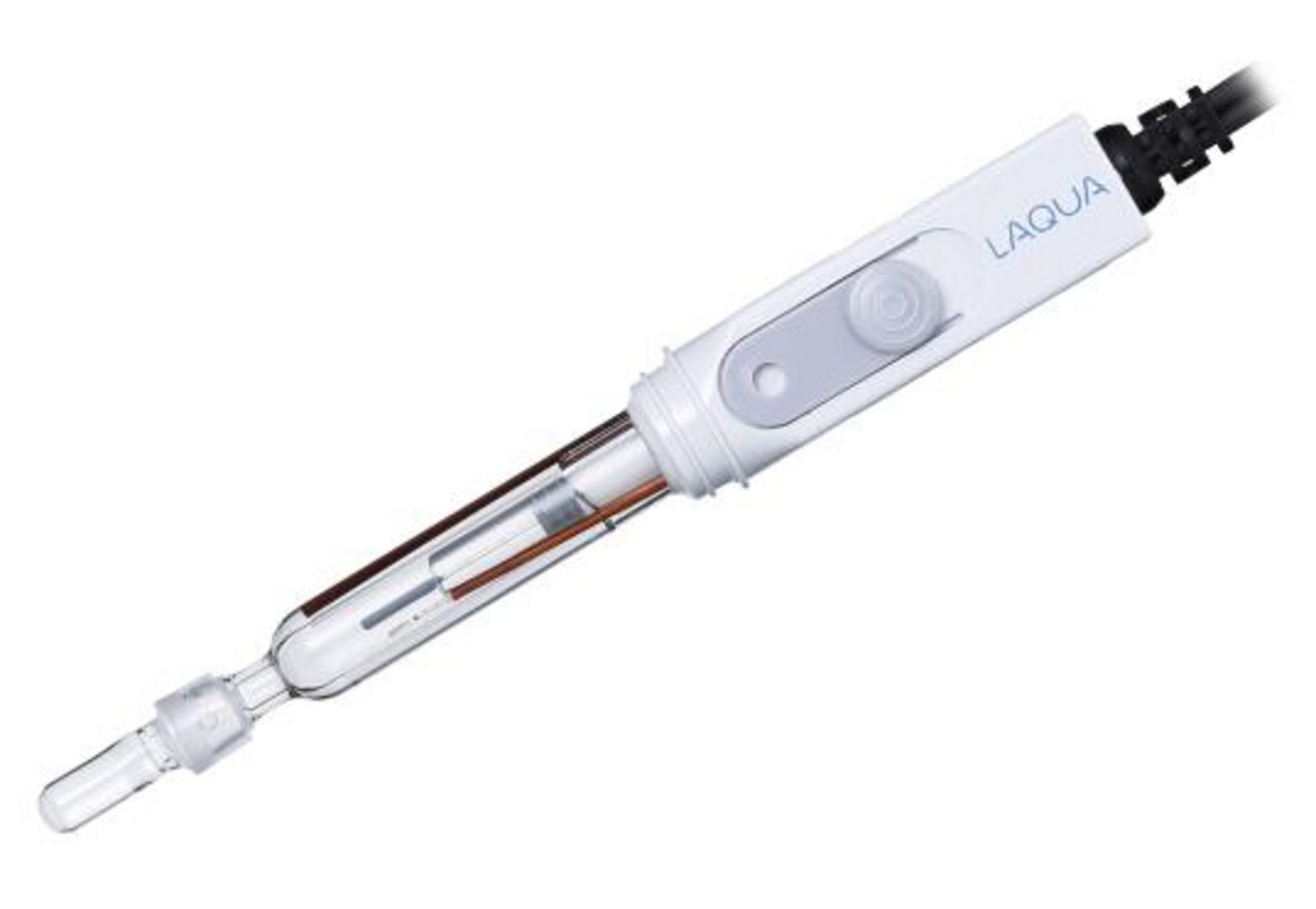
Two electrodes with different liquid junctions – 9615S-10D (ceramic) and 9681S-10D (sleeve)
pH measurement of a solution using a glass electrode works by measuring the potential difference generated between a glass electrode and a reference electrode across a liquid junction. A liquid junction1 is a fine aperture that allows internal solution to flow out from the electrode, thus establishing electrical contact between the reference electrode and the sample of interest. HORIBA’s 9615S-10D electrode is an example of a glass electrode with a ceramic liquid junction.
Samples that contain organic solvents tend to generate a junction potential, which occurs at the junction of the reference electrode and happens due to differences in electrolyte properties. It often takes time for the value to stabilize.
For pH measurements in organic media, selecting an electrode with a sleeve junction is recommended to suppress the development of erratic junction potentials. The high flow rate of reference internal solution in sleeve junctions ensures a stable electrical interface, resulting in a more responsive measurement. An example of this is HORIBA’s 9681S-10D electrode.
As a comparison, in a ceramic-type reference electrode, the level of internal solution decreases at a rate of 0.1 – 1.0 mm/hr^, whereas for a sleeve-type reference electrode, the level of internal solution decreases at a rate of 0.5 – 8.0 mm/hr^, and the rate of decrease varies depending on how the sleeve is closed.
^ values were determined experimentally in HORIBA’s laboratory.
This application note is adapted from the original technical note, ‘Responsiveness and stability when measuring organic solvents,’ published by HORIBA Japan.
The calibrated 9615S-10D and 9681S-10D electrodes were used to measure a 30% ethanol solution for 100s, under constant stirring at 25°C.
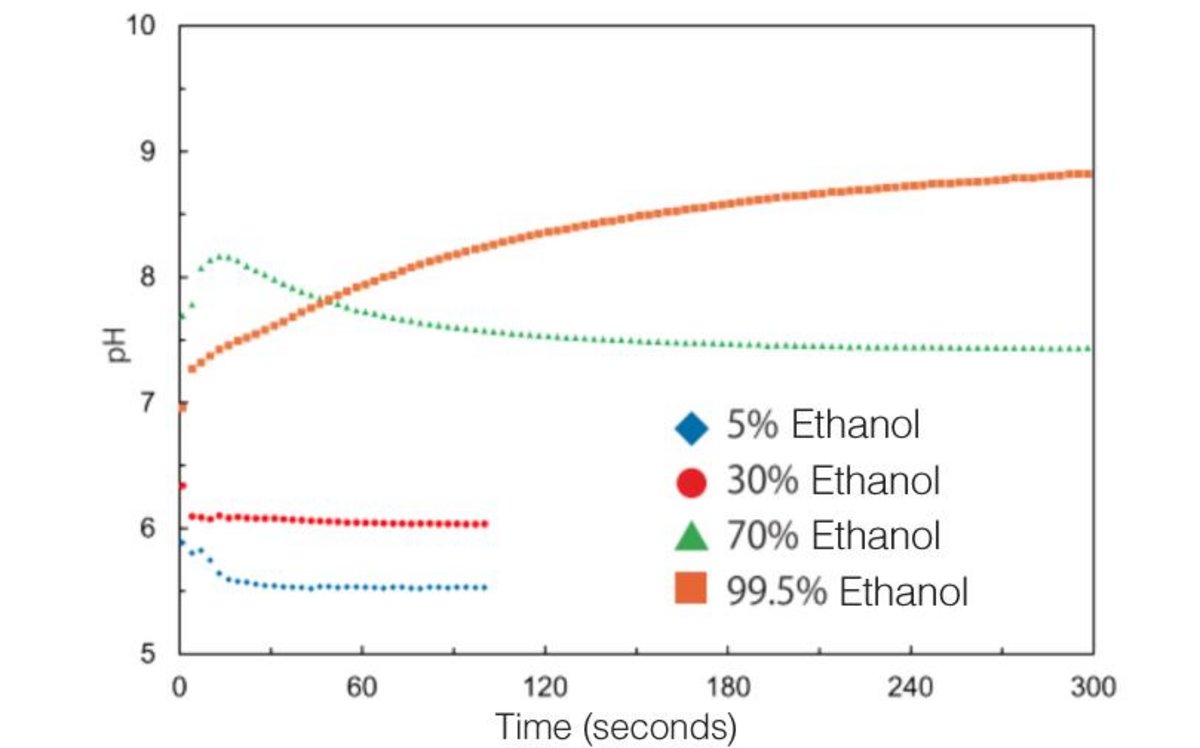
Using the same 9681S-10D sleeve electrode in Experiment 1, varying concentrations of ethanol (5%, 30%, 70%, 99.5%) at 25°C were measured until the pH readings stabilized. Ethanol was measured and diluted with deionised water using a graduated cylinder.
Figure 1: Comparison of pH readings of 9615S-10D and 9681S-10D in 30% ethanol solution
From Figure 1, it is observed that even though both pH electrodes were able to produce a final reading of approximately pH 6.0 after 100 seconds, the 9615S-10D took about 50 seconds for the pH value to begin stabilizing, with minor fluctuations in readings being observed until the end of the 100 seconds. In contrast, the 9681S-10D took roughly 20 seconds for the pH values to stabilize and remained stable till the 100 second mark when the experiment ended. This is attributed to the presence of the sleeve junction suppressing the development of junction potentials, which results in improved stability of pH measurements when using the 9681S-10D, as compared to the 9615S-10D. Based on this, it is recommended to use the 9681S-10D for reproducible and stable pH measurements in samples that contain organic solvents.
Figure 2: pH readings using the 9681S-10D in varying ethanol concentrations over time
Figure 2 summarizes the results from Experiment 2. Good response was observed for the 5% and 30% ethanol solutions as pH measurements stabilized within 60 seconds. The solution of 70% ethanol required slightly more time, approximately 120 seconds, before the pH value stabilized, and it was observed that the pH measurement value for 99.5% ethanol solution was still slightly trending upward and unable to fully stablilise, even after 300 seconds. Based on Figure 2, there seems to be a proportional relationship between the ratio of organic solvent present and time taken to obtain a stable pH reading. As the ratio of organic solvent increased from 5% to 99.5%, the time it took to achieve a stable pH reading also increased. Hence, for pH measurements involving organic solvents, it is recommended that the sample contain a sufficient aqueous fraction to ensure stability of the liquid junction potential, thereby producing a reliable and stable electrode response.
It should be noted that for aqueous solutions, a pH of 7 is considered neutral, as the activities of hydrogen (H+) and hydroxide (OH-) ions are equal. However, in organic solvents, this neutral point shifts due to variations in the dielectric constant2 and autoprotolysis constant. These properties alter proton behaviour and the relative pH scale of the solvent system. Consequently, for organic media, pH should be treated as a relative indicator of proton activity, rather than an absolute measurement.
When glass sleeve junction electrodes like the 9681S-10D are used for measurements involving organic media, extra care and maintenance is needed to ensure that the glass membrane of the pH electrode does not get dehydrated. To maintain electrode integrity, ensure that the sample contains a minimum aqueous fraction, and contact time with the sample should be kept to a minimum wherever possible. Following measurement, the electrode should be rehydrated by soaking in pH buffer or KCl solution to condition it after use3. A dehydrated membrane leads to increased electrical resistance4, thereby resulting in sluggish and unstable electrode response.
| 1 | HORIBA. (n.d.). Detector (Reference electrode, Temperature-compensation electrode, Combination electrode). HORIBA Water & Liquid. Retrieved November 20, 2025, from https://www.horiba.com/sgp/water-quality/support/electrochemistry/the-basis-of-ph/measuring-ph-using-a-glass-electrode/detector-reference-electrode-temperature-compensation-electrode-combination-electrode/ |
| 2 | Li, W., Zhang, Z., Han, B., Hu, S., Xie, Y., & Yang, G. (2007). Effect of water and organic solvents on the ionic dissociation of ionic liquids. The Journal of Physical Chemistry B, 111(22), 6452–6456. |
| 3 | HORIBA. (n.d.). Determination of pH in non-aqueous solutions.Retrieved November 21, 2025, from https://www.horiba.com/sgp/water-quality/applications/general/determination-of-ph-in-non-aqueous-solutions |
| 4 | Ge, N., Banerjee, R., Muirhead, D., Lee, J., Liu, H., Shrestha, P., ... & Bazylak, A. (2019). Membrane dehydration with increasing current density at high inlet gas relative humidity in polymer electrolyte membrane fuel cells.Journal of Power Sources, 422, 163–174. https://doi.org/10.1016/j.jpowsour.2019.03.001 |
| 5 | HORIBA Advanced Techno. (n.d.). Responsiveness and stability when measuring organic solvents (Technical Note). https://www.horiba.com/jpn/water-quality/support/technical-note/4031/ |
Revision 0, 23 April 2026
Do you have any questions or requests? Use this form to contact our specialists.