Perovskite solar cells (PSCs) are next-generation thin-film photovoltaics utilizing crystal-structured materials to achieve high efficiency (over 26%), low-cost manufacturing, and mechanical flexibility. These cells are promising alternatives to silicon, offering tunable bandgaps for tandem applications, though they currently face challenges regarding long-term stability and commercial scalability. Achieving large area, homogeneous perovskite films under ambient conditions remains one of the biggest bottlenecks on the pathway to industrializing perovskite solar technologies. A research team led by Prof. Ting Zhang and Prof. Shibin Li at the University of Electronic Science and Technology of China reports a breakthrough: 10 x 10 cm perovskite films fabricated under ambient conditions with excellent uniformity, low defect density, and high power-conversion-efficiency using a pyrrodiazole (PZ) additive during slot die coating.
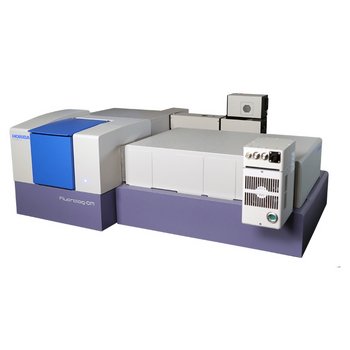
The authors utilized photoluminescence (PL) spectroscopy and PL mapping to investigate homogeneity, grain structure, and defect behavior. These measurements were enabled by HORIBA’s Fluorolog 3, predecessor of the Fluorolog-QM—a modular fluorometer with excellent stray light rejection, ideal for strongly scattering solid state samples such as perovskite thin films.