Microplastics Solutions

Microplastics

Microplastics Analysis

Solutions for a better life

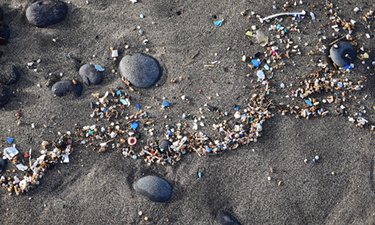
Microplastics have become a global environmental concern, present in oceans, rivers, soil, and even the air we breathe. Indeed, understanding their nature and behavior is essential to evaluate their impact on ecosystems and human health.

HORIBA provides advanced technologies for microplastic analysis, offering accurate, reliable, and comprehensive characterization of these complex particles. With decades of expertise in Raman spectroscopy and particle analysis, HORIBA supports researchers and industries worldwide in identifying, quantifying, and understanding microplastic pollution to build a cleaner, more sustainable future.

Characterization of Microplastics video teaser

See the complete 26-minute video with the link below. It features an extensive demonstration of HORIBA solutions for micro and nano plastics characterization, including all the steps, from sample preparation to data analysis, using both Raman and AFM techniques.

Solutions in action

Watch and read scientists working on microplastics with:

  • Testimonials
  • Science in Action articles

Resources

Microplastics applications
  • Webinars
  • Application Notes
  • Downloads

Educative content

Open-access e-learning modules to deepen the knowledge microplastics analysis.

Microplastics definition

What are they?

Microplastics are any solid synthetic polymer particle insoluble in water measuring between 1 µm and 5 mm. They are either intentionally produced or formed through the breakdown of larger plastic debris. These persistent fragments have been detected across ecosystems and food chains, from marine organisms to soil, rainwater, and even everyday products like salt, sugar, beer, and honey.

Monitoring them requires sophisticated workflows involving sampling, pretreatment, filtration, and analytical techniques such as Raman microscopy. Addressing microplastic pollution thus calls for both improved detection and a reduction in plastic use, as current regulations lag behind the scale and complexity of this global issue.

Read more in the what are microplastics? article from the Science in Action series.
 

What is their origin?

Microplastics originate from a variety of everyday sources that break down into tiny plastic particles. One of the largest contributors is synthetic textiles. However, automotive tires and simple city dust are other major sources, and even more come from other very mundane objects.

These particles not only persist in the environment but may also absorb harmful chemicals and pose a risk to marine life and ecosystems by entering food chains.

Read more in the where do microplastics come from? article from the Science in Action series.
 

To learn more about microplastics, download our ebook:

  • Provides you with an overview of the Microplastics world
  • Explains and details the protocols for sample preparation
  • Summarizes the measurement techniques available and their Pros and Cons
  • Helps you understand Microplastic analysis tips and tricks
  • Keeps you up to date. It will be updated twice a year with new protocols, and other information.
     

Microplastics analysis workflow

Microplastics Analysis

A typical analysis workflow for microplastics separation, counting and identification by means of spectroscopic techniques requires five main steps: sampling, sample preparation or sample pretreatment, filtration, measurement/data acquisition, and finally, analysis/report.

1. Sampling

The Sampling step involves the collection of a matrix and/or different matrices where the microplastics presence must be investigated.

2. Sample preparation

Sample pretreatment is one of the most important steps, since it can influence the accurate identification of the microplastics during the measurement step. Indeed, the contribution of the matrices (and all the organic contaminants within them) that can interfere with the microplastics identification must be eliminated.

3. Filtration

Filters must be carefully selected, considering the wide variety available. Three main characteristics must be considered: filter size (microplastic concentration, analysis time etc… are driving the choice), filter material (the measurement technique that is tuning this) and pore sizes (which microplastic size we want to analyze).

4. Measure/Data acquisition

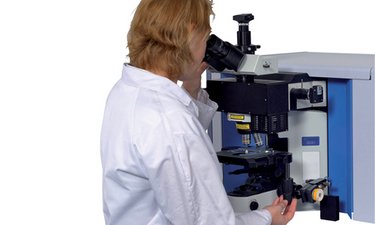
This is the chemical/morphological identification of the microplastics by the technique of choice. We propose Raman microscopy, which allows the identification of organic and inorganic particles and assures the analysis of particles from the macro (1 to 5 mm), down to the micron and sub micron ranges.

5. Analysis & Reporting

Software is a key point for data manipulation and for presenting the results. HORIBA provides fully automated ease-of-use particle analysis software called ParticleFinder, combined with IDFinder, a particle identification software.

HORIBA solutions

The HORIBA bundle

Considering the Microplastic analysis workflow and the needs and challenges facing scientists approaching it, we developed a full solution to help our existing and future users by providing all the tools needed in a single bundle.

Filtration kit
A filtration apparatus to get started with Microplastic analysis.
 

Filters, filter holder and VRM (Video Raman Matching)
A box of Silicon filters with a dedicated holde, developed and optimized for square filters to facilitate the analysis.

A VRM (Video Raman Matching) stage with patented NanoGPS technology to confidently localize your particles down to the minimum size range allowed.
 

Microplastics standard
A set of tablets with a mixture of polymer particles of known size distribution and number to validate your lab environment and workflow.
 

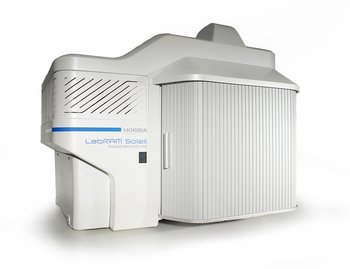
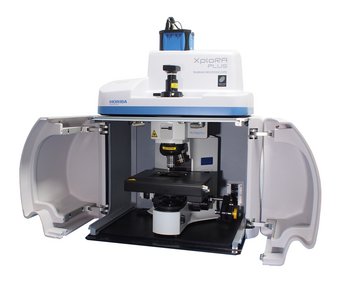
Choice of two Raman platforms

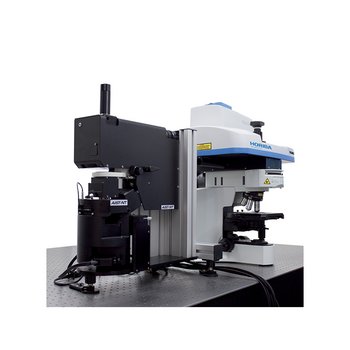
XploRA™ PLUS
Raman Spectrometer - Confocal Raman Microscope 

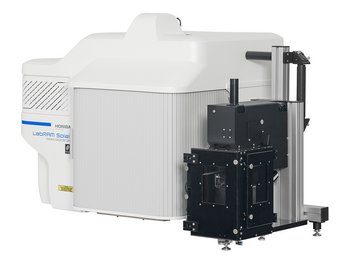
LabRAM Soleil
Raman Microscope

Both Raman microscopes can be equipped with a standard detector (CCD - Charge Couple Device) or imaging detector (EMCCD - Electron Multiplied Charge Couple Device).

LabSpec 6 is the software platform common to both systems for complete instrument control and data processing, along with additional tools in the Microplastic package. It includes:

  • ParticleFinder™
    ParticleFinder™ offers a user friendly tool for automated location, characterization and Raman analysis of particles. Hundreds or thousands of particles can be quickly located on a video image, analyzed for size and shape descriptors, and then chemically characterized using Raman spectroscopy.
     
  • IDFinder™
    IDFinder™ is an essential tool for managing spectral libraries and automatically identifying thousands of spectra directly in ParticleFinder™ interface. Each spectrum is compared with a dedicated spectral library and a matching coefficient called Hit Quality Index (HQI) is attributed. The component with the highest HQI is recognized as chemical identity of the particle.

All Microplastics products

LabRAM Soleil
LabRAM Soleil

Raman Spectroscope - Automated Imaging Microscope

XploRA™ PLUS
XploRA™ PLUS

MicroRaman Spectrometer - Confocal Raman Microscope

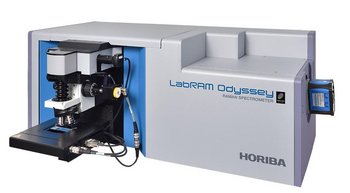
LabRAM Odyssey
LabRAM Odyssey

Confocal Raman & High-Resolution Spectrometer

LabRAM Soleil Nano
LabRAM Soleil Nano

Real-time and Direct Correlative Nanoscopy

XploRA Nano
XploRA Nano

AFM-Raman for Physical and Chemical imaging

ParticleFinder
ParticleFinder

Automated Particle Measurement, Identification and Classification using Raman Analysis

IDFinder
IDFinder

Spectral Identification Assistant within Raman Spectra Database

ViewSizer 3000
ViewSizer 3000

Simultaneous Multispectral Nanoparticle Tracking Analysis (NTA)

HORIBA solution in action!

Testimonials

Elisabetta Giorgini and Valentina Notarstefano, Polytechnic University of Marche (Ancona, Italy)

Elisabetta Giorgini and Valentina Notarstefano, Polytechnic University of Marche (Ancona, Italy)

“...In our study, for the first time, microplastics were detected in human placenta, an organ that is not directly involved in any kind of exposure. This makes us conscious of how ubiquitous MPs are and makes mandatory to further investigate the presence of MPS in all human districts... ...The choice of a HORIBA spectrometer was based by comparing the top-quality instrumentation commercially available and also by our personal experience...”

Read more...

Microplastics Researcher Videos

Microplastics explained part I

Dr. Chelsea Rochman breaks down what we know, what we don’t, and what we want to know. Alterra Sanchez describes the big risks and factors involved. 

Microplastics explained part II

What is Dr. Chelsea Rochman doing with microplastics? Part II gives us a look into the Rochman Lab and the work being done there. Alterra Sanchez tells us the importance of her research as well. 

Raman XPerience Newsletter - Microplastics pollution

Our special issue of HORIBA's Raman XPerience newsletter reviews articles recently published by our customers and highlights the contribution of HORIBA instrumentation to understanding human exposure to microplastic pollution. You can also download the full newsletter here.
 

Featured application note highlighting microplastics analysis in cosmetics products

Using the example of hand sanitizer, this application note demonstrates how to evaluate whether the product contains synthetic polymer microparticles covered by Microbeads ban.
 

Science in Action article

Microplastics: a big problem for the environment

Resources

Microplastics webinars

Watch the webinar: Microplastics in Air and Food: Tackling Human Exposure with Raman Spectroscopy

Microplastics in Air and Food: Tackling Human Exposure with Raman Spectroscopy

In 2022, the World Health Organization (WHO) reported a lack of reliable data on microplastics in food and air, urging standardized analysis, better data collection, and more research on health effects. The report emphasized the need to study microplastic particles smaller than 10 µm, as they may pose greater health risks.
Three years on, meaningful progress has been made. In this webinar, we will discuss the latest developments in microplastics analysis, the existing protocols for monitoring contamination in food and air, and HORIBA’s contributions to advancing this field.

Watch the webinar: Microplastics characterization by Raman microscopy

Microplastics characterization by Raman microscopy

Microplastics are becoming the 21st century environmental scourge. To control it, more and more regulations are being set in all countries worldwide to monitor the amount of microparticles released in the environment. Thus, some techniques have been identified as reference methods: Pyrolysis GC-MS, Infrared microscopy, and Raman microscopy. This last one provides the best combination of information in both morphological and chemical characterization of each particle down to the micron.
During this webinar, we presented how Raman microscopy is becoming the best reference method for microplastics characterization.

Microplastics application notes

Microplastics downloads

Educative content

Free e-learning modules on microplastics analysis

PlasticTrace aims to address the urgent need for the development and harmonisation of methods for the chemical identification, physical characterisation, and quantification of released small micro- and nanoplastics (SMPs/NPs) in drinking water, food, and environmental matrices, as required by the EU’s Circular Economy Action Plan (CEAP).

As part of its knowledge dissemination activities, the PlasticTrace project has launched a series of open-access e-learning modules designed to help scientists, students, and professionals deepen their understanding of micro- and nanoplastics analysis.

Access the PlasticTrace e-learning modules for free here: https://plastictrace.eu/elearnings/

HORIBA is proud to participate in this great initiative.

Explore Module 6, dedicated to the Raman analysis of small microplastics and nanoplastics:

The project has received funding from the European Partnership on Metrology, co-financed from the European Union’s Horizon Europe Research and Innovation Programme and by the Participating States.

Pedido de Informação

Você tem alguma dúvida ou solicitação? Utilize este formulário para entrar em contato com nossos especialistas.

* Esses campos são obrigatórios.

Corporate