
HORIBA Scientific and Analytical Instruments
Märkte
Corporate Webseite
  • Corporate
Marktwebseite
  • Mobility
  • Energy and Environment Solutions
  • Life Science
  • Healthcare
  • Materials
  • Semiconductor
Länder/Regionen
Amerika
  • Brazil / Brasil
  • United States / United States
Asien
  • China / 中国
  • India / India
  • Japan / 日本
  • Korea / 한국
  • Singapore / Singapore
  • Taiwan / 台灣
  • Thailand / ประเทศไทย
  • Vietnam / Việt Nam
Europa
  • Austria / Österreich
  • Czech Republic / Česko
  • France / France
  • Germany / Deutschland
  • Poland / Polska
  • Russia / Россия
  • Spain / España
  • Türkiye / Türkiye
  • United Kingdom / United Kingdom
Global
  • International
Suche
HORIBA Scientific and Analytical Instruments

Kontakt

Standorte

  • A giant leap in fuel cell engineering
  • AFIS key to catching crook in unlikely match
  • The Alchemist’s Factory – A Particle Characterization Story
  • Alternative light sources and AFIS help identify murder suspects
  • An act of mercy in Baltimore
  • Astrobiologist/Geobiologist uses Earth as a lab to examine possibility of extraterrestrial life
  • A-TEEM™ and fluorescence spectroscopy may offer a better way to feed the world
  • Can Raman microscopy reveal art forgeries?
  • Carbon black lightens your wallet
  • Chilean grape and wine quality assessment with Aqualog A-TEEM analyses
  • Cleaner water through fluorescence spectroscopy and artificial intelligence
  • Companies collaborate for better water treatment
  • Cryogenics and Multimodal Microspectroscopy — Filtering out the Noise
  • Designing a new breed of nuclear reactors
  • Detecting early signs of cancer with Raman microscopy
  • Detection of smoke taint in grapes and wine
  • Developing in-situ, online monitoring tools for radioactive materials using fluorescence spectroscopy
  • Discovering the origins of life
  • "Disruptive" carbon research deepens climate change understanding
  • Drilling deep to discover life
  • Duetta: fluorescence and absorbance - in the blink of an eye
  • Elemental analysis and a cold brew
  • Exploring biogeochemical cycles, speciation, and primary productivity in the ocean using fluorescence spectroscopy
  • Exposing Counterfeit Drugs
  • Finding ancient life through minerals on earth and beyond
  • Fine wine-making with the help of HORIBA tech
  • Fingerprint database leads to killers
  • Fluorescence sensors contribute to biological and display technologies
  • Fluorescence Spectroscopy: An Alternative to Chromatography in Enhancing the Flavor of Foods
  • Fluorescence spectroscopy becoming key to identifying pain
  • Fluorescence spectroscopy exposes carbon cycle changes
  • Fluorescence spectroscopy exposes carbon cycle changes
  • Fluorescent carbon nanodots: making foldable displays
  • Forensic light sources nab the suspects
  • Glucose Binding Molecules could revolutionize diabetes management
  • The Grape Identity Crisis and How Spectroscopy Separated History’s Most Confusing Cultivars
  • Health benefits of olive oils get boost
  • Historic carbon fluctuations could expose climate change secrets
  • How do thin films help NASA uncover the secrets to the universe?
  • How fusion breakthroughs will lead to clean renewable energy
  • How to measure temperature with light
  • How we customized a spectroscopy solution in the low UV range
  • Investigating missing carbon in Australian caves
  • Ionic Liquids as a Breakthrough for Resource Recycling Issues
  • Is this the next breakthrough in medicine?
  • Killing cancer with lanthanides and air
  • Launch of Mars 2020 to explore Mars using XRF
  • Leading the World with All-Solid-State Batteries
  • Low cost solar power on the horizon
  • Man of science follows business path
  • Making better gas turbines
  • Making carbon nanotubes more accessible
  • Making more efficient solar energy
  • Materials characterization crucial in Silicon Valley systems
  • Medical examiner department ID’s evidence with alternative light sources
  • Micro-XRF uncovers secrets to Van Gogh’s brilliance
  • Microplastics: a big problem for the environment
  • Microplastics explained
  • Mishaps and ski trip lead to laser revolution
  • Museum’s mineral studies improving life
  • MXenes are revolutionizing nanotechnology with the help of Raman Spectroscopy
  • Nano-scale research and technology leads to advanced materials development
  • Nanotechnology a pathway to efficient solar energy
  • Optimizing Wastewater Treatment in South Africa: A-TEEM Fluorescence Spectroscopy for BOD Analysis Amidst Economic Pressures
  • Mars life signs probed by spectroscopy
  • Photodynamic therapy – A non-toxic way to fight cancer
  • Photoluminescence contributes to staggering growth of photovoltaics
  • Photovoltaics and photoluminescence
  • Raman breakthrough recovers erased serial numbers from plastic guns
  • Raman and X-ray fluorescence spectroscopies reveal the mysteries behind ancient Japanese art form
  • Raman gets the goods on counterfeiters
  • Raman spectroscopy breakthroughs make CSI real
  • Research into ion transport through cell membranes aided by fluorescence spectroscopy
  • Researcher fights food fraud
  • Researcher developing (non) linear nano-optical methods to characterize heterogenous interfaces
  • Researcher traces path of potentially toxic nanoparticles
  • Scientist pioneers wastewater treatments to fight global warming effects
  • Should you be worried about nanotoxicity?
  • SPEX Forensics algorithms used to solve cold cases
  • Study validates fluorescence spectroscopy with A-TEEM for fast and precise wine authentication
  • Targeting toxic waste with minerals
  • The ARC Program: Forging Appalachia's Future Workforce
  • The baker’s son
  • The best nanoparticle
  • The mystery of gemstone colors has finally been revealed
  • The science of food
  • Thin film analysis reveals secrets to renewable energy
  • Tracing toxic heavy metals in organisms using X-ray fluorescence (XRF)
  • Understanding two-dimensional material interfaces with AFM Raman/TERS will transform computing
  • Unlocking the Secrets of the Deep Ocean’s Carbon Engine
  • Using AFM-Raman to understand defects in two-dimensional semiconductor materials
  • Using low temperatures to probe 2D materials for device applications
  • Using renewable and alternative sources for value-added products production
  • Versatile Aqualog saves chemical costs at treatment plants
  • Weeding out Over-the-Counter Frauds
  • Welcome to the dawn of a paradigm shift in technology
  • What are microplastics?
  • Where do microplastics come from?
  • Yellowstone’s treasures may hold clues to life
  1. Home
  2. Scientific
  3. Ressourcen
  4. How we customized a spectroscopy solution in the low UV range

How we customized a spectroscopy solution in the low UV range

The United States Naval Research Laboratory (NRL) faced a challenge. It wanted to conduct photoemission spectroscopy in the extreme low UV range using a tunable light source. It’s a difficult application. No off-the-shelf instruments existed to achieve its goals.

The lab’s end game was to study high band gap materials in semiconductors. In an organization that ultimately develops warships, the specific reasons for the research remain a mystery. But one can deduce the aim was to increase the efficiency of semiconductor materials.

Photoemission spectroscopy (PES) is one of the most extensively and efficiently used methods to explore the electronic structure of atoms, molecules and solids. If a molecule is excited by a high-energy photon in the ultraviolet region of the spectrum that has sufficient energy to ionize the molecule, the excited species will eject electrons. PES is the analysis of the kinetic energies of the ejected electrons, according to John Holmes in the Encyclopedia of Spectroscopy.

The NRL identified a laser light source that would get it to these low frequencies of 177 nm to 2100 nm. The lab approached HORIBA near the end of 2018. It was looking for a spectrometer it could adapt to the light source and its sample chamber. The NRL planned to build its own system.

HORIBA is a high-end supplier of spectrometers, so it was a logical step for the NRL. But HORIBA offered something more. As a systems integrator, HORIBA builds custom systems to meet researchers’ unique needs.
Challenges

“They were looking for a company that can supply the spectrometer, as well as the coupling optics that would be compatible in this UV range,” Francis Ndi, Ph.D. and Product Line Manager for HORIBA’s Optical Spectroscopy Division said. “But when they contacted us, they found out that we've done a similar light source before.”

The light source was a demanding component to integrate. It’s a laser-driven xenon lamp with special technology that enables it to go down to low wavelengths. UV light sources are finicky and fragile in this range. These need special cooling and other physical requirements.

But this particular light source is not fragile, Ndi said. That is the novelty of light source itself.

“Not only are we able to provide the light source, we were able to provide all the relevant UV coupling uptakes, both input and output,” he said.

As a system integrator, HORIBA could both design custom components and assemble them.

French connection

“We were able to leverage some components that we made here in the US,” Ndi said. “We leveraged some technologies in the VUV that are developed in our French office, HORIBA France SAS, to put together a unique tunable light source solution.”

HORIBA’s French office played a key role. It is HORIBA’s Center of Excellence for vacuum UV (VUV) components. These components are challenging. That's because there are few UV light sources. And most materials absorb the wavelengths.

The system design had complicated needs. HORIBA had to design optics to optimize reflection or transmission of the UV light. For a reflective system, it needed special coatings optimized for this wavelength. That includes the input optics, the coupling optics, the output optics and the actual spectrometer optics, the gratings and the mirrors in the spectrometer.

HORIBA used UV optimized MgF2 coatings - magnesium fluoride - MgF2 - provides minimum reflectance with only a single layer film. MgF2 becomes a hard durable coating when applied at a high temperature.

The result was a tunable user/software controlled tunable UV light source.

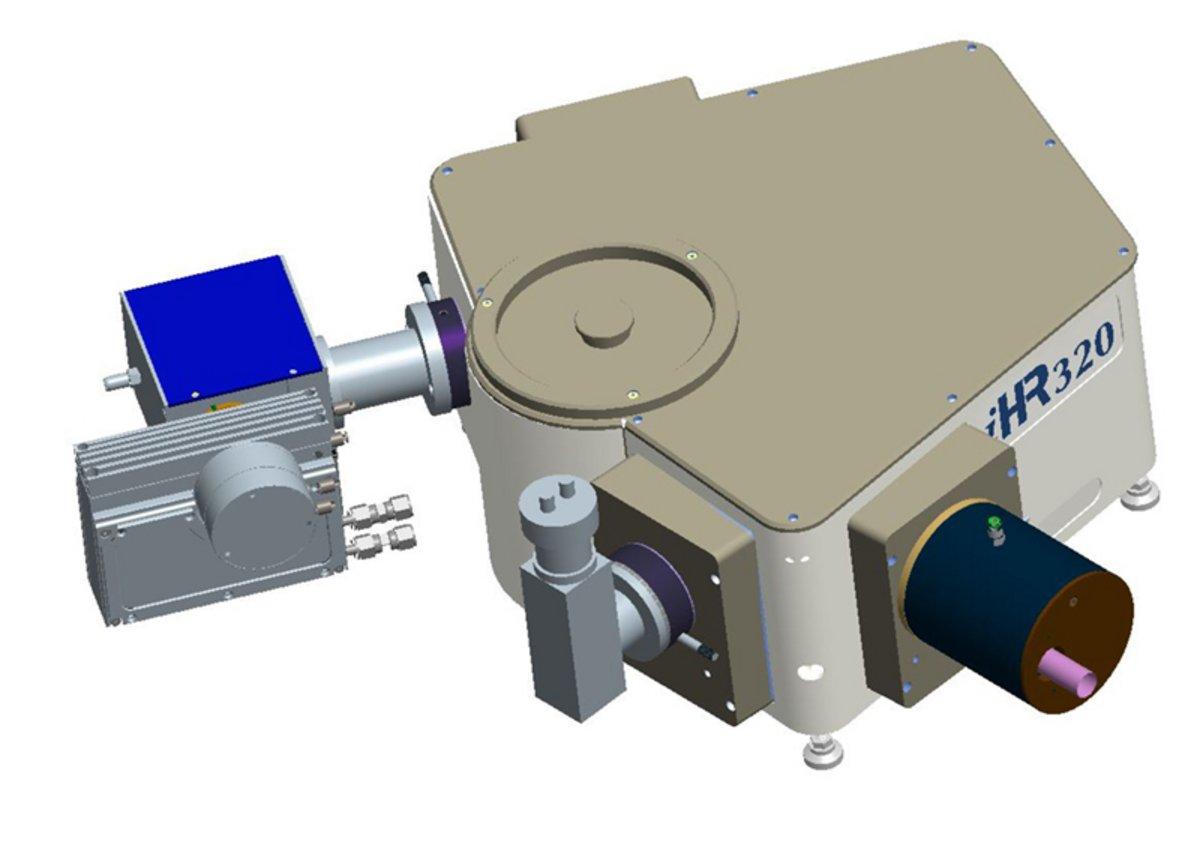
HORIBA used its popular IHR 320 Spectrometer as the heart of the customized system.

Fast turn around

custom spectrometer designed and built by HORIBA Scientific
A CAD rendering of the custom spectrometer designed and built by HORIBA Scientific for the Naval Research Lab

The NRL first approached HORIBA in the fourth quarter of 2018. Within a month, HORIBA had generated a system design and created a CAD model of the system. That gave NRL scientists a visualization of the instrument before HORIBA built the system. The deal closed in 30 days, and the instrument shipped early in 2019.

HORIBA had to address some unknown parameters along the way. The system had to integrate a third-party light source. The light source sent to HORIBA deviated from the drawing from the lamp vendor. HORIBA had to adapt its design to accommodate a different light source orientation.

“Customization and system integration is a very dynamic process,” Ndi said.

The system had to take into account the lab’s existing sample chamber. It also had to fit within a designated space.

“We have a history of doing these kinds of thing because we have developed similar light sources in the past,” Ndi said. “That's what gave them the customer confidence now to say, ‘Why should I try to do this as a first-timer, versus having HORIBA do it for me with the level of experience that they have doing these things.’”

The instrument aims to separate specific wavelengths and pass it along to its specialized application. That process of separation through a monochromator is challenging because, in the UV, almost everything is absorbed. To have a spectrometer do this, you have to capture as much light as feasible. It needs special optics to collect the maximum possible light from the light source.

The optics in the spectrometer need specialty coatings. These could not absorb or lose light as the spectrometer separates different wavelengths. It needs the same kind of optics when the light exits. When it does, the same optimized optics are necessary to send most of this light to the sample.

“That’s what we are bringing to the table,” Ndi said. “We didn't make the light source, but we can bring up all the connective tissue to take light from the source it and send it to the sample.”

HORIBA packaged a spectrometer, a specialized light source, and all the components that interface with the light source. That included the software and computer to operate the instrument. The collaboration went from a component sale to a full-blown system.

“We have to show the customer that not only can we put this together, but we can answer all the uncertainties as to how this will fit into whatever they are trying to do,” he said.

The United States Naval Research Laboratory provides advanced scientific capabilities to bolster the country’s global naval leadership. It is the corporate research laboratory for the United States Navy and the United States Marine Corps. It handles basic scientific research, applied research, technological development, and prototyping.

Follow Us 


Informationsanfrage

Sie haben Fragen oder Wünsche? Nutzen Sie dieses Formular, um mit unseren Spezialisten in Kontakt zu treten.

* Diese Felder sind Pflichtfelder.

Produkte/Segmente

  • Alle Produkte (A-Z)
  • Mobility
  • Energy and Environment
  • Life Science
  • Healthcare
  • Materials
  • Semiconductor

Anwendungen

  • Trinkwasser Versorgung
  • Automobil Herstellung
  • Halbleiter Herstellung
  • Forschung & Testlabore

Technologien

  • Glimmentladungsspektroskopie
  • Quadrupol-Massenspektrometrie
  • Raman-Spektroskopie

Service

  • Unterstützung vor Ort
  • Ersatzteile und Verbrauchsmaterialien

Unternehmen

  • Nachrichten
  • Veranstaltungen
  • Karriere
  • Geschichte
  • Unternehmenskultur

Kontakt

  • Karriere Kontakt
  • Kontakt Formular
  • Weltweite Standorte
  • Investor Relations-Kontakt

Terms and Conditions Datenschutzerklärung Cookies Impressum HORIBA Group Social Media

© Copyright 2026 - All Rights Reserved