HORIBA Scientific and Analytical Instruments
Explore HORIBA
Unternehmen
  • HORIBA-Gruppe
Märkte
  • Mobility
  • Energy and Environment
  • Life Science
  • Healthcare
  • Materials
  • Semiconductor
Länder/Regionen
Amerika
  • Brazil / Brasil
  • United States / United States
Asien
  • China / 中国
  • India / India
  • Japan / 日本
  • Korea / 한국
  • Singapore / Singapore
  • Taiwan / 台灣
  • Thailand / ประเทศไทย
  • Vietnam / Việt Nam
Europa
  • Austria / Österreich
  • Czech Republic / Česko
  • France / France
  • Germany / Deutschland
  • Poland / Polska
  • Russia / Россия
  • Spain / España
  • Türkiye / Türkiye
  • United Kingdom / United Kingdom
Global
  • International
Suche
HORIBA Scientific and Analytical Instruments

Kontakt

Standorte

  • A giant leap in fuel cell engineering
  • AFIS key to catching crook in unlikely match
  • The Alchemist’s Factory – A Particle Characterization Story
  • Alternative light sources and AFIS help identify murder suspects
  • An act of mercy in Baltimore
  • Astrobiologist/Geobiologist uses Earth as a lab to examine possibility of extraterrestrial life
  • A-TEEM™ and fluorescence spectroscopy may offer a better way to feed the world
  • Can Raman microscopy reveal art forgeries?
  • Carbon black lightens your wallet
  • Chilean grape and wine quality assessment with Aqualog A-TEEM analyses
  • Cleaner water through fluorescence spectroscopy and artificial intelligence
  • Companies collaborate for better water treatment
  • Cryogenics and Multimodal Microspectroscopy — Filtering out the Noise
  • Designing a new breed of nuclear reactors
  • Detecting early signs of cancer with Raman microscopy
  • Detection of smoke taint in grapes and wine
  • Developing in-situ, online monitoring tools for radioactive materials using fluorescence spectroscopy
  • Discovering the origins of life
  • "Disruptive" carbon research deepens climate change understanding
  • Drilling deep to discover life
  • Duetta: fluorescence and absorbance - in the blink of an eye
  • Elemental analysis and a cold brew
  • Exploring biogeochemical cycles, speciation, and primary productivity in the ocean using fluorescence spectroscopy
  • Exposing Counterfeit Drugs
  • Finding ancient life through minerals on earth and beyond
  • Fine wine-making with the help of HORIBA tech
  • Fingerprint database leads to killers
  • Fluorescence sensors contribute to biological and display technologies
  • Fluorescence Spectroscopy: An Alternative to Chromatography in Enhancing the Flavor of Foods
  • Fluorescence spectroscopy becoming key to identifying pain
  • Fluorescence spectroscopy exposes carbon cycle changes
  • Fluorescence spectroscopy exposes carbon cycle changes
  • Fluorescent carbon nanodots: making foldable displays
  • Forensic light sources nab the suspects
  • Glucose Binding Molecules could revolutionize diabetes management
  • The Grape Identity Crisis and How Spectroscopy Separated History’s Most Confusing Cultivars
  • Health benefits of olive oils get boost
  • Historic carbon fluctuations could expose climate change secrets
  • How do thin films help NASA uncover the secrets to the universe?
  • How fusion breakthroughs will lead to clean renewable energy
  • How to measure temperature with light
  • How we customized a spectroscopy solution in the low UV range
  • Investigating missing carbon in Australian caves
  • Ionic Liquids as a Breakthrough for Resource Recycling Issues
  • Is this the next breakthrough in medicine?
  • Killing cancer with lanthanides and air
  • Launch of Mars 2020 to explore Mars using XRF
  • Leading the World with All-Solid-State Batteries
  • Low cost solar power on the horizon
  • Man of science follows business path
  • Making better gas turbines
  • Making carbon nanotubes more accessible
  • Making more efficient solar energy
  • Materials characterization crucial in Silicon Valley systems
  • Medical examiner department ID’s evidence with alternative light sources
  • Micro-XRF uncovers secrets to Van Gogh’s brilliance
  • Microplastics: a big problem for the environment
  • Microplastics explained
  • Mishaps and ski trip lead to laser revolution
  • Museum’s mineral studies improving life
  • MXenes are revolutionizing nanotechnology with the help of Raman Spectroscopy
  • Nano-scale research and technology leads to advanced materials development
  • Nanotechnology a pathway to efficient solar energy
  • Optimizing Wastewater Treatment in South Africa: A-TEEM Fluorescence Spectroscopy for BOD Analysis Amidst Economic Pressures
  • Mars life signs probed by spectroscopy
  • Photodynamic therapy – A non-toxic way to fight cancer
  • Photoluminescence contributes to staggering growth of photovoltaics
  • Photovoltaics and photoluminescence
  • Raman breakthrough recovers erased serial numbers from plastic guns
  • Raman and X-ray fluorescence spectroscopies reveal the mysteries behind ancient Japanese art form
  • Raman gets the goods on counterfeiters
  • Raman spectroscopy breakthroughs make CSI real
  • Research into ion transport through cell membranes aided by fluorescence spectroscopy
  • Researcher fights food fraud
  • Researcher developing (non) linear nano-optical methods to characterize heterogenous interfaces
  • Researcher traces path of potentially toxic nanoparticles
  • Scientist pioneers wastewater treatments to fight global warming effects
  • Should you be worried about nanotoxicity?
  • SPEX Forensics algorithms used to solve cold cases
  • Study validates fluorescence spectroscopy with A-TEEM for fast and precise wine authentication
  • Targeting toxic waste with minerals
  • The ARC Program: Forging Appalachia's Future Workforce
  • The baker’s son
  • The best nanoparticle
  • The mystery of gemstone colors has finally been revealed
  • The science of food
  • Thin film analysis reveals secrets to renewable energy
  • Tracing toxic heavy metals in organisms using X-ray fluorescence (XRF)
  • Understanding two-dimensional material interfaces with AFM Raman/TERS will transform computing
  • Unlocking the Secrets of the Deep Ocean’s Carbon Engine
  • Using AFM-Raman to understand defects in two-dimensional semiconductor materials
  • Using low temperatures to probe 2D materials for device applications
  • Using renewable and alternative sources for value-added products production
  • Versatile Aqualog saves chemical costs at treatment plants
  • Weeding out Over-the-Counter Frauds
  • Welcome to the dawn of a paradigm shift in technology
  • What are microplastics?
  • Where do microplastics come from?
  • Yellowstone’s treasures may hold clues to life
  1. Home
  2. Scientific
  3. Ressourcen
  4. Investigating missing carbon in Australian caves

Investigating missing carbon in Australian caves

Prof. Andy Baker
Prof. Andy Baker

For up to seven hours each day this past July, 17 students and teachers trekked on and off trails and into caves during a rugged, multiday expedition outside of Sydney, Australia. The trip included three hours of freeway and dirt-road driving. Their destination was the Wombeyan Caves, a part of Australia’s National Parks and Wildlife Service.

Their mission was to find missing carbon.

The class was led by Professor Andy Baker, Ph.D., Director of Research for the School of Biological, Earth and Environmental Sciences at the University of New South Wales in Sydney, Australia. He teaches environmental geoscience.

“Everyone is probably aware that human carbon dioxide emissions and land use changes have disturbed the natural carbon cycle,” Baker said. “This has led to rising atmospheric carbon dioxide levels and associated climate change.”

However, not all carbon accumulates in the atmosphere, with carbon sequestration occurring in the oceans and terrestrial biosphere, according to Baker. His research helps to tackle a fundamental problem, which is that the global carbon budget does not balance. Researchers have focused on the terrestrial system to identify the missing carbon, such as in rivers and glaciers. Baker’s group is focusing on groundwater. To date, there has been no assessment of the contribution of organic matter in groundwater to the global terrestrial carbon budget.

Twelve undergraduates and two postgraduate students were led by three researchers from the University. Baker was joined by academic and research staff, including Associate Professor Bryce Kelly, Ph.D., and post-doctoral researcher Helen Rutlidge, Ph.D. Rutlidge taught the class and led the fluorescence projects for the field class.

Dissolved organic carbon has a fundamentally important role in ecology, according to Baker. Removing dissolved organic matter from water and waste waters is of engineering interest.

“And from my cave science background, dissolved organic matter is transported from the soil to the cave and is preserved in stalagmites. So there is a cave science interest too,” he said.

Rutlidge helped the students design projects that directly related to the team’s research questions. She taught them about the processes that can transform dissolved organic matter, such as biological degradation and photodegradation, and asked them to work out which was more important for different water types.

Students collected samples from a river, a surface water pool, a subsurface cave stream, and a groundwater bore. To understand how fast sunlight breaks down organic matter, they left samples in the sunlight, removing one each day, measuring the dissolved organic matter’s fluorescence and absorbance. They could then work out a degradation rate. They also took some samples, filtered them, placed them in a dark and warm location, and measured the changes in fluorescence and absorbance due to biological degradation.

To make those measurements, the team brought along a HORIBA Scientific Aqualog, a spectrometer that measures fluorescence and absorption simultaneously, in a matter of moments. Baker uses the Aqualog as one of the ways to characterize groundwater dissolved organic matter.

“Over the last few years, we will have trained over a hundred students using the Aqualog,” Baker said.

The study of organic matter is key to identifying those carbon molecules.
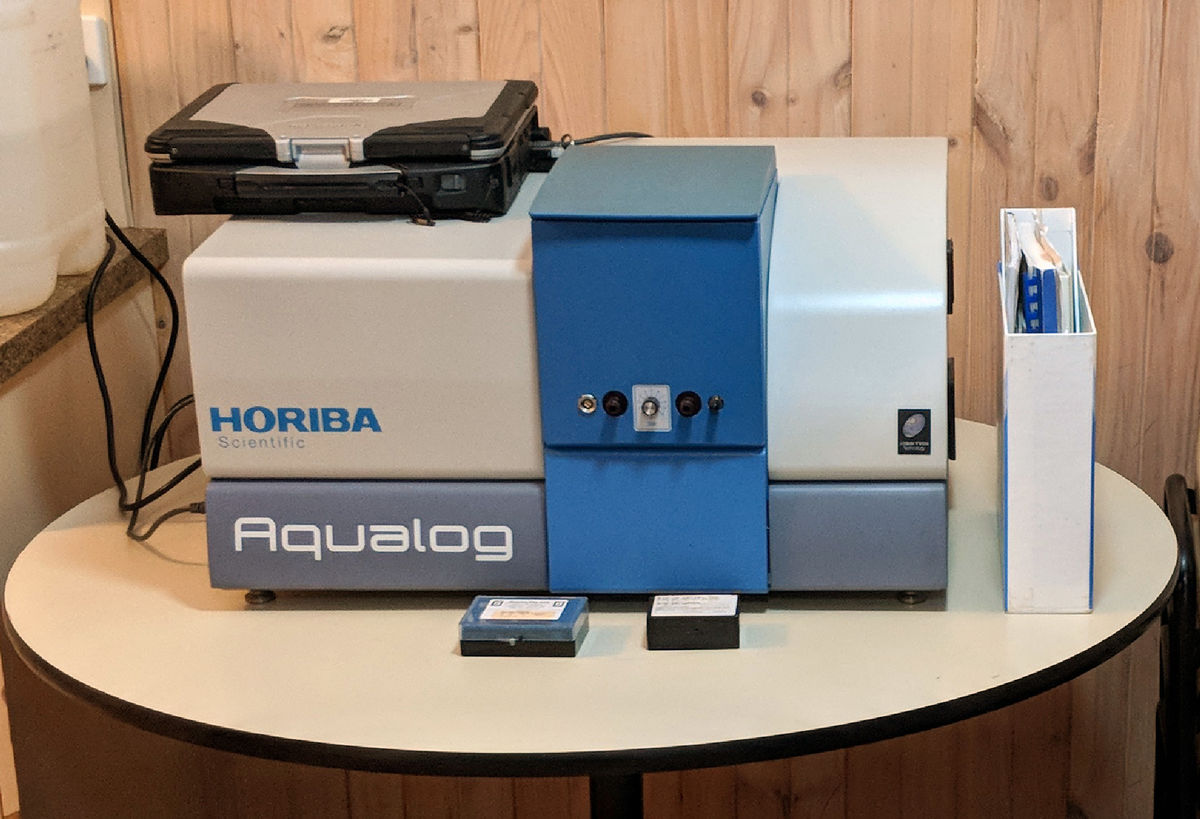
Aqualog at Wombeyan Caves
使用Aqualog在旺比恩洞中进行测试

“Organic matter is the base of the food web, so understanding its character and concentration, and how that changes with environmental processes, is of fundamental ecological importance,” Baker said. “And organic matter is present in our potable water supplies - reservoirs, rivers, lakes and groundwater - and water treatment processes aim to remove as much as possible, as it can react with disinfection products or lead to biofilm growth.”

The Aqualog, Baker said, is the team’s “go-to” instrument for rapid characterization of dissolved organic matter using fluorescence and absorbance spectroscopy, both for teaching and research.

“The speed of fluorescence analyses means that we can collect experimental data at close to real-time, which is exceptionally useful on a field class,” he said. “It is also great that we can pack it into a Pelican case and drive it wherever we want, including remote cabins in national parks. For research, it has proven invaluable, especially when we are in the method development stage and can collect data rapidly to help refine methods.”

Baker is a scientist at heart. His pursuits have led him to other areas.

“I have been lucky to be able to pursue diverse research interests,” he said. “One area is cave science, where I use cave stalagmites to reconstruct past environments. It’s because of this that I like to take the environmental geophysics students to cave and karst sites – limestone terrain usually characterized by rocky ground, caves and sinkholes, underground rivers, and the absence of surface streams and lakes.”

“The second is characterizing organic matter in natural and engineered environments, and this where I have used fluorescence spectroscopy in my research career. Currently, we are funded by the Australian Research Council to investigate dissolved organic matter in groundwater and find out why there is so little organic carbon in groundwater. Where does it go? We are using the Aqualog as one of the ways to characterize groundwater dissolved organic matter.”

Follow Us 


Informationsanfrage

Sie haben Fragen oder Wünsche? Nutzen Sie dieses Formular, um mit unseren Spezialisten in Kontakt zu treten.

* Diese Felder sind Pflichtfelder.

Produkte/Segmente

  • Alle Produkte (A-Z)
  • Mobility
  • Energy and Environment
  • Life Science
  • Healthcare
  • Materials
  • Semiconductor

Anwendungen

  • Trinkwasser Versorgung
  • Automobil Herstellung
  • Halbleiter Herstellung
  • Forschung & Testlabore

Technologien

  • Glimmentladungs-Spektroskopie
  • Quadrupol-Massenspektrometrie
  • Raman-Spektroskopie

Service

  • Unterstützung vor Ort
  • Ersatzteile und Verbrauchsmaterialien

Unternehmen

  • Nachrichten
  • Veranstaltungen
  • Karriere
  • Geschichte
  • Unternehmenskultur

Kontakt

  • Karriere Kontakt
  • Kontakt Formular
  • Weltweite Standorte
  • Investor Relations-Kontakt

Terms and Conditions Datenschutzerklärung Cookies Impressum HORIBA Group Social Media

© Copyright 2026 - All Rights Reserved