

Refractive Index Selection
Choosing a Refractive Index
The accuracy of your laser diffraction particle size measurement depends by varying degrees upon the accuracy of your choice of refractive index. How to identify good refractive index from bad is one of the most common questions (and most common headaches) of the typical laser diffraction user.
Why is Refractive Index Important?

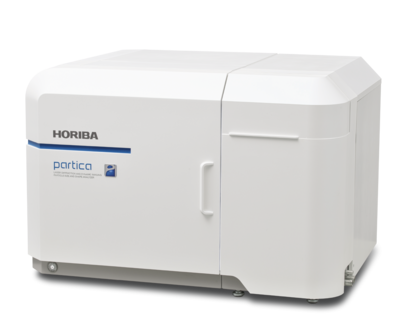
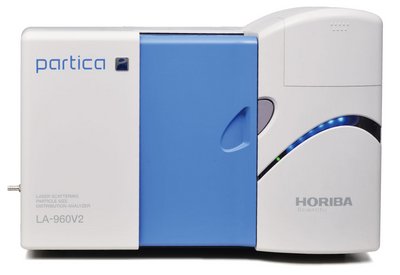
One of the key factors affecting the accuracy of many laser diffraction particle size measurements is the choice of refractive index (RI). Consisting of real and imaginary components the RI describes how light interacts with a material. The real component is often either listed in the software library, located through a literature or internet search, or can be directly measured. The imaginary component, or i term is a value between 0.0 and 10.0 that correlates to the degree of difference between a transparent and opaque particle. The iterm is sometimes easy to deduce - for example samples that are transparent and spherical and therefore have an imaginary value of zero. For non-transparent particles the i term is a non-trivial selection and directly affects result accuracy. The LA-960 Method Expert software provides a structured, automated approach with expert advice to choose the optimum i term.
Choosing the Optimum Imaginary Component
The raw data for the experiment is the scattered light measured on the instrument detectors. This scattered light is then used to calculate the particle size distribution (PSD). An error calculation called the R parameter quantifies the error when converting from the raw data to the PSD. This error calculation can be used to select the optimum i term; the lower the R parameter, the better the calculation (result). The i term generating the lowest R parameter is then used for all future measurements of this sample.
Automation by Method Expert

The sample is measured once and then this raw data is used for optimization in the Method Expert. The real component of RI is kept fixed and the i term is varied as determined by the user – typically 0, 0.01, 0.1, 1, and 10. A screen shots from the wizard set up is shown below.

After the calculations are completed a summary report is generated the displays the following information as seen below:
- PSD for each calculation
- D90, D50, D10 vs. RI
- R parameter vs. RI

For this and every test the Method Expert provides the user with Expert Advice containing guidance on how to make the best possible choice.
In this case the user should select 1.0 as the best i term for this sample and can choose from a number of options to report the results.
The same wizard can also be used to select the optimum real RI component while keeping the i term fixed. This approach works for the majority of samples, but the user must still also decide that the result generated meets expectations or correlates to another technique or product performance.
The user can then perform the other automated tests within the Method Expert software including structured tests to select the optimum:
- Pump and stirrer speed
- Experiment duration
- Concentration
- Amount of ultrasound
Browse Products
Informationsanfrage
Sie haben Fragen oder Wünsche? Nutzen Sie dieses Formular, um mit unseren Spezialisten in Kontakt zu treten.