The interest in room temperature phosphorescence (RTP) has been steadily growing over the years with numerous applications in the fields of medicine, organic electronics, protein studies and biological imaging. The characterization of RTP is often severely handicapped due to a strong fluorescence overlap, especially when organic materials are involved. This fluorescence interference makes it difficult to determine some basic photophysical properties, such as the phosphorescence spectrum and the quantum yield.
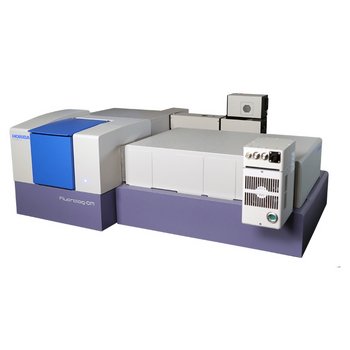
In this note we employ a time-resolved methodology, which utilizes the Single-Shot Transient Digitizer (SSTD) mode of the Fluorolog-QM equipped with a pulsed microsecond Xe lamp and an integrating sphere to determine both the phosphorescence decay and the gated phosphorescence spectrum of a sample. In addition, with the time gate positioned over the excitation pulse time range, a spectral scan is performed across the Rayleigh peak for both the sample and the blank. Using the results of the RTP decay fit analysis, the integrated intensity of the time-resolved phosphorescence is then extrapolated to the onset time of the excitation pulse. This approach makes the standard integrating sphere calculation formula for the quantum yield applicable to the results obtained from the time-gated experiment. The SSTD/PLQY method was applied to determine the RTP quantum yield of a deoxygenated solution of human serum albumin (HSA) protein, as well as crystalline samples of BN-substituted xanthene derivatives.