HORIBA
Search English
Czech Republic
  • Výrobky
    • Mobility
    • Energy and Environment
    • Industrial Process and Environment
    • Life Science
    • Healthcare
    • Materials
    • Semiconductor
    • Scientific and Analytical Instruments
    • Water & Liquid
    • All products from A to Z
  • Použití
    • Arts, Entertainment and Recreation
      • Art Conservation
      • Museums, Historical Sites and Similar Institutions
    • Biopharma and Pharma
    • Biotechnology and Biomedical
    • Cosmetics
    • Education, R&D and Government Institutions
      • Universities
      • Research and Testing Laboratories
    • Energy Solutions
      • Why HORIBA
      • Hydrogen Energy
        • Water Electrolysis Solutions
        • Global Initiatives
        • Fuel Cell Evaluation
        • FCEV / FCV Evaluation
        • Stationary Fuel Cells
        • Sintering and Reduction Test Station
        • Glow Discharge Optical Emission Spectroscopy: GD-Profiler 2™
        • Evaluation of Hydrogen and Ammonia Engine / Gas Turbine for Power Generation
        • Hydrogen Station Evaluation
        • Water Electrolysis Evaluation
        • Hydrogen Production Evaluation
      • Energy Usage Optimization
        • Energy Management System
        • Environmental Impact Assessment (LCA and GHG Protocol)
        • Battery Manufacturing/Recycling
      • CO2 Capture and Carbon Resource Circulation
        • Reduce
        • Direct Carbon Capture
        • Carbon Resource Circulation
        • CCUS Measurement Solutions
      • Coal and Consumable Fuels
      • Electric Utilities
      • Energy Fuel Oil
      • Environmental Countermeasures
      • Petroleum and Coal Products Manufacturing
        • Petrochemicals
      • Photovoltaics
      • Oil and Gas
      • RoHS and ELV
    • Food and Beverage
    • Healthcare
    • Industrials
      • Battery
      • Commercial and Professional Services
        • Gas mass flow control and measurement for reference value of PM2.5 measurement
      • Construction & Engineering
      • Electrical Equipment
      • Machinery
    • Information Technology
      • Semiconductors
        • 2D Materials
        • Graphene
        • Photovoltaics
        • Display Technologies
        • Data Storage
        • Nanomaterials
      • Semiconductor Manufacturing Process
      • Technology Hardware and Equipment
    • Marine
    • Materials
      • Carbon
      • Polymers and Composites
      • Raw Materials for Semiconductors
      • Metals
      • Minerals
      • Corrosion
      • Ceramics
      • Glass
      • Chemicals
      • Chemical Manufacturing
      • Construction Materials
      • Containers and Packaging
      • Paper, Forest Products and Manufacturing
      • Material Research
      • Photovoltaics
      • Forensic Science
    • Mobility and Transportation
    • Waste Management
      • Solid Waste Management and Remediation Services
      • Water Waste Management and Remediation Services
        • Waste Water and Soil Analysis
        • Waste Water Treatment and Disposal
      • Plastic Waste
    • Water
      • Drinking Water Utilities
      • Water Reuse
        • Water Testing
  • Technology
    • Elemental Analysis
      • Energy Dispersive X-ray Fluorescence (ED-XRF)
        • What is X-ray Fluorescence (XRF)
        • What is X-ray Fluorescence Spectroscopy (micro-XRF)?
        • XRF Key Components
        • XRF Analysis
        • XRF Articles
        • HORIBA XRF Analyzers
      • Glow Discharge Optical Emission Spectroscopy
        • What is Glow Discharge Optical Emission Spectroscopy GDOES?
        • Sample Measurement with GDOES
        • Sample Test and Analysis
        • Comparison with Other Techniques: Surface Analysis
        • Comparison with Other Techniques: Bulk Analysis
        • Instrument Introduction
        • Benefits and Features of Pulsed RF GDOES
        • Join the GD Community
        • Bibliography
      • Inductively Coupled Plasma - Optical Emission Spectroscopy (ICP-OES)
        • Inductively Coupled Plasma - Optical Emission Spectroscopy (ICP-OES)
        • Scientific ICP Spectrometers
        • Applications for ICP-OES
        • ICP-OES and other techniques
        • Principles and Theory
        • Instrumentation
        • Excitation Source
        • Dispersive System
        • Detection Systems Used with ICP-OES
        • Performances in ICP-OES
      • Carbon/Sulfur & Oxygen/Nitrogen/Hydrogen Analysis
    • Health Care
      • Multi Distribution Sampling System (MDSS)
      • Reticulocytes Analysis
      • CBC + CRP
      • Slide Production
      • Automatic Rerun
      • Absorbance
      • Fluorescence
      • Flow cytometry
      • Impedance / Resistivity
      • Sedimentation
      • Spectrophotometry
      • Potentiometry
      • INR screening
      • Clotting
      • Turbidimetric
      • Chromogenic
    • Particle Analysis
      • Dynamic Light Scattering (DLS) Particle Size Distribution Analysis
      • Molecular Weight
      • Nanoparticle Tracking Analysis
      • Static Light Scattering (SLS) / Laser Diffraction Particle Size Distribution Analysis
      • Zeta Potential
      • Centrifugal Sedimentation
    • Fluid Control
      • Vaporization of Critical Process Chemistries
      • Coriolis Flowmetry
      • Thermal Mass Flowmetry
    • Mass Spectrometry
      • Quadrupole Mass Spectrometry
    • Microscopy and Imaging
      • AFM-Raman
        • AFM-Raman
        • What is Tip Enhanced Raman Spectroscopy?
        • What information does TERS provide?
        • How does enhancement of the Raman signal occur in TERS?
        • What are the TERS instrumental configurations?
        • What are the TERS tips materials and morphology?
        • What kind of substrates can be probed with TERS?
        • What is the SPM feedback used for TERS?
        • What is the spatial resolution of TERS?
        • What is the definition of TERS Enhancement factor?
        • What is nonlinear TERS?
        • What are the degradation issues and artifacts in TERS?
        • What are the main TERS applications in Materials Sciences?
        • What are the main Life Sciences TERS applications?
        • References
        • Products
      • Atomic Force Microscopy [AFM]
      • Cathodoluminescence
      • Particle Image Analysis
      • Micro X-ray Fluorescence
      • Raman Microscopy
    • Spectroscopy
      • Cathodoluminescence Spectroscopy
        • Cathodoluminescence Spectroscopy
        • Electron Microscope
        • SEM, ESEM, SEM-FIB, (S)TEM
        • EM Add-on detector
        • SEM-Cathodoluminescence (SEM-CL)
      • AFM-Raman
      • Detectors
        • Introduction to the detectors techniques
        • What is a CCD Detector?
        • What is an EMCCD Detector?
        • Selecting a CCD Camera for Spectroscopic Applications
        • The Relationship Between Wavelength and Pixel Position on an Array
        • Spectroscopy Detector Products
        • Scientific CCD Camera Products
      • 50 years of Diffraction Gratings
      • Diffraction Gratings Ruled and Holographic
      • Fluorescence Spectroscopy
        • Fluorescence Spectroscopy
        • Principles and Theory of Fluorescence Spectroscopy
        • What is the Jablonski Diagram?
        • What is a Fluorescence Measurement?
        • Steady State Fluorescence Techniques
        • What is Fluorescence Anisotropy or Fluorescence Polarization?
        • What are Luminescence Quantum Yields?
        • What is Ratiometric Fluorescence?
        • What is an Excitation Emission Matrix (EEM)?
        • What is A-TEEM spectroscopy?
        • What is Singlet Oxygen?
        • How to Calculate Signal to Noise Ratio
        • Fluorescence Lifetime Techniques
        • Products Using Fluorescence Spectroscopy
      • Quantum Cascade Laser (QCL) Spectroscopy
        • Optical Hardware
        • Concentration Calculation Algorithm
        • Application Fields
      • Raman Imaging and Spectroscopy
        • Raman Spectroscopy
        • History of Raman Spectroscopy
        • Application field
        • Comparison with other techniques
        • Raman analysis
        • Recording spectral images and profiles
        • Description: Combined/hybrid/hyphenated Raman system
        • Confocal Raman microscopy
        • Raman Spectrometer Presentation
        • How the technique is used
        • Raman Image Gallery
        • Related Products
      • Spectrometers and Monochromators
        • Monochromator System Optics
        • Bandpass and Resolution
        • Order, Resolution, and Dispersion
        • Choosing a Monochromator/ Spectrograph
        • Spectrometer Throughput and Etendue
        • Optical Signal to Noise Ratio and Stray Light
        • Entrance Optics
        • Spectrometer, Spectrograph and Monochromator Products
      • Spectroscopic Ellipsometry
        • Spectroscopic Ellipsometry
        • Advantages
        • Instrumentation
        • Measurement Techniques
        • Data Analysis
        • Cauchy dispersion module
        • Products
      • Vacuum Ultra Violet Spectroscopy
        • Vacuum Ultra Violet Spectroscopy
        • VUV technology
        • High Vacuum (HV), Ultra High Vacuum (UHV), gas purge
        • Light sources in VUV
        • VUV system: Detector
        • Aberration
        • References - Articles
      • X-ray Fluorescence
    • Surface Plasmon Resonance
      • Surface Plasmon Resonance imaging
        • Surface Plasmon Resonance Imaging (SPRi)
        • Brief History of the Technique
        • SPR Measurements, Application Field and Comparison with Other Techniques
        • The Basics of Label-free Biomolecular Interactions
        • Instrument Presentation
        • How SPRi is Used
        • Key Accessories. Sensorchips. Surface Chemistry
        • How are the Molecules Immobilized on the biochip?
        • Conclusion & Bibliography
  • Služba
    • Analysis Services
      • Analysis Centers and Services
      • EMC Analysis Service
    • Calibration and Certification
    • Customer Support
      • HORIBA Medical Documentation Database
      • Medical Customer Support
      • On-Site Support
      • Software Support
    • Spare Parts and Consumables
    • Testing and Consulting
      • Automotive Testing Centers
    • Training
      • Product Training
        • Scientific Product Training
        • Automotive Product Training
        • Medical Product Training
      • Technology Training
  • Společnost
    • About HORIBA
      • Home
      • Message
      • Company Profile
      • Corporate Motto and Philosophy
      • Code of Ethics
      • Our Future (Vision, Mission, Values)
      • Corporate Governance
      • Board of Directors
      • Culture
      • History
        • 1945–1960s
        • 1970s
        • 1980s
        • 1990s
        • 2000s
        • 2010s
        • 2020s
      • Group Companies
      • HORIBA Talk
        • Green Future Lab: HORIBA Thailand Inspires Children to Explore Science and Sustainability
    • Events
    • Career
    • Investor Relations
      • Home
      • Investor Relations News
      • IR Library
        • Financial Statements
        • Presentation Materials
        • HORIBA Report
      • Message from the CEO
      • Mid-Long Term Management Plan
      • Stock Information
      • Shareholders Meeting
      • Other IR Information
        • Investor Relations Calendar
      • Investor Relations Contact
    • News
  • Contact
    • Contact Form
    • Worldwide Locations
Material Procurement open open
  • HORIBA Procurement Policy
  • Green Procurement
  • Responsible Mineral Procurement
  • Supply Chain Initiatives
    HORIBA » Společnost » Social » Material Procurement » Supply Chain Initiatives 

Supply Chain Initiatives

Deepening Partnerships with Suppliers through Direct Dialogue

HORIBA Group invites executives and representatives from key suppliers to its headquarters and works to strengthen trust-based partnerships through ongoing communication.
We regularly share our management policies, business plans, and procurement strategy to the extent that they can be disclosed. We also exchange views on important procurement-related topics, such as respecting human rights, reducing environmental impact, ensuring information security, and managing risks, while explaining our views and expectations.
Through these direct conversations, we deepen our understanding of CSR procurement and strengthen efforts throughout the supply chain.

Valuable Insights from a Decarbonization Workshop

We held a sustainability workshop for the next generation of leaders from key suppliers. First, the relevant HORIBA department explained our decarbonization efforts across the supply chain. Next, participating companies reported on specific examples of their own initiatives. Finally, as a practical exercise, participants learned how to calculate GHG emissions (Scope 1 and Scope 2)*1. 
Participants said that they had gained a better understanding of the importance of reducing CO2 emissions, found the examples of initiatives being undertaken by other companies very helpful, and would like to pursue SBT certification*2.

*1 GHG emissions (Scope 1 and Scope 2): Scope 1 refers to greenhouse gas emissions released directly from a company’s activities, such as fuel combustion. Scope 2 refers to indirect greenhouse gas emissions associated with the generation of purchased electricity, heat, and other forms of energy consumed by a company.

*2 SBT certification: This refers to submitting a company’s greenhouse gas reduction targets to the Science Based Targets initiative (SBTi) for validation and having them approved.

Taking the First Step Together to Reduce Scope 3 Emissions
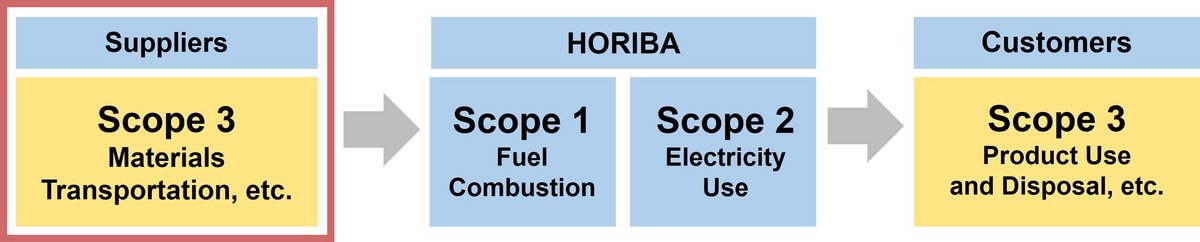
At HORIBA Group, reducing CO2 emissions across the entire supply chain is a major priority in our efforts to achieve carbon neutrality by 2050. As part of this effort, we are working with key suppliers to collect primary data*3 on Scope 3 (Category 1) emissions*4.
In the first step, we conducted a questionnaire on CO2 reduction to understand the current situation and challenges. In the second step, we held online briefing sessions and individual consultations, and suppliers provided the necessary data related to their production activities wherever possible. We are currently considering our future approach based on the information collected and feedback from suppliers regarding practical implementation.
This initiative represents an important first step, and we will continue working to improve its effectiveness.

*3 Primary data: Basic emissions data obtained directly from suppliers, such as actual measured values, that are used to calculate emissions.

*4 Scope 3 (Category 1): CO2 emissions associated with purchased goods and services.

Introducing Energy-Saving Assessments and Other Available Programs

To help reduce CO2 emissions across the supply chain, we encourage our suppliers to make use of energy-saving assessments so that they can better understand their own energy performance.

Through these efforts, more suppliers in Japan are undergoing energy-saving assessments and considering energy-saving measures. Some suppliers have also used subsidy programs as an opportunity to upgrade to high-efficiency air-conditioning equipment, convert to LED lighting, and install solar power systems. In addition, interest is growing in obtaining SME SBT*5 (Science Based Targets) certification, which helps companies make their efforts to reduce CO2 emissions visible.

*5 SME SBT: A greenhouse gas target-setting program developed by the Science Based Targets initiative for small and medium-sized enterprises.

ESG Questionnaires That Make Progress Visible and Dialogue That Drives Improvement

As part of our efforts to help create a sustainable society, we are working with key suppliers to promote responsible sourcing throughout the supply chain. To understand the status of initiatives in important areas such as labor, occupational health and safety, the environment, and ethics, and to support continuous improvement, we conduct ESG questionnaires.
These questionnaires are not intended to serve as audits or ratings. Rather, they are designed to promote mutual understanding and support improvement through dialogue.
The questionnaire covers six areas and approximately 50 questions, including management systems and resilience in addition to the important areas mentioned above. The questionnaire uses a five-point rating scale and includes a simple free-text section, enabling us to review suppliers’ initiatives from multiple perspectives. Based on the responses, we hold individual discussions as needed and exchange views on how to improve.
We received active and positive feedback from all participating suppliers, and the constructive discussions marked a major step forward. We plan to follow up on progress in implementing improvements over the next several months, up to approximately six months, with a view to providing advice and support. Going forward, we will continue to work closely and thoughtfully with our suppliers, supporting them in making improvements in a practical and manageable manner while strengthening the foundation for sustainable procurement and building a responsible supply chain.

  • Products
    • All Products (A-Z)
    • Mobility
    • Energy and Environment
    • Life Science
    • Healthcare
    • Materials
    • Semiconductor
  • Applications
    • Drinking Water Utilities
    • Automotive Manufacturing
    • Semiconductor Manufacturing Process
    • Research and Testing Laboratories
  • Technology
    • Glow Discharge Spectroscopy
    • Pressure-based Flowmetry
    • Quadrupole Mass Spectrometry
    • Raman Spectroscopy
  • Service
    • On-Site Support
    • Spare Parts and Consumables
  • Company
    • News
    • Events
    • Career
    • History
    • Corporate Culture
  • Contact
    • Career Contact
    • Contact Form
    • Worldwide Locations
    • Investor Relations Contact

Terms and Conditions Privacy Notice Cookies HORIBA Group Social Media