




PDF
13.02
MB


As the world works toward achieving carbon neutrality by 2050 and the need to reduce greenhouse gases—particularly carbon dioxide (CO₂)—continues to intensify, advances in materials technologies are opening new possibilities. One material drawing particular attention is zeolite, which offers outstanding adsorption and catalytic performance. We spoke with Professor Toru Wakihara of the School of Engineering, The University of Tokyo, whose research ranging from fundamental science to practical applications, about what makes zeolites so compelling and what the future may hold.
Zeolites are crystalline, microporous aluminosilicates—discovered in 1756—with aluminosilicate (aluminum silicate) as their principal component. Their distinctive porous framework provides properties such as adsorption and ion exchange, which is why zeolites are widely used in everyday applications, including powdered detergents, soil conditioning, and water treatment. Today, there are roughly 260 types in total when both natural and synthetic zeolites are included, but only about 10 of these are used industrially.
The greatest appeal of zeolites lies in the performance enabled by their pores. These pores selectively adsorb specific molecules and can also promote chemical reactions. In particular, as catalysts, zeolites play a key role in large-scale industrial processes such as petroleum refining and exhaust-gas treatment.
Zeolites are also attracting attention as key materials for addressing environmental challenges, as they are known for their high selectivity in adsorbing harmful substances.
A representative example is the high cesium-selective zeolites used for water treatment following the Fukushima Daiichi nuclear accident. Zeolites and zeolite-related materials efficiently adsorb radioactive species, enabling the safe treatment of contaminated water. This achievement can be regarded as a groundbreaking demonstration of zeolites’ potential for environmental applications.
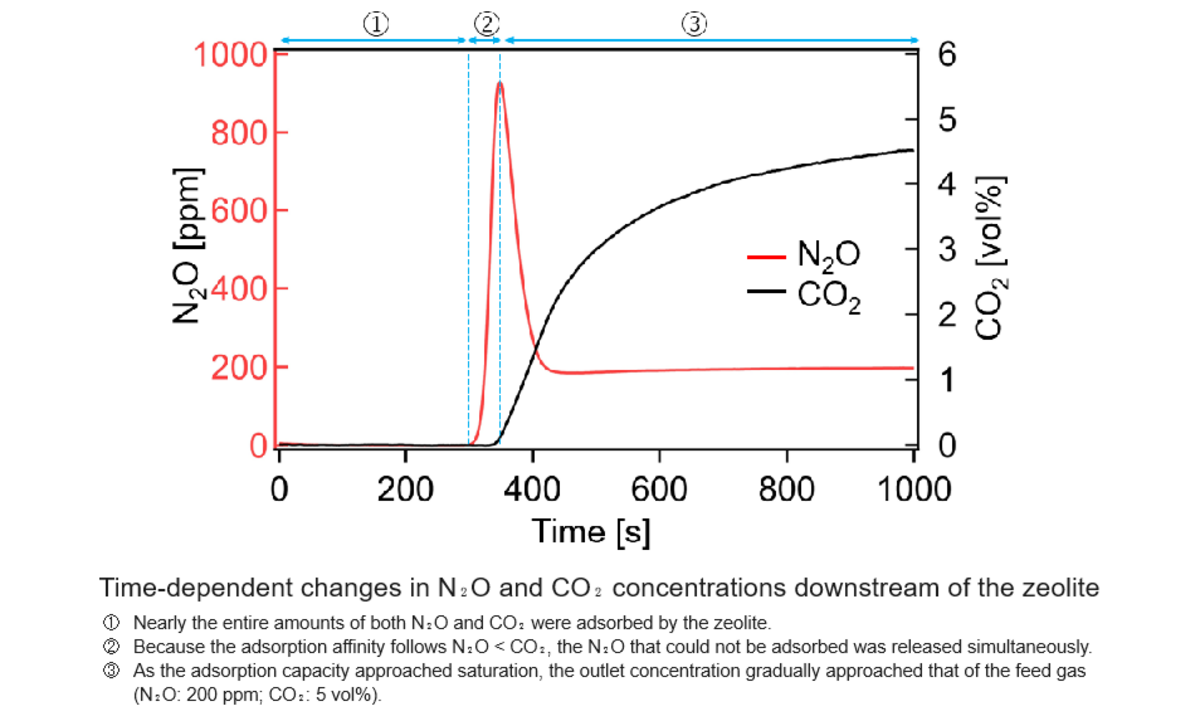
Zeolites are also highly regarded in today’s greenhouse-gas reduction technologies. In particular, in CCUS (Carbon Capture, Utilization and Storage) - aimed at capturing and storing CO₂ - zeolites’ adsorption capacity has drawn significant attention. However, the role of zeolites extends beyond CO₂. Because zeolites can adsorb greenhouse gases such as methane (CH₄) and nitrous oxide (N₂O), they are expected to be applied to technologies for the capture, desorption, and concentration of these gases. N₂O, in particular, is considered an urgent target for mitigation because it has a greenhouse effect roughly 300 times that of CO₂. Zeolite-based adsorption technologies are expected to help build systems that manage these gases efficiently.
As an undergraduate in the Department of Chemical Systems Engineering, I was completely absorbed in “making things.” During that time, I encountered zeolites, and their unique nature as porous materials - with well-defined internal pores - sparked my first step into research. At the time, however, I never imagined that zeolite science would become my specialty.
My starting point was fundamental research, which involved investigating how zeolites form and elucidating their synthesis pathways. Beginning with these fundamentals enabled me to develop a deep understanding of zeolite properties - knowledge that later proved invaluable as I advanced into applied research. Had I started from applications, I might have been constrained by the roles and use cases of “materials already in use.” By learning the fundamentals first, I gained the capability to engineer materials at the atomic level - an essential skill when designing efficient reactions or removing hazardous substances. This experience became a critical foundation for my work as a researcher.
I later moved to Yokohama National University, where I became involved in ceramics research. Through this work, I realized that ceramics synthesis techniques and powder engineering could be directly leveraged in zeolite research. This shift in perspective further broadened the scope of my studies, and I came to appreciate the excitement of tackling challenges through a new lens.
Successfully integrating zeolite and ceramics processing allowed me to open up new academic possibilities that had not existed before. That achievement became the catalyst for my return to the University of Tokyo, where a path emerged to further deepen my zeolite research.
Zeolites are widely used as catalysts across a broad range of applications. As a result, there is strong demand for research that further enhances their performance - such as reactivity and adsorption - while also reducing manufacturing costs. In our laboratory, we are particularly focused on improving durability. To maximize performance as catalysts and adsorbents, enhancing durability has become an indispensable challenge.
At the same time, improving durability often comes with a trade-off: the manufacturing process becomes more complex and costs rise. Research aimed at overcoming this challenge is highly demanding, but given its importance, we believe it is well worth pursuing.
The raw materials - silica (SiO₂) and alumina (Al₂O₃) - crystallize into zeolites with characteristic microporous structures when crystallized in the presence of organic compounds known as quaternary ammonium ions (structure-directing agents). A key issue, however, is that quaternary ammonium compounds are extremely expensive.
Identifying ways to replace them with lower-cost alternatives is therefore an important research theme. There are also template-free approaches that create zeolite pores without using organics, but these methods can lead to compositional deviations and may require additional post-treatments. By deeply understanding the fundamental principles underlying zeolite synthesis, it becomes possible to devise manufacturing routes that are both efficient and cost-effective.
To improve the zeolite synthesis process, we conducted an in-depth study of the mechanisms of crystal formation. As a result, we developed a technique that shortened synthesis times from several days to just minutes. Continuing this work, we went on to identify an approach that can synthesize zeolites in as little as a few seconds. This technology represents a breakthrough in zeolite research, opening up unprecedented possibilities.
As noted earlier, zeolites offer tremendous potential for addressing environmental challenges by leveraging their unique properties. In our research, we are developing zeolite-based adsorption columns and working toward real-world deployment of technologies that concentrate and decompose greenhouse gases. Because this material can be recycled repeatedly, it is attracting attention as a breakthrough solution with the potential to effectively reduce environmental impact.
For example, CO₂ captured and concentrated using zeolites can be supplied to agricultural greenhouses to promote crop growth or utilized in chemical production processes. Research is also underway on technologies that combine captured CO₂ with hydrogen to produce value-added products. While the cost of hydrogen remains a challenge today, overcoming this barrier would further expand the pathway to practical implementation.
Beyond CO₂, we strategically apply zeolite-based adsorption and catalytic technologies to reduce other greenhouse gases such as methane (CH₄) and nitrous oxide (N₂O). Our goal is to build systems that concentrate these gases and decompose them on-site. In particular, for N₂O - which has a particularly high global warming potential - we have developed a technology that decomposes the concentrated gas in situ, marking a crucial step toward practical solutions for greenhouse-gas mitigation.
Zeolites also hold significant promise in the nitrogen cycle. For instance, by improving the performance of exhaust-gas catalysts, it is possible to make decomposition processes more efficient and develop technologies that drastically reduce environmental burden compared with conventional, energy-intensive methods. Through these efforts, we continue to take on highly challenging areas where unmet needs remain substantial.
Moreover, zeolites are expanding their impact not only in environmental applications but also in the energy domain. As catalysts, zeolites can support technology development for a hydrogen-based society and enable new chemical processes that convert methanol and other feedstocks into value-added products. These technologies are expected to meet next-generation energy demands and will likely become essential elements in realizing a sustainable society.
The broad range of capabilities unlocked by zeolites is indispensable for solving today’s pressing challenges - protecting the environment and improving energy efficiency. We will further advance our fundamental research and accelerate the practical implementation of these technologies to bring zeolites to society as an innovative material that leads to a more sustainable future.
One of the essential tools supporting my research is HORIBA’s Portable Gas Analyzer, the PG-300 Series. Whereas we previously relied on gas chromatography, the PG-300 enables continuous measurement and captures highly useful data for evaluating zeolite performance. As a result, the quality of our data on greenhouse-gas concentration and decomposition has improved, and we can now acquire data far more efficiently. We are currently using it in our research that focuses on the three major greenhouse gases - N₂O, CH₄, and CO₂.

I have a deep passion for fundamental research. At its core, the mechanisms behind why and how zeolites form are still not fully understood, and I want to help uncover those fundamentals. By rigorously pursuing the basic science of zeolites, my goal is to create entirely new zeolites with unprecedented structures.
Addressing environmental and energy challenges is a central pillar of my research. Using zeolites, I aim to develop systems that concentrate and then decompose harmful substances such as greenhouse gases. For example, my objective is to build mechanisms that enable net-zero greenhouse-gas emissions through CO₂ utilization and flue-gas treatment. If a hydrogen-based society becomes a reality, technologies for producing a variety of value-added chemicals from methanol will be in even greater demand. Meeting that need will require the development of higher-performance catalysts - and I want to address it though zeolite-based catalysts.
Contributing to the nitrogen cycle is another important theme of my research. By improving processes, I hope to eliminate “wasteful loops” in the cycle.
Through these efforts, my mission is to deliver innovative technologies that benefit society and help realize a sustainable future. The potential of zeolites is limitless. By harnessing novel structures and expanding their range of applications, I hope to advance technologies that make a meaningful contribution to society.
(Interview date: July 2025)
Note: All information published here, including the names of organizations, affiliations, and titles mentioned in the text, is accurate as of the interview date.
Toru Wakihara
Professor, School of Engineering, The University of Tokyo
Expertise: Zeolite synthesis and applications; ceramics research
Background: Earned his Ph.D. in the Department of Chemical System Engineering, School of Engineering, The University of Tokyo (Okubo Laboratory). After conducting ceramics research at Yokohama National University, he returned to The University of Tokyo, where he currently serves as Professor. He promotes interdisciplinary research that integrates zeolites and ceramics, aiming to contribute to solving environmental and energy challenges.
Career History:
Mar 1999: B.E., Department of Chemical System Engineering, Faculty of Engineering, The University of Tokyo
Mar 2001: M.E., Department of Chemical System Engineering, School of Engineering, The University of Tokyo
Mar 2004: Ph.D., Department of Chemical System Engineering, School of Engineering, The University of Tokyo
Apr 2004: Research Associate, Graduate School of Environment and Information Sciences, Yokohama National University
Apr 2007: Assistant Professor, Graduate School of Environment and Information Sciences, Yokohama National University
Apr 2012: Associate Professor, Graduate School of Environment and Information Sciences, Yokohama National University
Apr 2013: Associate Professor, School of Engineering (Faculty of Engineering), The University of Tokyo
Apr 2020: Professor, School of Engineering (Faculty of Engineering), The University of Tokyo
