


Dynamic Image Analysis is a Particle Image Analysis technique that continuously captures images of particles in motion as they pass through a measurement zone. By extracting particle outlines from these images, the system calculates particle size distributions and shape descriptors such as circularity and aspect ratio. Because it can measure a large number of particles in a short time, Dynamic Image Analysis is widely used for particle size evaluation and morphological quality control.
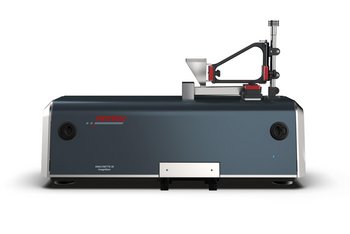
Figure : DIA Observation System
Comprehensive Size and Shape Data
In addition to basic particle size, Dynamic Image Analysis quantitatively analyzes distinct morphological characteristics, ensuring the accurate detection of variations in aspect ratio, circularity, length, and width.
Rapid Measurement of High Particle Volumes
By continuously capturing images of a flowing particle stream, this method easily acquires a statistically robust sample size in significantly less time.
Wide Measurement Range
By employing techniques such as the simultaneous use of multiple cameras to extend the measurement range, Dynamic Image Analysis is highly adaptable to samples with a broad distribution of particle sizes. Consequently, it is increasingly being adopted for applications that traditionally relied on sieve analysis.
Dynamic Image Analysis is especially useful when statistically robust particle size distributions are needed, since accurate results may require data from tens of thousands of particles or more. It is also widely used in applications that have traditionally relied on sieving, because appropriate size parameters can produce results that closely match sieve measurements while also providing particle shape information. In addition, it enables fast and efficient measurement, making it suitable for routine inspection and quality control.
While Static Image Analysis is often preferred for stationary samples when detailed particle images or correlative analysis are needed, Dynamic Image Analysis is better suited for measuring large numbers of particles quickly and generating statistically robust size distributions.
Dynamic Image Analysis uses many of the same image-processing steps as a Static Image Analysis. However, sample preparation is different because the sample is moving during measurement, and the measurement process is typically more automated.
For a more detailed comparison, please refer to the comparison table on the Particle Image Analysis page.
A critical consideration in the design of Dynamic Image Analysis systems is the optimization of illumination intensity, optical throughput, and shutter speed. Because particles travel through the measurement zone at high velocities, capturing them without specialized configurations results in motion blur—elongated particle images similar to photographing a fast-moving train with a standard camera. While shortening the shutter speed is the conventional method to prevent this blurring, camera hardware has fundamental limits, and shorter exposures inevitably lead to darker images.
To solve this, advanced Dynamic Image Analysis systems employ stroboscopic (flash) lighting. By emitting a high-intensity flash for a mere fraction of a second, the effective exposure time is restricted to the duration of the flash, effectively freezing the particle's motion, even if the camera shutter remains open longer. However, because capturing light in such a brief window inherently darkens the image, utilizing a highly intense strobe light source and a highly sensitive camera sensor becomes absolutely essential for accurate analysis.
Unlike Static Image Analysis, where lenses can be easily switched to observe the same particles at different magnifications, Dynamic Image Analysis faces hardware-driven limitations regarding the size range a single camera can capture. A standard image sensor comprises several million pixels (typically thousands by thousands). To ensure accurate size and shape measurement, a particle must cover a sufficient number of pixels, yet it must remain small enough not to exceed the frame. Due to these geometric constraints, the measurable size range for a single camera is generally limited to a dynamic range of approximately 100:1.
To overcome this limitation and measure a broader range of particle sizes simultaneously, advanced Dynamic Image Analysis systems can be equipped with two cameras operating at different magnifications. This dual-camera configuration captures the same stream of particles across a significantly wider size range. However, this sophisticated setup introduces a complex computational challenge: the system's software must seamlessly integrate the distinct data sets derived from the two separate camera feeds to construct a single, unified particle size distribution histogram.
Dynamic Image Analysis is a technique where particles are continuously passed in front of a camera and imaged in real time. This allows for rapid measurement of particle size distribution and particle shape, providing more comprehensive information compared to traditional sieve analysis.
Static Image Analysis involves imaging particles that are stationary, typically on a microscope slide. Dynamic Image Analysis, on the other hand, measures particles as they move through the observation area. Dynamic methods are ideal for analyzing large numbers of particles quickly, and for real-time monitoring.
Dynamic Image Analysis is well-suited for powders, granules, and suspensions where large numbers of particles need to be measured, and statistical analysis of particle size distribution and shape is required. It is widely used in industries such as pharmaceuticals, food, ceramics, and mining.
Image analysis provides not only particle size distribution, but also detailed shape information, offering a more complete characterization than sieve analysis. Furthermore, finer particle size fractions allow for higher resolution particle size distributions to be obtained. It is also better suited for fine particles and automated measurements.
The larger limit is determined by the size that exceeds the angle of view. The smaller limit is determined by both the size of one pixel and the optical resolution. The size of one pixel also affects how accurately particles can be measured.
For Dynamic Image Analysis, samples are typically dispersed in a liquid or fed dry to ensure uniform distribution. Proper dispersion and dilution are essential for accurate measurement.
HORIBA’s Partica uses multiple cameras to perform wide-range Dynamic Image Analysis and simultaneously measures particle size distribution using laser diffraction. This allows you to obtain size information from two measurement technologies at once, as well as shape information from an image analysis.
Laser Diffraction and Dynamic Imaging Particle Size and Shape Analyzer
Dynamic Image Analysis
Masz pytania lub prośby? Skorzystaj z tego formularza, aby skontaktować się z naszymi specjalistami.
