HORIBA
Search English
Singapore
  • Products
    • Mobility
    • Energy and Environment
    • Industrial Process and Environment
    • Life Science
    • Healthcare
    • Materials
    • Semiconductor
    • Scientific and Analytical Instruments
    • Water & Liquid
    • All products from A to Z
  • Applications
    • Arts, Entertainment and Recreation
      • Art Conservation
      • Museums, Historical Sites and Similar Institutions
    • Biopharma and Pharma
    • Biotechnology and Biomedical
    • Cosmetics
    • Education, R&D and Government Institutions
      • Universities
      • Research and Testing Laboratories
    • Energy Solutions
      • Why HORIBA
      • Hydrogen Energy
        • Global Initiatives
        • Global Trends and Strategies toward Carbon Neutrality
        • Fuel Cell Evaluation
        • FCEV / FCV Evaluation
        • Stationary Fuel Cells
        • Sintering and Reduction Test Station
        • Evaluation of Hydrogen and Ammonia Engine / Gas Turbine for Power Generation
        • Hydrogen Station Evaluation
        • Water Electrolysis Evaluation
        • Hydrogen Production Evaluation
      • Energy Usage Optimization
        • Energy Management System
        • Environmental Impact Assessment (LCA and GHG Protocol)
        • Battery Manufacturing/Recycling
      • CO2 Capture and Carbon Resource Circulation
        • Reduce
        • Direct Carbon Capture
        • Carbon Resource Circulation
      • Coal and Consumable Fuels
      • Electric Utilities
      • Energy Fuel Oil
      • Environmental Countermeasures
      • Petroleum and Coal Products Manufacturing
        • Petrochemicals
      • Photovoltaics
      • Oil and Gas
      • RoHS and ELV
    • Food and Beverage
      • Agriculture & Crop Science
      • Beverages
      • Food
      • Food & Beverage Manufacturing
    • Healthcare
    • Industrials
      • Battery
      • Commercial and Professional Services
        • Gas mass flow control and measurement for reference value of PM2.5 measurement
      • Construction & Engineering
      • Electrical Equipment
      • Machinery
    • Information Technology
      • Semiconductors
        • 2D Materials
        • Graphene
        • Photovoltaics
        • Display Technologies
        • Data Storage
        • Nanomaterials
      • Semiconductor Manufacturing Process
      • Technology Hardware and Equipment
    • Materials
      • Carbon
      • Polymers and Composites
      • Raw Materials for Semiconductors
      • Metals
      • Minerals
      • Corrosion
      • Ceramics
      • Glass
      • Chemicals
      • Chemical Manufacturing
      • Construction Materials
      • Containers and Packaging
      • Paper, Forest Products and Manufacturing
      • Material Research
      • Photovoltaics
      • Forensic Science
    • Mobility and Transportation
      • Automotive Manufacturing
      • Engine, Turbine and Power Transmission Equipment Manufacturing
      • Real Driving Emissions
      • Intelligent Lab
      • Marine
    • Waste Management
      • Solid Waste Management and Remediation Services
      • Water Waste Management and Remediation Services
        • Waste Water and Soil Analysis
        • Waste Water Treatment and Disposal
      • Plastic Waste
    • Water
      • Drinking Water Utilities
      • Water Reuse
        • Water Testing
  • Technology
    • Elemental Analysis
      • Energy Dispersive X-ray Fluorescence (ED-XRF)
        • What is X-ray Fluorescence (XRF)
        • What is X-ray Fluorescence Spectroscopy (micro-XRF)?
        • XRF Key Components
        • XRF Analysis
        • XRF Articles
        • HORIBA XRF Analyzers
      • Glow Discharge Optical Emission Spectroscopy
        • What is Glow Discharge Optical Emission Spectroscopy GDOES?
        • Sample Measurement with GDOES
        • Sample Test and Analysis
        • Comparison with Other Techniques: Surface Analysis
        • Comparison with Other Techniques: Bulk Analysis
        • Instrument Introduction
        • Benefits and Features of Pulsed RF GDOES
        • Join the GD Community
        • Bibliography
      • Inductively Coupled Plasma - Optical Emission Spectroscopy (ICP-OES)
        • Inductively Coupled Plasma - Optical Emission Spectroscopy (ICP-OES)
        • Scientific ICP Spectrometers
        • Applications for ICP-OES
        • ICP-OES and other techniques
        • Principles and Theory
        • Instrumentation
        • Excitation Source
        • Dispersive System
        • Detection Systems Used with ICP-OES
        • Performances in ICP-OES
      • Carbon/Sulfur & Oxygen/Nitrogen/Hydrogen Analysis
    • Health Care
      • Multi Distribution Sampling System (MDSS)
      • Reticulocytes Analysis
      • CBC + CRP
      • Slide Production
      • Automatic Rerun
      • Absorbance
      • Fluorescence
      • Flow cytometry
      • Impedance / Resistivity
      • Sedimentation
      • Spectrophotometry
      • Potentiometry
      • INR screening
      • Clotting
      • Turbidimetric
      • Chromogenic
    • Particle Analysis
      • Dynamic Light Scattering (DLS) Particle Size Distribution Analysis
      • Molecular Weight
      • Nanoparticle Tracking Analysis
      • Static Light Scattering (SLS) / Laser Diffraction Particle Size Distribution Analysis
      • Zeta Potential
      • Centrifugal Sedimentation
    • Fluid Control
      • Vaporization of Critical Process Chemistries
      • Coriolis Flowmetry
      • Thermal Mass Flowmetry
    • Mass Spectrometry
      • Quadrupole Mass Spectrometry
    • Microscopy and Imaging
      • AFM-Raman
        • AFM-Raman
        • What is Tip Enhanced Raman Spectroscopy?
        • What information does TERS provide?
        • How does enhancement of the Raman signal occur in TERS?
        • What are the TERS instrumental configurations?
        • What are the TERS tips materials and morphology?
        • What kind of substrates can be probed with TERS?
        • What is the SPM feedback used for TERS?
        • What is the spatial resolution of TERS?
        • What is the definition of TERS Enhancement factor?
        • What is nonlinear TERS?
        • What are the degradation issues and artifacts in TERS?
        • What are the main TERS applications in Materials Sciences?
        • What are the main Life Sciences TERS applications?
        • References
        • Products
      • Atomic Force Microscopy [AFM]
      • Cathodoluminescence
      • Image Analysis of Particles
      • Micro X-ray Fluorescence
      • Raman Microscopy
    • Spectroscopy
      • Cathodoluminescence Spectroscopy
        • Cathodoluminescence Spectroscopy
        • Electron Microscope
        • SEM, ESEM, SEM-FIB, (S)TEM
        • EM Add-on detector
        • SEM-Cathodoluminescence (SEM-CL)
      • AFM-Raman
      • Detectors
        • Introduction to the detectors techniques
        • What is a CCD Detector?
        • What is an EMCCD Detector?
        • Selecting a CCD Camera for Spectroscopic Applications
        • The Relationship Between Wavelength and Pixel Position on an Array
        • Spectroscopy Detector Products
        • Scientific CCD Camera Products
      • 50 years of Diffraction Gratings
      • Diffraction Gratings Ruled and Holographic
      • Fluorescence Spectroscopy
        • Fluorescence Spectroscopy
        • Principles and Theory of Fluorescence Spectroscopy
        • What is the Jablonski Diagram?
        • What is a Fluorescence Measurement?
        • Steady State Fluorescence Techniques
        • What is Fluorescence Anisotropy or Fluorescence Polarization?
        • What are Luminescence Quantum Yields?
        • What is Ratiometric Fluorescence?
        • What is an Excitation Emission Matrix (EEM)?
        • What is A-TEEM spectroscopy?
        • What is Singlet Oxygen?
        • How to Calculate Signal to Noise Ratio
        • Fluorescence Lifetime Techniques
        • Products Using Fluorescence Spectroscopy
      • Quantum Cascade Laser (QCL) Spectroscopy
        • Optical Hardware
        • Concentration Calculation Algorithm
        • Application Fields
      • Raman Imaging and Spectroscopy
        • Raman Spectroscopy
        • History of Raman Spectroscopy
        • Application field
        • Comparison with other techniques
        • Raman analysis
        • Recording spectral images and profiles
        • Description: Combined/hybrid/hyphenated Raman system
        • Confocal Raman microscopy
        • Raman Spectrometer Presentation
        • How the technique is used
        • Raman Image Gallery
        • Related Products
      • Spectrometers and Monochromators
        • Monochromator System Optics
        • Bandpass and Resolution
        • Order, Resolution, and Dispersion
        • Choosing a Monochromator/ Spectrograph
        • Spectrometer Throughput and Etendue
        • Optical Signal to Noise Ratio and Stray Light
        • Entrance Optics
        • Spectrometer, Spectrograph and Monochromator Products
      • Spectroscopic Ellipsometry
        • Spectroscopic Ellipsometry
        • Advantages
        • Instrumentation
        • Measurement Techniques
        • Data Analysis
        • Cauchy dispersion module
        • Products
      • Vacuum Ultra Violet Spectroscopy
        • Vacuum Ultra Violet Spectroscopy
        • VUV technology
        • High Vacuum (HV), Ultra High Vacuum (UHV), gas purge
        • Light sources in VUV
        • VUV system: Detector
        • Aberration
        • References - Articles
      • X-ray Fluorescence
    • Surface Plasmon Resonance
      • Surface Plasmon Resonance imaging
        • Surface Plasmon Resonance Imaging (SPRi)
        • Brief History of the Technique
        • SPR Measurements, Application Field and Comparison with Other Techniques
        • The Basics of Label-free Biomolecular Interactions
        • Instrument Presentation
        • How SPRi is Used
        • Key Accessories. Sensorchips. Surface Chemistry
        • How are the Molecules Immobilized on the biochip?
        • Conclusion & Bibliography
  • Service
    • Analysis Services
      • Analysis Centers and Services
      • EMC Analysis Service
    • Calibration and Certification
    • Customer Support
      • HORIBA Medical Documentation Database
      • Medical Customer Support
      • On-Site Support
      • Software Support
    • Spare Parts and Consumables
    • Testing and Consulting
      • Automotive Testing Centers
    • Training
      • Product Training
        • Scientific Product Training
        • Automotive Product Training
        • Medical Product Training
      • Technology Training
  • Company
    • About HORIBA
      • Home
      • Message
      • Company Profile
      • Corporate Motto and Philosophy
      • Code of Ethics
      • Our Future (Vision, Mission, Values)
      • Corporate Governance
      • Board of Directors
      • Culture
      • History
        • 1945–1960s
        • 1970s
        • 1980s
        • 1990s
        • 2000s
        • 2010s
        • 2020s
      • Group Companies
      • HORIBA Talk
    • Events
    • Career
    • Investor Relations
      • Home
      • Investor Relations News
      • IR Library
        • Financial Statements
        • Presentation Materials
        • HORIBA Report
      • Message from the CEO
      • Mid-Long Term Management Plan
      • Stock Information
      • Shareholders Meeting
      • Other IR Information
        • Investor Relations Calendar
        • Disclaimer
      • Investor Relations Contact
    • News
    • Social Responsibility
      • Sustainability
      • Topics
      • Message
      • Sustainable Management
        • Policy and Promotion System
        • Integrated Management System
        • Health and Productivity
        • UN Global Compact
      • HORIBARIANs
        • HORIBARIANs
        • Human Rights and Labor Management
        • Development of HORIBARIANs
        • Empowerment of Diverse HORIBARIANs
        • Occupational safety and health
      • Environment
        • Environment
        • Environmental Management
        • Climate Action
        • Reduction of Environmental Impact
        • Actions for RoHS Directive, REACH Regulation and GHS Regulations
        • Eco-Friendly Products
      • Social
        • Quality
        • Material Procurement
        • Social Activities
      • Governance
        • Governance
        • Corporate Governance
        • Internal Controls
        • Compliance Promotion Systems
        • Code of Ethics
        • Risk Management
      • HORIBA and the SDGs
      • HR and ESG related Data
      • HORIBA Report
      • Editing Policy
  • Contact
    • Contact Form
    • Worldwide Locations

Surface Area open open
  • Surface Area
    HORIBA » Technology » Surface Area 

Back to Particle Characterization Products Overview
Back to Particle Webinar List
Back to Particle Applications​​​​​​​

Surface Area

Physisorption Technology

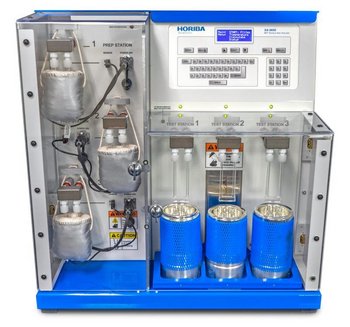
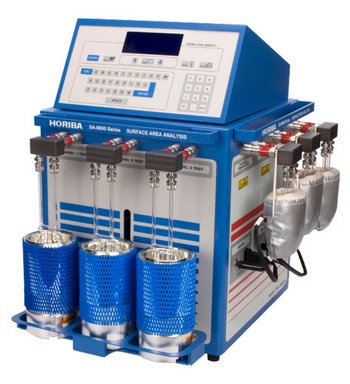
Specific surface area and pore size distribution are fundamental parameters of many solids. Properties such as porosity, strength, hardness, permeability, separation selectivity, rheology, catalytic activity, dissolution, net density, corrosion, thermal stress resistance, and other physical properties can be directly affected by the porous structure of a material. These properties can be easily investigated using the physisorption or gas adsorption technique provided by the SA-9650 Series of surface area analyzers.

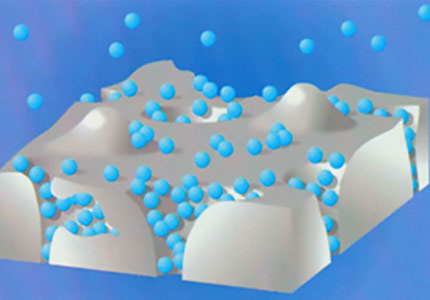
     Example of gas molecules adsorbing to a surface.

BET Theory

In nature, all surfaces adsorb water or other vapors to satisfy surface energy. After preparation for gas adsorption, known as “Degassing”, is completed, that surface energy can be used to adsorb probe gas molecules. The volume of gas adsorbed on a surface is recorded and plotted versus pressure. From these raw data, several modelling methods can be used to produce useful results. One of the most frequently used and well known is the BET method, named after the developers, Stephen Brunauer, Paul Emmett and Edward Teller. In essence, the BET method permits the calculation of a “theoretical monolayer” of gas molecules. Knowing the number of moles of gas comprising that monolayer and knowing the cross-sectional area of a single gas molecule permits the determination of surface area. Carefully recording the mass of the sample permits the reporting of “specific surface area” typically in meters squared per gram.

As more gas is adsorbed, layer upon layer of gas builds up on the surface of a material. And if porosity is present, larger pores are eventually filled. Additional models can be used to determine pore size distribution from these data.

Surface pores are divided into three categories by their diameters according to the International Union of Pure and Applied Chemistry (IUPAC). Micropores which are 2 nm and smaller, mesopores which are between 2 and 50 nm, and macropores which are greater than 50 nm.

The actual measurement process of physisorption or gas adsorption, requires the sample and sample holder to be cooled, typically using liquid nitrogen, and then exposing the sample to increasing concentrations of nitrogen in a flowing carrier gas – usually helium. As the nitrogen molecules lose thermal energy, the degassed surface energy of the material can adsorb these nitrogen molecules. In a flowing gas adsorption instrument, an automatic calibration is performed followed by an adsorption cycle and then the process is completed by returning the sample to room temperature and a desorption cycle takes place.

     Typical single point raw signal of Volts plotted vs Time.

Single and Multi Point Analysis

This process can be used one time for a single point measurement, or several times for a multi-point measurement. In general, a surface area result obtained by the multipoint method using nitrogen as the adsorbate may sometimes be more accurate than a single point measurement, but the SA-9650 is built to provide high sensitivity results even with single point analysis. The SA-9650 performs these measurements using the flowing gas method which has several advantages, including high speed of analysis, small footprint, higher reliability as well as lower purchase and ownership costs.

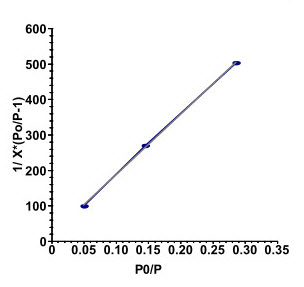
     Example of a multi-point analysis.

Whether one chooses to perform single or multi-point measurements with the SA-9650, the process is completely automated requiring that an operator only select an analysis protocol, input sample identifier and sample mass. The instrument and the onboard computer (or if desired, a separate PC) does the rest. The analysis is performed, and results are calculated and displayed and/or printed and saved.


For more information about acquiring an instrument, click here.


Application Notes

PDF
0.52 MB
thumbnail
Metal Powder Properties: A Case with Low Specific Surface Area
Determination of specific surface area of metal powders is an important parameter in the field of powder metallurgy. In this note, we demonstrate the use of Brunauer-Emmett-Teller (BET) technique to measure another critical metal powder property: specific surface area (SSA).
open
PDF
0.15 MB
thumbnail
Measuring Low Specific Surface Area Standards
A feasibility study to measure low specific surface areas with the HORIBA SA-9600 was performed using Certified Reference Materials BCR 169, 170 and 172 from the European Commission Joint Research Centre. The reference materials consist of two alpha-alumina powders and one quartz powder.
open
PDF
0.28 MB
thumbnail
Comparison of Single-Point and Multi-Point Surface Area Measurements
The Flowing Gas Technique for determining BET Surface Area has been in use for over 70 years. Many facets of the technology make it a very attractive alternative to the Static-Volumetric approach. Detection is done by measuring a gas concentration difference instead of an absolute pressure. Difference measurements are typically more accurate than many absolute measurements.
open
PDF
0.57 MB
thumbnail
Surface Area of Graphite
Graphite is an important and widely used material. Graphite’s properties stem from its hexagonal lattice structure. It is composed of carbon atoms arranged in layers, each consisting of interconnected hexagonal rings. These layers can easily slide past one another, giving graphite its characteristic lubricity.
open
PDF
0.55 MB
thumbnail
Surface Area of Aluminum Oxide
Aluminum oxide is one of the most abundant minerals in the Earth’s crust and has many practical applications. It is naturally occurring and most commonly found as bauxite. The extraction of aluminum from bauxite involves refining processes that ultimately lead to the production of aluminum oxide.
open
PDF
0.37 MB
thumbnail
Surface Area of Hydroxyapatite
Hydroxyapatite is a naturally occurring mineral form of calcium apatite. Hydroxyapatite’s unique properties make it useful in various fields and applications. It is the main mineral component of vertebrate bones and teeth and is also found in some other tissues like dentin and enamel.
open
PDF
0.39 MB
thumbnail
Surface Area of Calcium Carbonate
Calcium carbonate is used in construction materials. Limestone and marble, which are forms of calcium carbonate, are used as building stones and in the production of cement, concrete, and mortar. It is used as a filler and extender in a wide range of products...
open
PDF
0.41 MB
thumbnail
Surface Area of Bentonite
Bentonite is a widely used natural clay material which originates from past volcanic ash deposits. For industrial purposes, two main classes of bentonite are recognized: sodium and calcium bentonite. Sodium bentonite is the more valuable, but calcium bentonite is more common.
open
PDF
0.44 MB
thumbnail
Surface Area of Kaolinite
One of the most widely distributed and common clay minerals is Kaolinite. Kaolinite is a soft, earthy, usually white, mineral produced by the chemical weathering of aluminum silicate minerals like feldspar.
open
PDF
0.54 MB
thumbnail
Surface Area of Calcium Hydroxide
Calcium hydroxide, also called slaked lime or hydrated lime, is typically a white, odorless powder which is widely used in the chemical industry. An inorganic compound, it is produced by a chemical reaction when calcium oxide is mixed with water and forms calcium hydroxide.
open

Request for Information

Do you have any questions or requests? Use this form to contact our specialists.

* These fields are mandatory.

Browse Products

SA-9650 Series
SA-9650 Series

BET Surface Area Analyzers

SA-9600 Series
SA-9600 Series

BET Flowing Gas Surface Area Analyzers

  • Products
    • All Products (A-Z)
    • Mobility
    • Energy and Environment
    • Life Science
    • Healthcare
    • Materials
    • Semiconductor
  • Applications
    • Drinking Water Utilities
    • Automotive Manufacturing
    • Semiconductor Manufacturing Process
    • Research and Testing Laboratories
  • Technology
    • Glow Discharge Spectroscopy
    • Pressure-based Flowmetry
    • Quadrupole Mass Spectrometry
    • Raman Spectroscopy
  • Service
    • On-Site Support
    • Spare Parts and Consumables
  • Company
    • News
    • Events
    • Career
    • History
    • Corporate Culture
  • Contact
    • Career Contact
    • Contact Form
    • Worldwide Locations
    • Investor Relations Contact

Terms and Conditions Privacy Notice HORIBA Group Social Media