On this page: What is IRLAM™ | Advanced Optical Hardware | Advanced Calculation Algorithm | Solutions and Benefits | Conclusion
HORIBA's Infra-Red Laser Absorption Modulation (IRLAM™) is a next-generation gas measurement technology built on over 80 years of expertise in emissions analysis. As a new core technology for HORIBA, it will be integrated into future gas analysis systems.
This article provides an in-depth look at IRLAM technology, highlights current IRLAM solutions in HORIBA’s portfolio, and highlights its measurement advantages over previous-generation techniques.
HORIBA's IRLAM technology combines advances in laser technology, computational algorithms, and modern sampling techniques to deliver highly accurate and reliable measurements. IRLAM combines three technology pillars that enable HORIBA to solve current and future measurement challenges for its markets with highly accurate low concentration measurement of complex pollutants:
Figure 1: Three pillars of IRLAM technology
These three pillars have resulted in the creation of an IR technology which overcomes many of the challenges associated with conventional emissions measurement methods, especially insufficient sensitivity, and interference from coexisting gases.
Figure 2: Schematic representation of absorption spectrum for target gas and interference gas
Each exhaust gas component absorbs specific wavelengths of light, forming the foundation of absorption spectroscopy. HORIBA has developed a simplified approach by modulating the wavelength of a QCL around a target gas's absorption peak.
By leveraging advanced laser technology, HORIBA enhances the QCL method, precisely tuning the target wavelength through structural and temperature control in the mid-infrared region (~3-100 nm). This narrow wavelength window enables accurate concentration measurements while minimizing interference from other gases. The schematic below illustrates target gas absorption signals in the mid-infrared region alongside interfering gases, demonstrating how precise laser control ensures accurate analysis.
Furthermore, HORIBA's QCL is developed, designed, and manufactured in-house specifically for gas measurement, and has unique innovations to minimize optical interference noise and oscillation wavelength shift due to ambient temperature change, which are issues unique to gas analysis using lasers. (Patented: Japanese Patent No. 07090572, US Patent No. 10551299) (Europe, China: Patent pending)
Advancements in optical hardware have also driven improvements in the sampling system. HORIBA's Herriott Cell design maintains a long optical path length while reducing footprint size. The high directivity of HORIBA’s QCL lasers enables extended optical paths within a compact detector cell without signal degradation—critical for accurate low-concentration emissions measurement. This extended path length increases light-molecule interactions, even at low gas flow rates ensuring high-speed and precise measurements across a wide concentration range.
Figure 3: Schematic of the internal structure of Herriot detector cell, which utilizes spherical mirrors and a high-directivity QCL laser to achieve long optical path lengths in a small physical space (left), and an image of the detector cell exterior (right).
Particularly relevant for automotive emissions testing, IRLAM offers a unique approach to NOx measurement compared to conventional infrared spectroscopy. Unlike traditional methods, it utilizes a QCL that emits light in the mid-infrared region, where NO and NO₂ molecules strongly absorb light.
By using a QCL laser instead of a broad-band light source, IRLAM minimizes interference from co-existing gases. A narrow, focused wavelength window is used for calculations, reducing cross-gas interference. Since each gas component has its own dedicated light source, no converter is needed, making IRLAM an efficient alternative to both conventional IR and CLD techniques as illustrated below.
Figure 4: Overview of IR measurement techniques including IRLAM
Extracting meaningful data from raw absorption signals is essential for accurate concentration measurements. HORIBA’s advanced concentration calculation algorithm enhances precision and sensitivity by effectively isolating key features from the measured signal. Unlike conventional intra-pulse methods that require large datasets and high-specification computers, IRLAM achieves the same level of accuracy with significantly less data, enabling the use of smaller embedded microcomputers.
HORIBA has developed a streamlined absorption spectroscopy method by modulating the wavelength of a QCL around a target gas’s absorption peak. The resulting absorption signal is correlated with predetermined feature reference signals, allowing for effective interference correction—similar to the principles of pneumatic detector-type NDIR gas sensors. This approach, named IRLAM, simplifies spectroscopy while improving measurement reliability.
Figure 5: Conceptual diagram of the measurement principle of IRLAM for (a) the feature quantity extraction and (b) the interference correction.
The diagram above illustrates IRLAM’s measurement principle. When the QCL wavelength is modulated around a target gas’s absorption peak, the detector output signal D(t) changes according to the sample gas's absorption spectrum. By applying a logarithmic transformation to D(t) and removing the DC component, the absorption-modulated signal A(t) is obtained. The “feature quantities” Si are then derived by correlating A(t) with feature reference signals Fi(t) over the modulation period T, where i = 1, 2, …, n, and n is a positive integer.
By comparing these feature quantities with the pre-measured unique feature quantities of the target gas and interfering gas, the system recognizes the degree of mixing of each component based on the relationship and calculates the concentration.
Figure 6: Comparison of concentration calculation methods between conventional technology and IRLAM.
Compared to conventional spectrum fitting method, which requires hundreds of data points to calculate, this feature-based approach can calculate the concentration using only a few numerical values, thus significantly reducing the number of calculations. However, this does not degrade the accuracy of the measurement because the feature quantity contains enough information necessary for measurement.
By utilizing the “Feature Quantity” approach, IRLAM provides a streamlined and effective interference correction method with fewer variables than traditional spectral curve-fitting. This approach compresses spectral data through feature extraction, eliminating the need for complex calculations - where conventional spectral curve fitting requires solving several hundred simultaneous linear equations due to the large number of spectral data points. In contrast, IRLAM reduces this to around 10 equations, cutting calculation time by a factor of 10–100. As a result, even for fast-response real-time measurements, a high-performance computer is unnecessary—an embedded processor is sufficient. This enables the development of compact analyzers without bulky computer systems, making IRLAM highly advantageous for industrial applications.
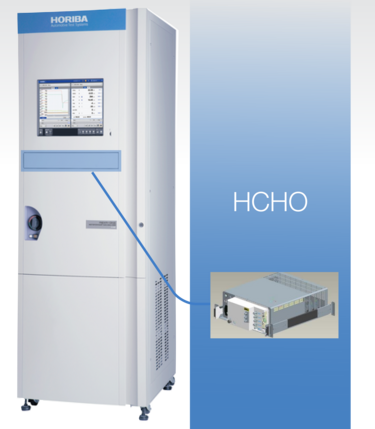
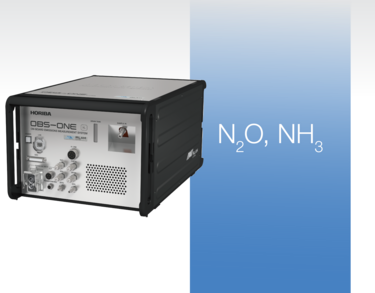
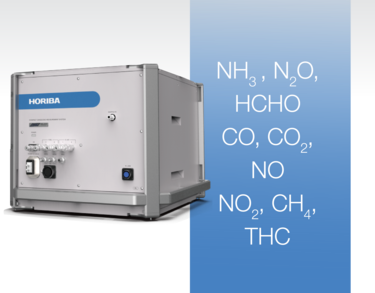
IRLAM has enabled the development of advanced in-laboratory and on-road measurement systems. HORIBA has introduced a lineup of IRLAM-based products that help improve vehicle environmental performance and support the automotive industry's goal of reducing emissions even as vehicle electrification advances. HORIBA has a product roadmap that will expand the current portfolio to include additional gas species and applications by 2030.
HORIBA’s current portfolio of IRLAM equipment for automotive testing, showing both in lab solutions (top) and portable in-use testing equipment (bottom).
As a solution for automotive testing, HORIBA is confident that IRLAM technology provides significant benefits for both OEMs and regulatory agencies, particularly in NOx measurement. With increasingly stringent NOx standards, these advantages lead to improved data quality and potential cost reductions:
IRLAM, the latest advancement in HORIBA’s core measurement technology, is a cutting-edge gas analysis solution backed by eight decades of expertise. This proprietary IR technology integrates innovative hardware and advanced processing algorithms to address the limitations of conventional emissions measurement methods.
Now embedded in HORIBA’s IRLAM-based in-lab and on-road measurement systems, this groundbreaking technology enhances NOx measurement for OEMs and regulatory agencies. Key benefits include superior accuracy, reliable wet measurement, minimal interference, lower maintenance costs, and consistent response times—contributing to improved vehicle environmental performance and supporting the automotive industry's emission reduction efforts.
Article Written by:
Joshua Israel, Applications Engineering and Technical Marketing Manager, HORIBA Instruments, Inc.
HORIBA제품의 자세한 정보를 원하시면, 아래의 양식에 내용을 입력을 부탁드립니다.