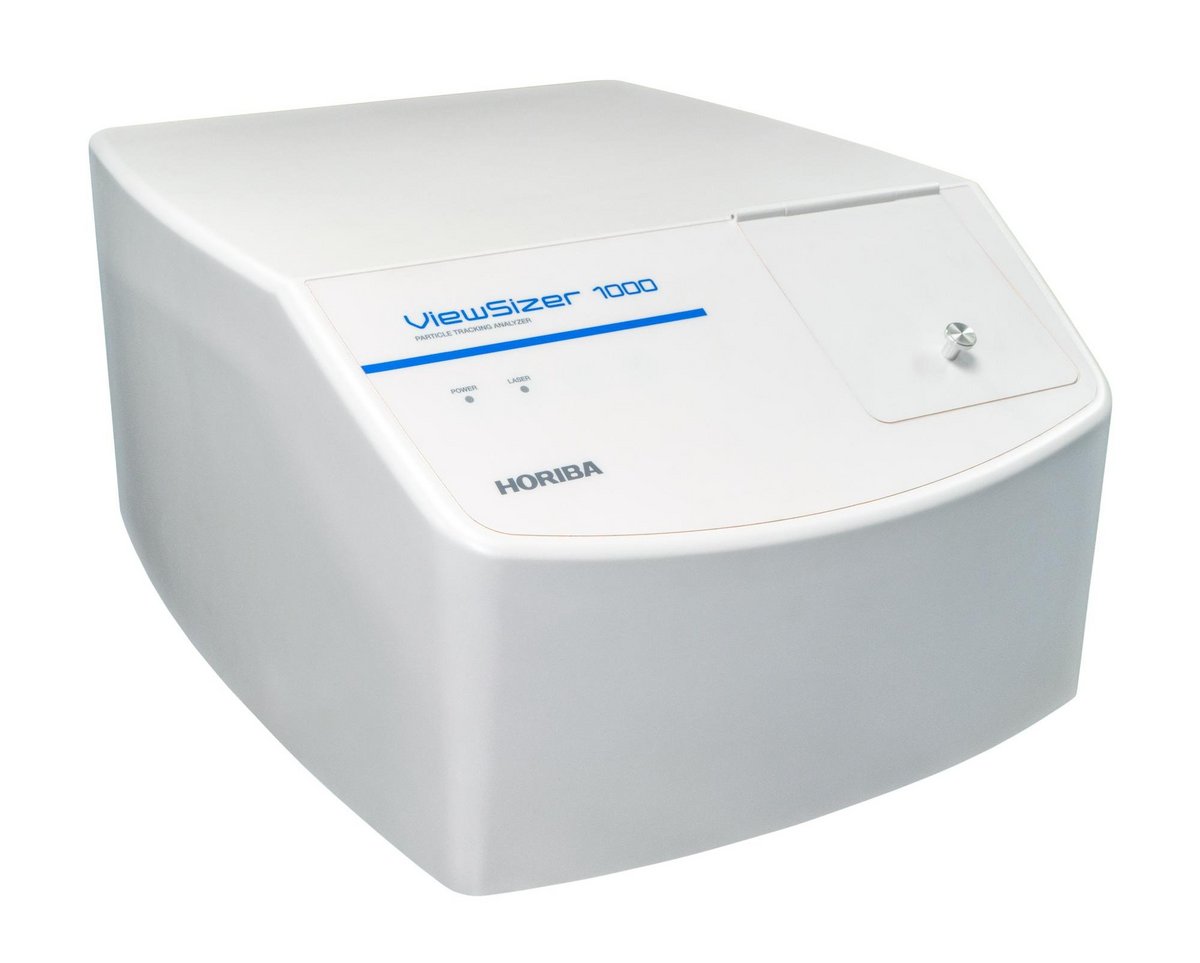
ViewSizer 1000

多变量脉冲纳米颗粒追踪分析(NTA)

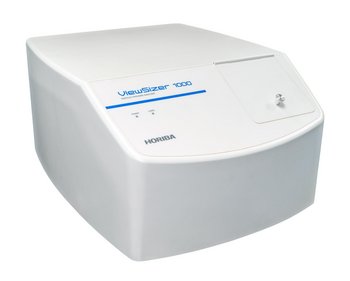
ViewSizer™ 1000 采用多变量脉冲纳米颗粒追踪分析(MVP NTA)技术,仅凭一台紧凑型单激光系统,即可实现传统多激光 NTA 系统的分析能力。

对于细胞外囊泡(EVs)、纳米气泡、脂质体、病毒、蛋白质及胶体等复杂样品,如何高效、可重复且精确地测定纳米颗粒的尺寸分布与浓度,仍是一项技术挑战。尽管激光衍射和动态光散射(DLS)等光散射技术能够快速提供平均粒径数据,但受其原理所限,无法同时获取颗粒浓度信息及单颗粒尺度的分布特征。

纳米颗粒追踪分析(NTA)技术本身具备单颗粒级别的粒径分析能力,而 ViewSizer 1000 在此基础上进一步融合 MVP NTA 技术,无需复杂多激光配置,即可针对各类复杂样品获得准确高、重复好的颗粒分析结果。

*仅在部分区域有售。如需更多信息,请联系我们。

产品分类: 颗粒表征
制造商: HORIBA Instruments Incorporated

仪器特点

  • 专利的多变量脉冲 NTA 技术(MVP NTA):精准采集宽分布颗粒的数据;
  • 光学稳定性、温控与磁力搅拌设计:确保光学条件、检测温度与颗粒混合均匀性的一致,保障检测结果的重复性;
  • 高空间分辨率 NTA:可对缓慢移动的颗粒(含沉降分析)进行检测,拓宽颗粒尺寸上限;
  • 易清洗、可更换的比色皿:使用比色皿而非管路式进样装置,有效防止交叉污染,减少样品消耗,简化操作流程;
  • 灵活的参数设置:可独立设置激光强度、相机增益、脉冲时长及帧率,满足个性化实验需求;
  • 内置标准检测方法:覆盖多种应用场景,即选即用,高效测试;
  • 多种和比色皿可选,适配各类溶剂:包括玻璃/石英、氟聚合物及阳极氧化铝;另可选配玻璃/氟聚合物比色皿;
  • 非管路设计:样品消耗量更低;


关于多变量脉冲纳米颗粒追踪分析(NTA)技术

新一代软硬件平台采用“一系列可变脉冲宽度”替代传统的“可变激光功率”,每个脉宽均对应独立的视频帧序列。其中,长脉冲帧对小颗粒信号灵敏,短脉冲帧则更有利于大颗粒的检测;随后基于Stokes-Einstein方程,通过分析颗粒位置随时间的变化(即布朗运动轨迹),即可得到样品中每个颗粒的粒径。

由于样品体积精确已知,结合成像获取的颗粒计数,无需额外信息即可直接得出颗粒数浓度。为确保采样均匀性,系统采用磁力搅拌进行随机混匀(而非管路慢速流动),有效避免流式体系固有的选择偏差;仪器自动汇总各视频帧识别的颗粒总数,并除以测量体积,即可计算得到样品浓度。

由此,仅需一台系统即可同步完成粒径分布与颗粒浓度的快速、精确测量,实现了对复杂样品的高效综合表征。


先进的软件

ViewSizer 1000 软件设计得直观易用,只需几次点击即可启动数据采集,结果支持多种格式导出,便于后续分析。界面实时呈现所有颗粒的影像,有助于随时观察样品状态并评估数据质量。


    测量范围

    10 nm - 15 μm

    样品体积

    100 μL - 2.5 mL

    样品浓度范围

    1E5 - 1E9 颗粒/mL

    仪器尺寸

    55 cm (W) x 66 cm (D) x 35 cm (H)

    运行环境

    15°C - 30°C , 相对湿度 <85%  
    (干燥气体吹扫功能允许在露点以下运行)
    用电100 - 240 伏交流电,47-63 赫兹(含),功率<450 w
    1 级激光21 CFR 第 I 章 第 1040 部分

    Investigating Polydispersity Limits with Multi-Variable Pulse Nanoparticle Tracking Analysis
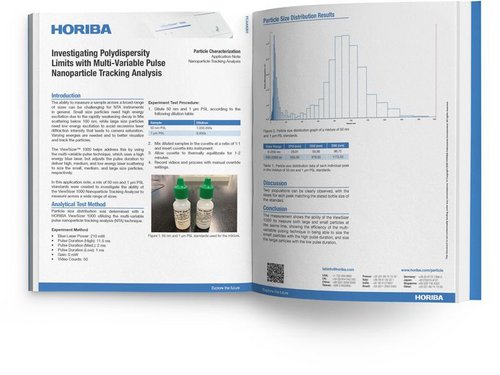
    Investigating Polydispersity Limits with Multi-Variable Pulse Nanoparticle Tracking Analysis
    The ability to measure a sample across a broad range of sizes can be challenging for NTA instruments in general. Small size particles need high energy laser scattering due to the exponential decay in Mie scattering below 100 nm, while large size particles need low energy laser scattering to avoid excessive laser diffraction patterns and to better visualize and track the particles. The ViewSizer 1000 helps address this.
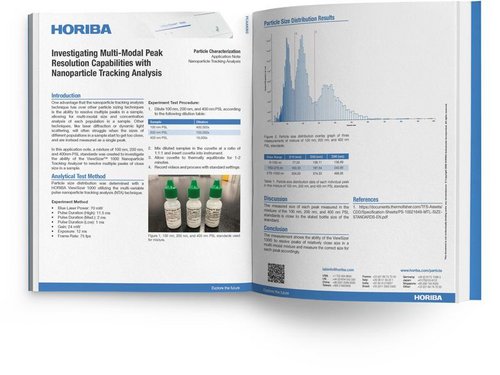
    Investigating Multi-Modal Peak Resolution Capabilities with Nanoparticle Tracking Analysis
    Investigating Multi-Modal Peak Resolution Capabilities with Nanoparticle Tracking Analysis
    One advantage that the nanoparticle tracking analysis technique has over other particle sizing techniques is the ability to resolve multiple peaks in a sample, allowing for multi-modal size and concentration analysis of each population in a sample. Other techniques, like laser diffraction or dynamic light scattering, will often struggle when the sizes of different populations in a sample start to get too close, and are instead measured as a single peak.
    Repeatability Analysis for Size and Concentration using Nanoparticle Tracking Analysis
    Repeatability Analysis for Size and Concentration using Nanoparticle Tracking Analysis
    Repeatability is an important factor that is often overlooked with NTA measurements, but it is good practice to always check repeatability when performing measurements as it not only checks that the instrument is giving accurate and repeatable results, it also checks that the sample is stable at that dilution or measurement condition. In this application note, Fuso PL-71 colloidal silica was measured fifteen times on the same sampling to evaluate instrument repeatability and sample stability.
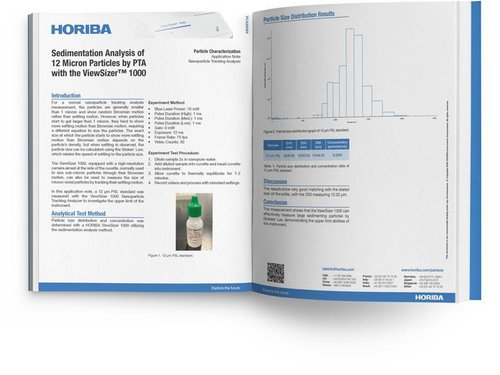
    Sedimentation Analysis of 12 Micron Particles by PTA with the ViewSizer™ 1000
    Sedimentation Analysis of 12 Micron Particles by PTA with the ViewSizer™ 1000
    For a normal nanoparticle tracking analysis measurement, the particles are generally smaller than 1 micron and show random Brownian motion rather than settling motion. However, when particles start to get larger than 1 micron, they tend to show more settling motion than Brownian motion, requiring a different equation to size the particles. The exact size at which the particle starts to show more settling motion than Brownian motion depends on the particle’s density, but when settling is observed, the particle size can be calculated using the Stokes’ Law, which relates the speed of settling to the particle size.
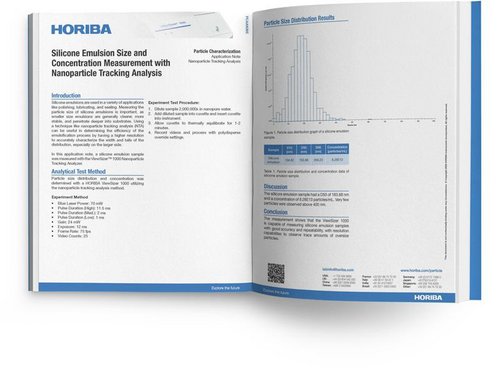
    Silicone Emulsion Size and Concentration Measurement with Nanoparticle Tracking Analysis
    Silicone Emulsion Size and Concentration Measurement with Nanoparticle Tracking Analysis
    Silicone emulsions are used in a variety of applications like polishing, lubricating, and sealing. Measuring the particle size of silicone emulsions is important, as smaller size emulsions are generally clearer, more stable, and penetrate deeper into substrates. Using a technique like nanoparticle tracking analysis (NTA) can be useful in determining the efficiency of the emulsification process by having a higher resolution to accurately characterize the width and tails of the distribution, especially on the larger side.
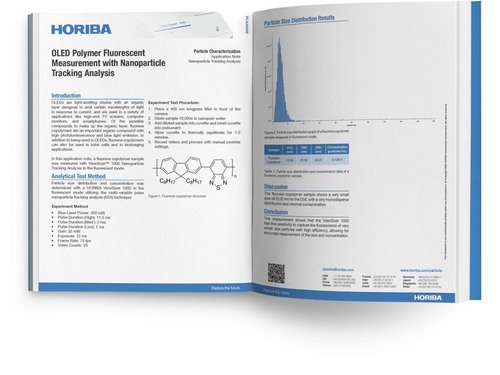
    OLED Polymer Fluorescent Measurement with Nanoparticle Tracking Analysis
    OLED Polymer Fluorescent Measurement with Nanoparticle Tracking Analysis
    LEDs are light-emitting diodes with an organic layer designed to emit certain wavelengths of light in response to current, and are used in a variety of applications like high-end TV screens, computer monitors, and smartphones. Of the possible compounds to make up the organic layer, fluorene copolymers are an important organic compound with high photoluminescence and blue light emission. In addition to being used in OLEDs, fluorene copolymers can also be used in solar cells and in bioimaging applications.
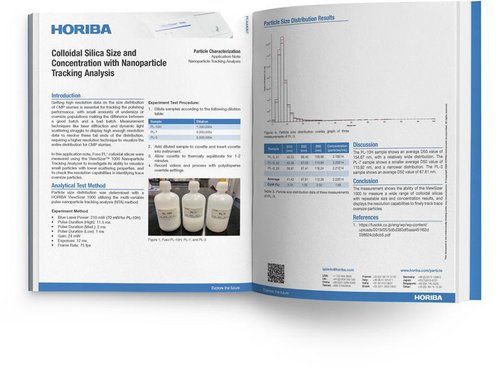
    Colloidal Silica Size and Concentration with Nanoparticle Tracking Analysis
    Colloidal Silica Size and Concentration with Nanoparticle Tracking Analysis
    In this application note, Fuso PL1 colloidal silicas were measured using the ViewSizer 1000 Nanoparticle Tracking Analyzer to investigate its ability to visualize small particles with lower scattering properties, and to check the resolution capabilities in identifying trace oversize particles.
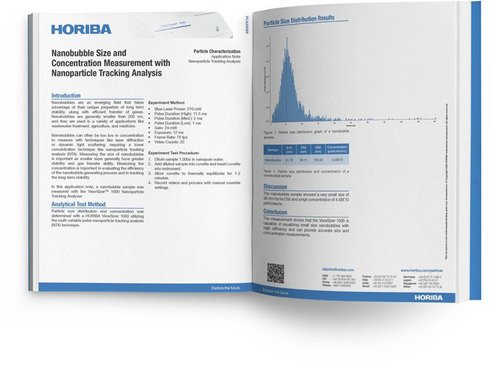
    Nanobubble Size and Concentration Measurement with Nanoparticle Tracking Analysis
    Nanobubble Size and Concentration Measurement with Nanoparticle Tracking Analysis
    In this application note, a nanobubble sample was measured with the ViewSizer 1000 Nanoparticle Tracking Analyzer.
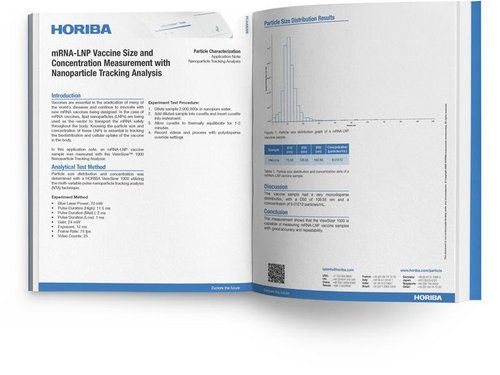
    mRNA-LNP Vaccine Size and Concentration Measurement with Nanoparticle Tracking Analysis
    mRNA-LNP Vaccine Size and Concentration Measurement with Nanoparticle Tracking Analysis
    Vaccines are essential in the eradication of many of the world’s diseases and continue to innovate with new mRNA vaccines being designed. In the case of mRNA vaccines, lipid nanoparticles (LNPs) are being used as the vector to transport the mRNA safely throughout the body. Knowing the particle size and concentration of these LNPs is essential in tracking the biodistribution and cellular uptake of the vaccine in the body. In this application note, an mRNA-LNP vaccine sample was measured with the ViewSizer 1000.
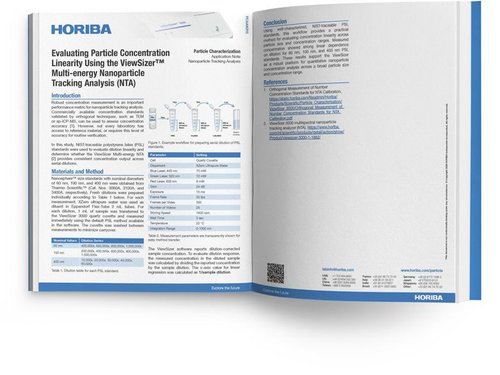
    Evaluating Particle Concentration Linearity Using the ViewSizer™ Multi-energy Nanoparticle Tracking Analysis (NTA)
    Evaluating Particle Concentration Linearity Using the ViewSizer™ Multi-energy Nanoparticle Tracking Analysis (NTA)
    Robust concentration measurement is an important performance metric for nanoparticle tracking analysis. Commercially available concentration standards validated by orthogonal techniques, such as TEM or sp-ICP-MS, can be used to assess concentration accuracy. However, not every laboratory has access to reference material, or requires this level of accuracy for routine verification. In this study, NIST-traceable polystyrene latex (PSL) standards were used to evaluate dilution linearity...

    留言咨询

    如您有任何疑问,请在此留下详细需求信息,我们将竭诚为您服务。

    * 这些字段为必填项。

    更多推荐

    ViewSizer 1000
    ViewSizer 1000

    多变量脉冲纳米颗粒追踪分析(NTA)

    ViewSizer 1000
    ViewSizer 1000

    多变量脉冲纳米颗粒追踪分析(NTA)

    Corporate