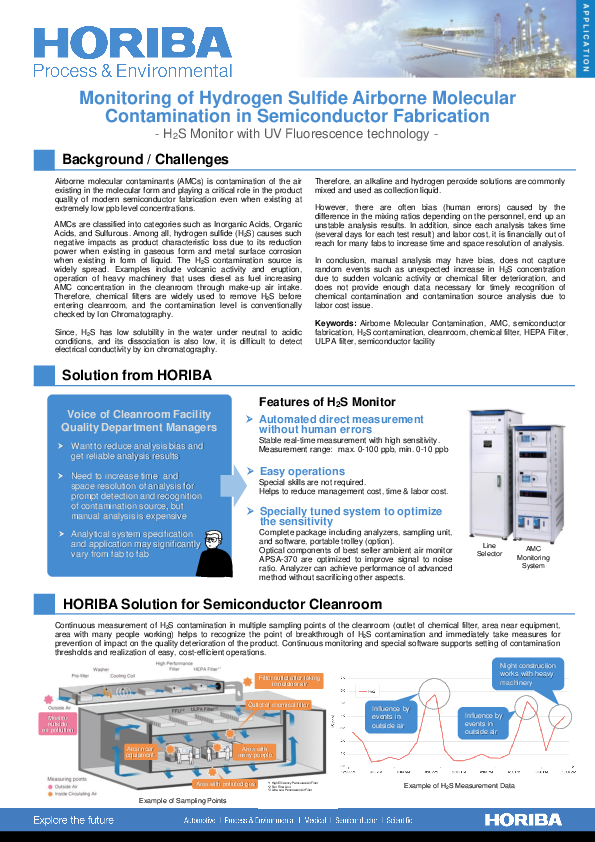
Monitoring of Hydrogen Sulfide Airborne Molecular Contamination in Semiconductor Fabrication
- H2S Monitor with UV Fluorescence Technology -
Airborne molecular contaminants (AMCs) is contamination of the air existing in the molecular form and playing a critical role in the product quality of modern semiconductor fabrication even when existing at extremely low ppb level concentrations.
AMCs are classified into categories such as Inorganic Acids, Organic Acids, and Sulfurous. Among all, hydrogen sulfide (H2S) causes such negative impacts as product characteristic loss due to its reduction power when existing in gaseous form and metal surface corrosion when existing in form of liquid. The H2S contamination source is widely spread. Examples include volcanic activity and eruption, operation of heavy machinery that uses diesel as fuel increasing AMC concentration in the cleanroom through make-up air intake. Therefore, chemical filters are widely used to remove H2S before entering cleanroom, and the contamination level is conventionally checked by Ion Chromatography.
Since, H2S has low solubility in the water under neutral to acidic conditions, and its dissociation is also low, it is difficult to detect electrical conductivity by ion chromatography. Therefore, an alkaline and hydrogen peroxide solutions are commonly mixed and used as collection liquid.
However, there are often bias (human errors) caused by the difference in the mixing ratios depending on the personnel, end up an unstable analysis results. In addition, since each analysis takes time (several days for each test result) and labor cost, it is financially out of reach for many fabs to increase time and space resolution of analysis.
In conclusion, manual analysis may have bias, does not capture random events such as unexpected increase in H2S concentration due to sudden volcanic activity or chemical filter deterioration, and does not provide enough data necessary for timely recognition of chemical contamination and contamination source analysis due to labor cost issue.
Voice of Cleanroom Facility Quality Department Managers
- Want to reduce analysis bias and get reliable analysis results
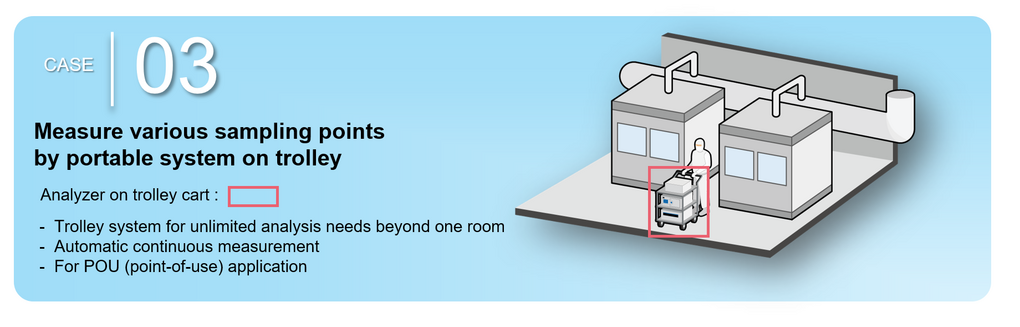
- Need to increase time and space resolution of analysis for prompt detection and recognition of contamination source, but manual analysis is expensive
- Analytical system specification and application may significantly vary from fab to fab