Key Takeaways
A-TEEM spectroscopy represents a critical advancement in molecular characterization, offering analytical sensitivity that rivals traditional vibrational methods like Raman spectroscopy. By integrating absorption, transmission, and excitation/emission matrix fluorescence into a single instrument, this methodology detects subtle conformational alterations in large organic molecules. This synergistic approach effectively resolves historic fluorescence concentration limitations, empowering scientists to perform precise, real-time characterization across environmental water monitoring and cell culture analysis.
Read the original story: A-TEEM–A Fantastic Spectroscopy that Rivals Raman. Fran Adar. https://doi.org/10.56530/spectroscopy.ub3580s6
A-TEEM resolves the traditional limitation of concentration-dependent signal degradation by simultaneously measuring absorption, transmission, and excitation/emission matrix fluorescence to correct the Inner Filter Effect (IFE). This quantitative characterization ensures spectral profiles remain linear and independent of concentration up to 2 absorbance units. Beyond basic concentration correction, this allows researchers to execute precise multicomponent analysis and measure the Quantum Efficiency (QE) of the underlying fluorescence process.
A-TEEM enables the rapid characterization of cell culture media by generating highly sensitive molecular fingerprints that distinguish between nearly identical formulations, avoiding the heavy sample handling of mass spectrometry. Utilizing Parallel Factor Analysis (PARAFAC) and principal component analysis, the technique successfully clusters media with similar chemistries. Building upon static formulation verification, the methodology can effectively track molecular degradation when samples are exposed to ambient temperatures.
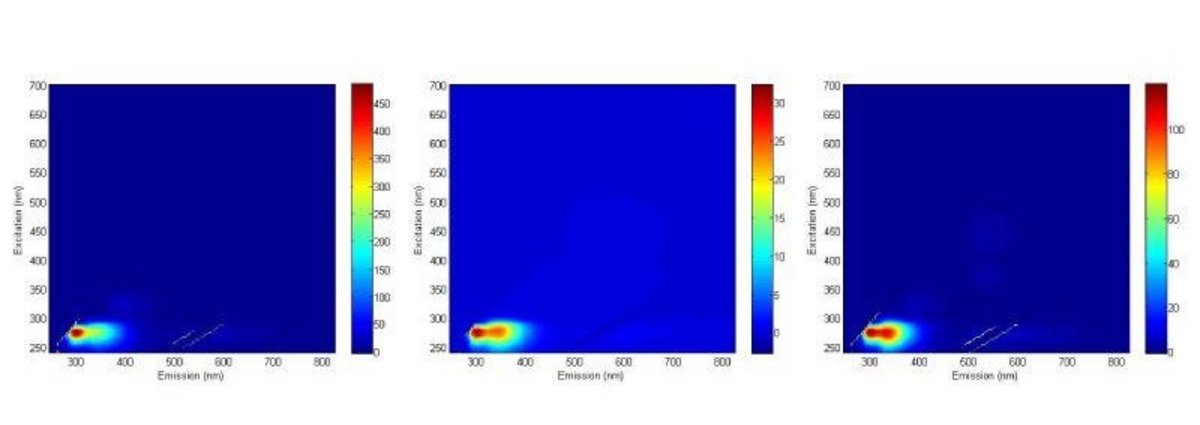
A-TEEM characterizes the biogeochemical evolution of aquatic ecosystems by precisely tracking the composition and transformation of Dissolved Organic Matter (DOM) over time and geographic location. By decomposing trilinear data arrays, analysts can quantify independent underlying components during water treatment processes. The spectral analysis reveals complex ecological mechanisms, directly mapping how microorganisms convert shorter-wavelength tryptophan-like substances into longer-wavelength microbial humic-like components during aquatic remediation.
Sie haben Fragen oder Wünsche? Nutzen Sie dieses Formular, um mit unseren Spezialisten in Kontakt zu treten.