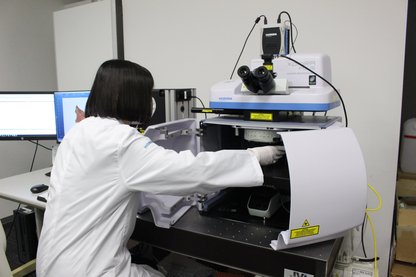
A scene of Dr.Taguchi analyzing and investigating works
In 2024, a notification arrived at the Museum of Art, Kochi questioning the authenticity of the painting “Girl and Swan,” part of the museum’s collection. This inquiry was rooted in the recent scandal that shook the art world: the arrest of Wolfgang Beltracchi, known as the "master of forgery." As more and more of Beltracchi's forgeries were uncovered, the museum began an investigation into the authenticity of “Girl and Swan,” prompted by information provided by the Berlin State Police.
Dr. Kaori Taguchi, Associate Professor at Kyoto University and a renowned art conservator, was entrusted with the scientific analysis of the painting. Dr. Taguchi has achieved remarkable results in the fields of art preservation and scientific investigation, and her longstanding relationship with the Museum of Art, Kochi—built through previous restoration projects—made her the ideal candidate for this task. HORIBA also collaborated in this scientific analysis.
“Using scientific analysis to uncover the internal structure and composition of a painting is essential to understanding its origins, techniques, and the context of its creation. For those involved in preservation and restoration, tracing the history and techniques of a work is indispensable for grasping its journey through time,” Dr. Taguchi explains.
“The subject of this investigation, Heinrich Campendonk’s “Girl and Swan,” is a work listed in a catalogue raisonné—a comprehensive inventory of an artist’s works—but had long been considered lost,” Dr. Taguchi says, offering insight into the painting’s unusual history.
The painting had been treated as an authentic work largely due to the captivating narrative surrounding its “rediscovery.”This supposed “lost masterpiece” emerged suddenly, evoking great excitement and admiration among art experts and enthusiasts. Adding to the illusion of authenticity, the forger meticulously falsified the painting’s provenance, affixing fake labels to the back of the canvas to make it appear genuine.
Wolfgang Beltracchi, the forger behind the painting, further complicated the authentication process by skillfully imitating the hallmarks of Campendonk’s style. The vibrant colors, fantastical depictions of animals, and forest landscapes—elements characteristic of Campendonk—were cleverly incorporated to convince viewers that “Girl and Swan” was indeed a legitimate work. These sophisticated techniques ultimately led many to believe in the painting’s authenticity, creating a situation where forgery was mistaken for truth.

[Photo] Exterior view of the Museum of Art, Kochi
[Painting] “Girl with Swan,” a forgery by Wolfgang Beltracchi falsely attributed to Heinrich Campendonk, 1990s, collection of Museum of Art, Kochi
The investigation began with a preliminary examination to confirm the painting’s techniques, structure, and any signs of restoration. Following this, a detailed scientific analysis was conducted step by step.
The first technique employed was X-ray fluorescence (XRF) analysis. XRF is an essential tool for identifying the metallic elements in pigments, helping to determine the distribution and composition of colors. Using this method, the team obtained fundamental information about the painting’s pigments, paving the way for further analysis. Two types of XRF devices were utilized: a handheld XRF analyzer capable of examining large canvases and an X-ray analytical microscope that can analyze areas as small as tens of micrometers.
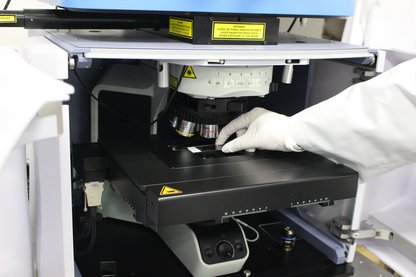
Next, the team used a Microscopic Raman Spectrometer. This highly sensitive technology can analyze the chemical structure of pigments from minute samples, offering detailed information that XRF cannot provide. For this investigation, samples measuring less than 1mm were taken from the edges of the painting and analyzed for primary colors such as blue, green, red (pink), and white.
Raman spectroscopy revealed surprising findings. Pigments such as “phthalocyanine blue,” “phthalocyanine green,” and “titanium white”—materials not widely available until the 1930s—were detected in “Girl and Swan.” These pigments, commonly found in Beltracchi’s forgeries, served as key evidence in determining the painting’s authenticity.
The high sensitivity of Raman spectroscopy allows the identification of chemical structures even from extremely small samples. From a sample smaller than a grain of sand, the device can extract valuable information and compare it against databases or reference samples to determine its origin. The precision of this technology is truly remarkable. Science, with its ability to transcend time, can uncover the truth hidden within materials. In this case, the analysis demonstrated that the painting contained materials that could not have existed during the era it was supposedly created. This finding played a critical role in determining the painting’s true nature.

A scene of analyzing paint pigments using a micro Raman spectroscopic analyzer
One notable aspect of this investigation was the permission granted to extract pigment samples from the painting—a rare occurrence in Japanese museums. Destructive testing is not undertaken lightly; it is only performed when absolutely necessary and is done with the utmost care to minimize risks to the artwork.
In this case, preliminary research, including information from the Berlin State Police, the examination of falsified labels, and prior studies, strongly suggested that “Girl and Swan” was not an authentic Campendonk painting. This led to the decision to proceed with the investigation under the hypothesis that the painting was likely a forgery. International institutions have also conducted sample-based analyses in cases involving Beltracchi’s forgeries. Based on this context, the Museum of Art, Kochi granted permission for micro-sampling under strict conditions.
Even samples smaller than 1mm can yield significant information, a fact that became apparent during this investigation. Scientific analysis not only aids in determining the authenticity of specific works but also broadens our understanding of art, history, and culture. This investigation exemplifies the potential of science to contribute to these fields.
Approaching the authenticity of the painting by examining analysis data obtained from minute samples and identifying the next areas to investigate
In the authentication of artworks, traditional visual observation remains an indispensable method. By intuitively recognizing an artist’s techniques, stylistic traits, and the conventions of their era, experts can distinguish between genuine works and forgeries. However, when an artist’s body of work is limited or research on their techniques is scarce, visual authentication alone may not suffice.
This is where scientific approaches come into play. By analyzing the chemical composition of pigments and identifying materials at the molecular level, science can uncover evidence that traditional methods might overlook. Such analyses provide new perspectives, deepening our understanding of art history and artistic techniques.
Even forgeries have stories to tell. While the act of forgery is undeniably deceptive and disrespectful to the original artist, the study of these works can open new avenues for understanding the art world.
Scientific analysis of forgery techniques and materials reveals the intentions and methods of the forger, shedding light on the historical and cultural context in which the forgery was created. For example, analyzing pigments can highlight differences from contemporaneous materials and uncover unique aspects of the forger’s process. This information contributes to a broader understanding of artistic expression and technique during the period in question.
Rather than dismissing forgeries as mere falsehoods, studying them can provide valuable insights into art history. Scientific investigations can transform forgery into a starting point for discussions in philosophy, material science, and law, among other fields.
One of the most challenging aspects of this investigation was considering both Campendonk’s techniques and Beltracchi’s methods, approaching the painting from both perspectives. Understanding these techniques and verifying them through scientific analysis required a highly complex and meticulous process.
Scientific analysis treats paintings as physical objects, examining their structure and materials to uncover hidden truths. In this case, science provided crucial clues that ultimately revealed the painting’s true nature.
The issue of authenticity has been a persistent theme in art history and culture since ancient times. Rather than reducing it to a simplistic binary of good or bad, it is important to examine the details and context of such cases as part of the broader history of art. By delving into the complexities behind these stories, we can uncover valuable insights.
As someone involved in this investigation, I believe it is essential to share the findings with the public. The exhibition at the Museum of Art, Kochi, scheduled for September and October 2025, provides a unique opportunity to present the results of this scientific analysis.
In addition to “Girl and Swan,” the exhibition will feature works by artists from the same era as Campendonk. By exploring the intersection of science and art, visitors can experience the joy of discovery and gain new perspectives on how paintings are constructed and the techniques used to create them. I hope this exhibition inspires visitors to deepen their enjoyment of uncovering artworks as physical objects and gaining new insights through the lens of science.
(Interview conducted: August 2025)
All information, including the names of organizations, affiliations, and positions mentioned in the text, are as of the time of the interview.
Each individual value serves as a clue to uncovering the truth of the work.
Museums, Historical Sites and Similar Institutions - HORIBA
X-ray Analytical Microscope (Micro-XRF) XGT-9000 - HORIBA
X-ray Analytical Microscope Super Large Chamber Model (Micro-XRF) XGT-9000SL - HORIBA
XploRA PLUS: MicroRaman Spectrometer - Confocal Raman Microscope - HORIBA