
In today’s industrial landscape, electronic and electrical systems are increasingly exposed to corrosive gases like sulfur dioxide (SO2) - a byproduct of fossil fuel combustion and various industrial processes. These pollutants can silently degrade contact surfaces, weaken connections, and ultimately lead to costly failures. That is why ISO/IEC 60068-2-42*, the internationally recognized sulphur dioxide test for contacts and connections, is a vital tool for manufacturers committed to reliability and performance.
This test is especially relevant for industries such as automotive, aerospace, and telecommunications, where even minor corrosion can cause signal loss, system malfunction, or safety risks.
The procedure involves exposing components to a controlled atmosphere containing 10 or 25 ppm of SO2, maintained at 25°C and either 75% or 93% relative humidity, for 4, 10, or 21 days, depending on the test objective. After exposure, the components are evaluated for contact resistance changes, mechanical integrity, and visual signs of corrosion.
This accelerated aging process reveals vulnerabilities that might otherwise remain hidden until failure occurs in the field. Laboratories around the world (often ISO17025 accredited) offer corrosion test chambers and testing services to conduct these tests with precision and repeatability.
One significant challenge faced by operators of these chambers is accurately measuring and maintaining SO2 concentration at 10 or 25 ppm throughout the test period, with minimal drift under harsh sample gas conditions.
One approach is to dilute the sample gas to mitigate its corrosive nature however, this makes precise measurement of the SO2 concentration more difficult.
* IEC 60068-2-42:2003 Environmental testing - Part 2-42:Tests - Test Kc: Sulphur dioxide test for contacts and connections
Accurate measurement of SO2 throughout the test cycle in a corrosion test chamber using sulfur dioxide monitor APSA-380
As an air quality monitor, the APSA-380 delivers reliable measurement of even trace levels of SO2, even when used with a dilution system.
As demonstrated in QAL1 testing, the APSA-380 showed span drift of less than 2.5% of full scale over three months without calibration.
APSA-380 can be easily integrated in automation systems with Modbus TCP/IP communication.
APSA-380

Sulfur Dioxide Monitor APSA-380 - HORIBA
Dilution unit*

Dilution ratios: 1:10 / 1:50 / 1:100
* The design of dilution unit may vary by region.
Gas Measured | SO2 |
Measurement ranges | 0 - 0.05 / 0.1 / 0.2 / 0.5 / 1.0 / 5.0 / 10 / 20 ppm |
LDL (2σ) | < 0.3 ppb * |
Repeatability | ±1.0% of full scale |
Linearity | ±1.0% of full scale |
Zero drift | < 0.5 ppb (24 h) |
Span drift | < 0.5 % of full scale (24 h) |
* For ranges less than 1 ppm
* Digital filter
Figure. Experimental setup for corrosion testing of electronic components
 Voice from an Operating Engineer of a Test Chamber in Germany
 “If the analyzer does not maintain sufficient stability throughout the test cycle, the experiments must be invalidated. The APSA-380 with dilution has shown a level of stability we had not experienced before. It has been a major improvement in our daily process.”
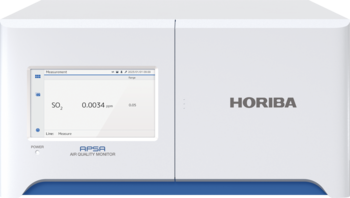
Sulfur Dioxide Monitor
如您有任何疑问,请在此留下详细需求信息,我们将竭诚为您服务。


