DNW's Cutting-Edge Automotive Testing: Powered by HORIBA's Wind Tunnel Innovation

In this interview, Dr. Ing. Andreas Bergmann, Managing Director of DNW (German-Dutch Wind Tunnels), discusses innovative advancements in automotive testing and the crucial role of wind tunnels. He sheds light on the challenges faced and the breakthroughs achieved under his leadership. Discover how strategic partnerships have enhanced DNW's testing capabilities and contributed to their success.

Please tell us a bit about DNW and what you do.

DNW is one of the most specialized organizations in Europe for high-quality and innovative wind tunnel testing for the aerospace and automotive industries. We operate seven wind tunnels including subsonic, transonic and supersonic facilities and offer experimental aerodynamic simulation options.
We are a non-profit foundation under Dutch law, with headquarters in Marknesse in the Netherlands. Our tunnels are situated in several locations in the Netherlands and Germany: Marknesse, Amsterdam, Braunschweig, and Göttingen


How did you come up with the idea for a dedicated Automotive Test Section?

The introduction of the WLTP created a need for highly accurate measurement of aerodynamic drag and other driving resistances in larger vehicles, such as SUVs, vans, and light trucks. However, relying solely on computer simulations to determine the drag coefficient is insufficient, as these models can only approximate real-world conditions. Factors such as body panel gaps, seals, and tires are difficult to accurately represent in simulations. Further, production tolerances of vehicles are not represented in simulation models.

To achieve the necessary precision, drag coefficients must therefore be measured in a wind tunnel. However, most existing wind tunnels and their measurement systems were designed for traditional passenger cars and SUVs, making them inadequate for testing larger vehicles like vans and light commercial vehicles (LCVs). Many OEMs lack wind tunnels with the required dimensions to accommodate these larger models


Why did you reach out to HORIBA?

Wind tunnel balances and road simulation systems are a very unique business. And not many suppliers have the knowledge and capabilities in this area. HORIBA has been a valuable partner for us in the past. And with their extensive background in this business and the number of systems they have delivered worldwide, we were quite confident that they would be able to develop a custom solution that meets the needs of this specific project.

What have been your challenges /pain points for this project?

Obviously, when you approach such a complex project, not all challenges that come from the detailed specification were clear to us at the beginning of the project. HORIBA has been a very experienced and knowledgeable partner in this project and was able to find good solutions for the challenges that came up.

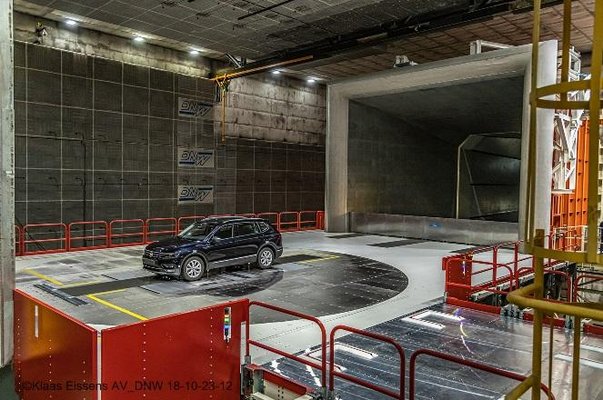
The LLF(large low speed facility)is Europe’s largest wind tunnel which is even capable of testing full-scale trucks and therefore has very specific requirements.
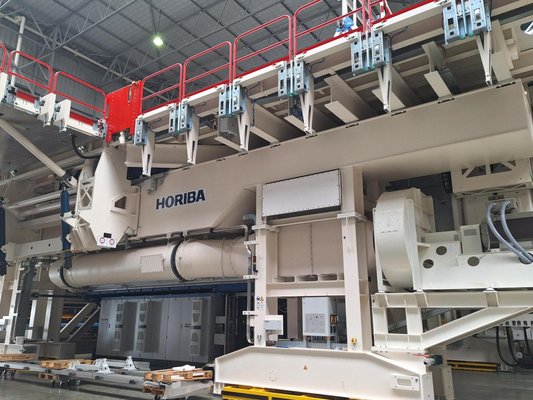
One challenge was the sheer size of the system. As mentioned, we test trucks and this means we need to go big here, but with no compromises when it comes to accuracy and flexibility concerning test requirements. The overall solution is around 19.5 m long, 14 m wide and around 8 m high and the system weighs a total of 400 tons. It has to fit into the unique requirements of DNW’s LLF in Marknesse, that means we need to maintain the ability to easily switch the configuration of the wind tunnel between automotive testing and aviation testing. Therefore, the whole Automotive Test Section rests on air cushions so it can be moved around in our wind tunnel, from the test section to the parking hall.


As part of the homologation process, rolling resistance and parasitic forces in the drivetrain need to be determined in addition to the vehicle’s aerodynamic drag to calculate the total road load of the vehicle. How did you approach this?

That is correct, we wanted to offer our customers an additional advantage when testing here, so that they are able to not only do aerodynamic testing but are also able to do the full set of measurements required for homologation under the same test conditions. This eliminates the need for coast down testing or going to another facility. HORIBA provided us with an integrated and automated solution that allows us to replicate the procedure to determine rolling resistance and parasitic forces – and this was certified by TÜV last year.

Can you outline the results of the project?

We had the official opening of the Automotive Test Section in December of 2024, but were already able to offer the system to customers for their testing throughout the year. We are very happy that the customers are pleased with this new testing opportunity that we can offer as it complements their own facilities.


Thank you very much for this interview Dr. Bergmann.

(Interviewed April 2025)
*All content and names of organizations, affiliations, positions, etc. mentioned in the text are those at the time the interview was conducted.

Profile

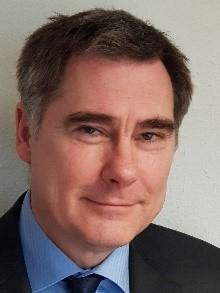
Dr. Ing. Andreas Bergmann, Director of DNW (German-Dutch Wind Tunnels), is an accomplished aerospace engineer with a robust career in aerodynamics, wind tunnel testing, and facility management, making significant contributions to both commercial and defense sectors.


Education: Graduated in Aerospace Engineering (Dipl.-Ing) from Technical University, Braunschweig, 1988

Career Path:
1988: Began as a scientific assistant at the Institute of Fluid Mechanics, Technical University Braunschweig
1996: Obtained doctorate in Mechanical Engineering
          Post-Doctorate: Project manager for Wind Tunnel Testing at the Institute for Aerodynamics and Flow Physics, DLR
1998: Joined DNW as Head of Low-Speed Facility DNW-NWB
2012-2015: Consultant for large facility design and engineering in the car industry for DNW
2015: Became Business-Unit Manager for all DNW Wind Tunnels in Germany
2018-Present: Director of DNW

Expertise: 
Extensive managerial experience
Specialized in system development in Wind Tunnel environments
Conceptualized and realized several advanced Wind Tunnel facilities and systems


Notes:

WLTP: Worldwide harmonized Light duty driving Test Procedure

Related Link:

Wind Tunnel Balance for Precise Aerodynamic Testing - HORIBA