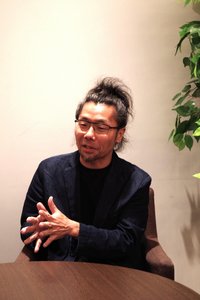
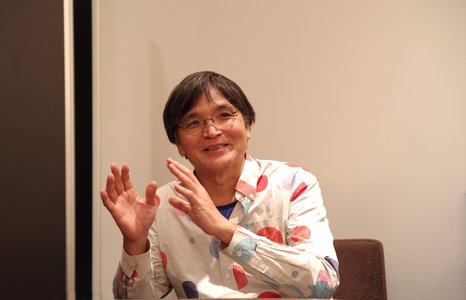
Architect and Exhibition Space Director Mr. Endo (center in photo), Project Manager Mr. Sumiyoshi (right), Interviewer: HORIBA’s Ueoka (left)
At the Expo 2025 Osaka, Kansai, Japan, the signature pavilion “Future of Life” was brought to life by a team of creators led by Pavilion Producer Professor Hiroshi Ishiguro, with Architect and Exhibition Space Director Jiro Endo (SOIHOUSE Inc.), and Project Manager for Architecture and Exhibition Space Masafumi Sumiyoshi (FARO DESIGN Inc.). Their innovative spatial production, combined with HORIBA’s “Analytical and Measurement” technologies through Light Installations, expressed the expansion of “life” itself.
In this interview, we delve into the behind-the-scenes of the project, the birth of the "Shores: Edge of Water" concept, and the possibilities of “Analytical and Measurement” technologies in future society.
“Future of Life” Pavilion: The black exterior walls of the building are intermittently covered with flowing water, creating a “Shores” scene together with the waterscape.
—The “Future of Life” pavilion left a strong impression on visitors by posing thought-provoking questions about “life” through its highly narrative exhibition structure.
Endo: We received feedback from both adults and children that the pavilion was so moving it made them cry. In designing the “Future of Life” pavilion, we focused on ensuring our message would reach a wide audience.
The concept of "Shores: Edge of Water" originated from a phrase my university mentor once said: “All things exist by the shore.” This idea has shaped my fundamental approach to architecture. While buildings tend to become closed-off boxes, I have always sought to create architecture that breathes, with ambiguous boundaries. Inspired by Professor Ishiguro’s words, “Humans emerge from inanimate matter, and living beings return to the inanimate,” I envisioned “water” as a medium that transcends boundaries and moves between realms. In the pavilion, we blurred architectural boundaries to evoke the expansion of life, culminating in the theme "Shores: Edge of Water." I am proud that this concept resonated with all generations and beautifully aligned with Professor Ishiguro’s vision of “expanding life.”
—How do you feel visitors responded to the "Shores: Edge of Water" concept?
Sumiyoshi: While it may have been difficult for visitors to grasp the concept of "Shores: Edge of Water" directly, the pavilion’s soft exterior materials and the unique appearance of water flowing and moving led many to linger and observe, rather than simply pass by. This left a strong impression; it felt as if the building itself was “alive.” I believe visitors were able to sense the atmosphere of "Shores: Edge of Water" firsthand.
—The exhibition featured scenes from the daily lives of a young girl and her grandmother, subtly posing questions about “life.”
Endo: The pavilion’s architectural design was carefully crafted to allow visitors to feel the passage of time. The exhibition incorporated performances themed around “time.” While most buildings are static and less affected by time, our pavilion aimed to infuse the space with “life” by presenting various scenes along a time axis, creating a richer sense of expansion.

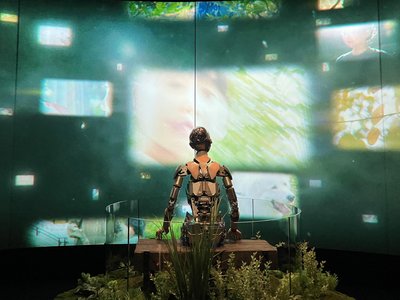
[Mr. Endo(left), Exhibition inside the pavilion (right)]
—Some visitors commented that they didn’t know where to look when encountering the androids on the second floor’s exhibition.
Endo: By exhibiting various androids, we wanted to raise the question: “In 50 years, might the act of ‘looking at androids’ itself be considered discriminatory?” In the future, the boundary between humans and machines may become naturally seamless. Rather than providing answers, we wanted visitors to leave with questions. We aimed to convey that there is no single “correct” answer—what you see is the result of everyone’s thoughts and creativity.
Sumiyoshi: We tried to create an environment where ambiguous boundaries are part of everyday life. The exhibition was designed to encourage visitors to think and make their own decisions.
Endo: If we over-designed the space like a theme park, it would feel fake. By not treating the set as a finished product, we hypothesized that visitors would feel as if they were “peeking into” the world 50 years from now.
—The idea of treating the pavilion itself as a living organism was groundbreaking. How was HORIBA’s Light Installations received?
Endo: From the beginning, I wanted the building itself to be a living organism, possessing sensory organs. We considered how the building, as a giant sensory organ, could receive and express stimuli. By adding a time axis, we enhanced the sense of life, and decided to use light for night scenes to express the transition from day to night. Incorporating “Analytical and Measurement” elements became a bridge to communicate the concept to visitors, infusing “life” into the architecture and creating a space that changes with time.
Sumiyoshi: As Endo-san mentioned, while the concept was integrated, it was challenging to translate it into a clear, understandable experience. In the end, the fusion of dynamic exterior lighting and “Analytical and Measurement” technologies resulted in a beautiful production that allowed visitors to feel the presence of life.
—HORIBA co-created Light Installations using “Analytical and Measurement” technologies.
Endo: “Analytical and Measurement” is the act of converting the world into numerical values. We worked hard to incorporate real-time measurement data into the narrative and light production, ensuring that no lighting pattern was ever repeated, creating a sense of live performance that captivated visitors.
Humans are constantly sensing various things. In the future, parameters essential to life, such as air and water, may be correlated and digitized, automatically deriving optimal solutions for comfort and balance.
Sumiyoshi: Through this project, I was reminded that “Analytical and Measurement” is indispensable as the foundational data for architecture. In the future, I believe we will see real-time measurement of complex parameters—air, water, environmental light quality—optimizing comfort autonomously and even quantifying tactile sensations to create even better spaces.
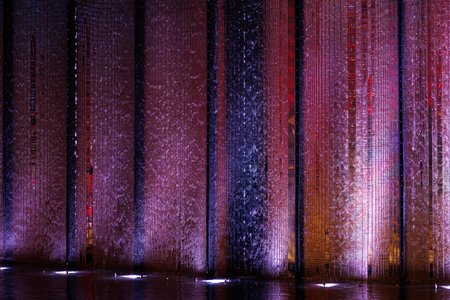
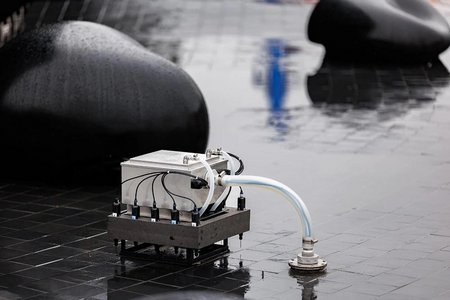
[Night view of the pavilion exterior and light installations (left), HORIBA water quality analyzer placed in the pavilion’s waterscape (center), Mr. Sumiyoshi (right)]
—The “Future of Life” pavilion challenges the expression of a world 1000 years in the future, doesn’t it?
Endo: Professor Ishiguro spoke about creating a story that extends from the Cambrian explosion depicted by the Tower of the Sun at Expo ’70 in Osaka, Japan, through to the present, and beyond. While we can somewhat imagine 50 years ahead, 1000 years is completely unknown. As technology advances, the very definition and nature of humanity may change. The “Mahoroba” space in the pavilion symbolizes this inquiry into the future.
Both art and technology are valued for expanding their domains. Science, too, is a history of overturning conventions. True value is born from expanding boundaries and the intersection of different fields.
Sumiyoshi: This project made me keenly aware that new creations emerge when architecture, art, and technology intersect and overlap. While deep expertise is important, curiosity and networks across fields generate new value.
Endo: The era of working in isolated silos is over. However, it is also important for experts to connect their deep knowledge to the outside world. Mastering your specialty and then connecting it to other fields leads to design and innovation. Technology bridges science and art, and their connection gives birth to new things.
Expertise must be broad and deep. By having interests beyond one’s own field, we can discover new and fascinating perspectives. When such diverse human landscapes expand, society becomes richer.
—What did you gain from the collaborative process of shaping the concept into a pavilion on the construction site?
Endo: Over the four and a half years of this long-term project, the greatest asset was meeting and collaborating with so many people of different expertise. Despite challenges such as limited information sharing and progressing without finalized exhibition content, I am deeply grateful to everyone who supported us until the end.
Sumiyoshi: Unlike typical architectural processes, this pavilion project advanced in tandem with the planning of measurement instruments and exhibitions, not ending with the completion of the building. Schedules and workflows were also different, presenting many difficulties, but those challenges enabled us to take on new endeavors.
By transcending the boundaries of architecture, we were able to collaborate with talented people along various timelines, which became a source of new creativity. This experience reaffirmed the importance and appeal of encounters and collaboration when thinking about architecture.
—Finally, please share a message for the future.
Endo: Under the theme of “Designing Future Society for Our Lives,” I believe that considering the freedom of “life” and its boundaries is a message for the next generation. When professionals from different fields gather and co-create beyond boundaries, they have the power to open up new worlds.
Sumiyoshi: I hope to apply the experience of “diverse encounters and collaboration” gained from this project to future architecture and society-building
When people, technology, and art—different fields and expertise—intersect, creativity is born, enriching the society of the future.
This is the message woven into the “Future of Life” pavilion. It was a fascinating look behind the scenes of the production.
(Interview conducted: October 2025)
All information, including the names of organizations, affiliations, and positions mentioned in the text, are as of the time of the interview.
©Expo 2025