Professor Fumiteru Akamatsu, Graduate School of Engineering, Osaka University (Right),
Specially Appointed Researcher Noriaki Nakatsuka, Graduate School of Engineering, Osaka University (Left)
Approximately 90% of Japan’s energy production relies on the combustion of fossil fuels. For instance, vehicle powertrains generate energy by burning gasoline in reciprocating (internal combustion) engines, while thermal power plants produce electricity through the combustion of natural gas, coal, and similar fuels.
However, the carbon dioxide (CO2) and nitrogen oxides (NOx) emissions from combustion are recognized as major contributors to global warming and air pollution, driving the development of advanced combustion techniques to suppress their concentration in exhaust gas.
Against this backdrop, the demand for developing combustion systems that utilize hydrogen and ammonia—expected to serve as carbon-free fuels—has been growing. In this context, we had the opportunity to speak with Professor Fumiteru Akamatsu and Specially Appointed Researcher Dr. Noriaki Nakatsuka of the Graduate School of Engineering at Osaka University, whose pioneering work has placed them at the forefront of ammonia combustion research.
Project Researcher Noriaki Nakatsuka (Left) and Professor Fumiteru Akamatsu (Right)
Professor Akamatsu: When I was a student, our laboratory focused on how much useful work could be extracted from the energy obtained from fuel, and how much instantaneous power we could generate.
In the context of engines, this research corresponded to overall power output, in the context of vehicles - to acceleration. Our goal was aimed at using fuel efficiency while avoiding the emission of harmful substances. This domain is commonly referred to as emission reduction and fuel-economy improvement. Originally, I was fascinated by car and motorcycle engines, and at the time, I focused my research on spray combustion: atomizing the liquid fuels typically used in diesel engines into fine droplets and studying their combustion characteristics.
Researcher Nakatsuka: Ever since childhood, I’ve been deeply interested in automotive internal combustion engines. I joined a combustion research laboratory at university and instead of focusing on how much power could be produced, my research emphasized what kind of gases were emitted.
My research theme was the partial oxidation reforming of gas produced during the gasification of woody biomass (*Note 1). Specifically, I investigated the composition of gases emitted during partial combustion caused by incomplete combustion during gasification. Although maximizing the energy yield from combustion is inherently desirable, the resulting exhaust must also comply with regulatory standards. Consequently, gas composition analysis and concurrent evaluation of power performance were pursued in tandem.
Professor Akamatsu: Early on, I recognized that biomass would be indispensable for future CO2 reduction, so my laboratory initiated research on biomass well in advance. Against this backdrop, and just as ammonia was emerging as promising clean-energy source, I received an invitation at an academic conference to collaborate on ammonia research, which prompted me to embark on studies of ammonia combustion.
Although ammonia combustion inherently generates NOx emissions, our laboratory focused on developing combustion strategies that minimize NOx formation. Since NOx is regulated due to its role in photochemical smog and acid rain, the prospect of ammonia combustion – fuel that contains nitrogen – appeared counterintuitive from a NOx-reduction standpoint. At the time, the prevailing consensus in engine combustion was that nitrogen (N) present in fuel would inevitably produce large quantities of NOx, and I recall a representative from an industry emphatically asserting that “combustion without NOx emission is absolutely impossible”.
Researcher Nakatsuka: It is known that ammonia exhibits a high ignition difficulty, which necessitates innovative strategies to sustain its combustion. Moreover, changing the fuel composition requires re-evaluating the materials surrounding the combustion zone. For example, although the feed gas enters at relatively low temperatures, once combustion initiates the flame temperature exceeds 1,000°C, so we conducted extensive trial- and error testing to identify suitable combustion-chamber materials.
Professor Akamatsu: Conventional exhaust-gas analysis for ammonia combustion has predominantly relied on oxidizing ammonia to NOx for detection, which makes direct measurement of ammonia in the presence of coexisting NOx extremely challenging.
In addition, ammonia dissolved readily in condensed water to form aqueous ammonia, preventing accurate measurement of the gas-phase ammonia concentration. This necessitated the use of hot sampling (*Note 2) technique to maintain precise measurements.
Professor Akamatsu: To address the numerous challenges we encountered, we implemented a technique known as the two-stage combustion process (*Note 3). In the primary combustion stage, ammonia is burned under fuel-rich conditions to intentionally generate unburned ammonia and its thermal-decomposition products; These unburned components are then utilized for selective catalytic reduction (SCR) of NOx in the secondary stage. While this method has been proven effective for NOx reduction in hydrocarbon-fueled systems, it had never been demonstrated in ammonia-fueled industrial furnaces – our laboratory was the first to conduct such experiments.
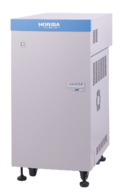
For gas analysis and combustion efficiency evaluation during ammonia combustion, we relied on HORIBA’s exhaust gas analyzer “MEXA” (hereafter referred to as MEXA).
SCR – the removal of NOx and other harmful compounds from exhaust – is a standard automotive aftertreatment technology, with ammonia widely employed as the NOx reductant. However, the actual NOx-removal performance achievable in ammonia combustion was unknown. By measuring post-combustion NOx with MEXA, we demonstrated that emissions could comply with regulatory limits. This was the moment we uncovered the true potential of our research.

MEXA-ONE-XL-NX Laser Spectroscopic Motor Exhaust Gas Analyzer - Visit the Products Website
Researcher Nakatsuka: I will never forget the moment we identified the conditions under which NOx and ammonia coexist during combustion and confirmed their coexistence quantitatively using MEXA. That was the moment I truly realized how remarkable MEXA is as an analytical device. Through repeated testing our research advanced to the point where we were able to produce "champion data" that validated our findings.
Looking ahead, our next step is to improve combustion control. Whereas most industrial furnace research to date has been carried out under steady, fixed fuel supply conditions. However, to efficiently utilize energy in the future, we aim to improve control mechanisms to maintain stable combustion environments while dynamically adjusting fuel supply rates. In this regard, evaluating the exhaust gases from industrial furnaces is crucial. By leveraging MEXA, we continue to advance our research in this area.
Data Confirming the Coexistence Region of NOx and Ammonia Using the MEXA Exhaust Gas Analyzer
Professor Akamatsu: As our research gradually began to produce results, we experienced a marked increase in invitations to present our work externally. In doing so, I found that I was increasingly approached not only by academic researchers but even more often by researchers from private inquiry. While ammonia combustion is a topic of diverse opinions, I’ve noticed that many companies are genuinely motivated to develop practical combustion technologies that contribute to environmental sustainability.
Currently, we are engaged in collaborative research with several companies. For the practical implementation of ammonia combustion in industrial furnaces, feedback from manufacturers who use these furnaces and those who produce them is incredibly valuable. These corporate perspectives provide us with insights into specific on-site needs, current challenges, and potential solutions, all of which are difficult to identify solely from a university research standpoint. I firmly believe that by pooling the expertise of both universities and companies, we can tackle these complex factors and move closer to realizing practical ammonia combustion technology.
Our research has now progressed to the point where combustion efficiency has improved, and emissions are within regulatory limits. However, further advancements are needed to reach full practical implementation.
For example, understanding the relationship between heating efficiency and two-stage combustion conditions has significant potential for further insight and development. Therefore, we believe it is essential to develop methods to further enhance heating efficiency.
Researcher Nakatsuka: I hope that our research will contribute to shaping the future of Japan. The future I envision is one where carbon neutrality is achieved, and combustion technology is utilized effectively and appropriately in various applications.
Professor Akamatsu: One example of ammonia utilization is its successful application as a direct fuel for power generation in fuel cells, showcasing the expanding scope of ammonia's potential. Moving forward, I believe there will be an increasing number of energy options that leverage not only ammonia but various other fuels.
For instance, technologies like methanation, which combines captured CO2 with hydrogen to produce methane, or Fischer-Tropsch synthesis, which uses carbon monoxide and hydrogen to create fuels similar to fossil fuels, are currently being developed.
Moreover, advancements in combustion technologies, such as polygeneration systems that cycle CO2 separation and capture, will be vital. Securing safe energy for Japan requires not just importing energy from abroad but diversifying energy options, which I see as a significant national goal.
In the future, I aim to contribute to a society where a wide variety of clean energy sources are available. To achieve this, we need to extend collaboration beyond the boundaries of universities and companies, working together to explore and realize the potential of combustion technology.
(Date of Interview: December 2023)
Please note that all information, including the names of organizations, affiliations, and titles mentioned in the text, reflects the status as of the time of the interview.
Fumiteru Akamatsu
Professor, Graduate School of Engineering, Osaka University
[Career Background]
March 1991: Completed Master's Program, Graduate School of Engineering, Osaka University
April 1991: Assistant, Faculty of Engineering, Osaka University
January 1996: Earned Doctorate in Engineering (Osaka University)
October 1997 – September 1998: Visiting Researcher, University of California, Irvine (Ministry of Education Overseas Research Fellow)
December 2000: Lecturer, Graduate School of Engineering, Osaka University
April 2003: Associate Professor, Graduate School of Engineering, Osaka University
April 2003 – March 2005: Invited Researcher, National Institute of Advanced Industrial Science and Technology (Concurrent Appointment)
November 2007 – March 2010: Associate Professor, Osaka University Research Institute for Sustainability Science (Concurrent Appointment)
July 2008 – Present: Professor, Graduate School of Engineering, Osaka University
April 2018 – March 2021: Collaborative Professor, Department of Mechanical Engineering, Graduate School of Engineering, University of Tokyo (Concurrent Appointment)
Noriaki Nakatsuka
Specially Appointed Researcher (Full-time)
Department of Mechanical Engineering, Division of Micromachine Science, Combustion Engineering Area
Graduate School of Engineering, Osaka University