HORIBA
Search English
Global
  • Products
    • Mobility
    • Energy and Environment
    • Industrial Process and Environment
    • Life Science
    • Healthcare
    • Materials
    • Semiconductor
    • Scientific and Analytical Instruments
    • Water & Liquid
    • All products from A to Z
  • Applications
    • Arts, Entertainment and Recreation
      • Art Conservation
      • Museums, Historical Sites and Similar Institutions
    • Biopharma and Pharma
    • Biotechnology and Biomedical
    • Cosmetics
    • Education, R&D and Government Institutions
      • Universities
      • Research and Testing Laboratories
    • Energy Solutions
      • Why HORIBA
      • Hydrogen Energy
        • Global Initiatives
        • Global Trends and Strategies toward Carbon Neutrality
        • Fuel Cell Evaluation
        • FCEV / FCV Evaluation
        • Stationary Fuel Cells
        • Sintering and Reduction Test Station
        • Evaluation of Hydrogen and Ammonia Engine / Gas Turbine for Power Generation
        • Hydrogen Station Evaluation
        • Water Electrolysis Evaluation
        • Hydrogen Production Evaluation
      • Energy Usage Optimization
        • Energy Management System
        • Environmental Impact Assessment (LCA and GHG Protocol)
        • Battery Manufacturing/Recycling
      • CO2 Capture and Carbon Resource Circulation
        • Reduce
        • Direct Carbon Capture
        • Carbon Resource Circulation
      • Coal and Consumable Fuels
      • Electric Utilities
      • Energy Fuel Oil
      • Environmental Countermeasures
      • Petroleum and Coal Products Manufacturing
        • Petrochemicals
      • Photovoltaics
      • Oil and Gas
      • RoHS and ELV
    • Food and Beverage
    • Healthcare
    • Industrials
      • Battery
      • Commercial and Professional Services
        • Gas mass flow control and measurement for reference value of PM2.5 measurement
      • Construction & Engineering
      • Electrical Equipment
      • Machinery
    • Information Technology
      • Semiconductors
        • 2D Materials
        • Graphene
        • Photovoltaics
        • Display Technologies
        • Data Storage
        • Nanomaterials
      • Semiconductor Manufacturing Process
      • Technology Hardware and Equipment
    • Materials
      • Carbon
      • Polymers and Composites
      • Raw Materials for Semiconductors
      • Metals
      • Minerals
      • Corrosion
      • Ceramics
      • Glass
      • Chemicals
      • Chemical Manufacturing
      • Construction Materials
      • Containers and Packaging
      • Paper, Forest Products and Manufacturing
      • Material Research
      • Photovoltaics
      • Forensic Science
    • Mobility and Transportation
      • Automotive Manufacturing
      • Engine, Turbine and Power Transmission Equipment Manufacturing
      • Real Driving Emissions
      • Intelligent Lab
      • Marine
    • Waste Management
      • Solid Waste Management and Remediation Services
      • Water Waste Management and Remediation Services
        • Waste Water and Soil Analysis
        • Waste Water Treatment and Disposal
      • Plastic Waste
    • Water
      • Drinking Water Utilities
      • Water Reuse
        • Water Testing
  • Technology
    • Elemental Analysis
      • Energy Dispersive X-ray Fluorescence (ED-XRF)
        • What is X-ray Fluorescence (XRF)?
        • What is X-ray Fluorescence Spectroscopy (micro-XRF)?
        • XRF Key Components
        • XRF Analysis
        • XRF Articles
        • HORIBA XRF Analyzers
      • Glow Discharge Optical Emission Spectroscopy
        • Glow Discharge Optical Emission Spectroscopy
        • Sample Measurement with GDOES
        • Sample Test and Analysis
        • Comparison with Other Techniques: Surface Analysis
        • Comparison with Other Techniques: Bulk Analysis
        • Instrument Introduction
        • Benefits and Features of Pulsed RF GDOES
        • Join the GD Community
        • Bibliography
      • Inductively Coupled Plasma - Optical Emission Spectroscopy (ICP-OES)
        • Inductively Coupled Plasma - Optical Emission Spectroscopy (ICP-OES)
        • Scientific ICP Spectrometers
        • Applications for ICP-OES
        • ICP-OES and other techniques
        • Principles and Theory
        • Instrumentation
        • Excitation Source
        • Dispersive System
        • Detection Systems Used with ICP-OES
        • Performances in ICP-OES
      • Carbon/Sulfur & Oxygen/Nitrogen/Hydrogen Analysis
    • Health Care
      • Multi Distribution Sampling System (MDSS)
      • Reticulocytes Analysis
      • CBC + CRP
      • Slide Production
      • Automatic Rerun
      • Absorbance
      • Fluorescence
      • Flow cytometry
      • Impedance / Resistivity
      • Sedimentation
      • Spectrophotometry
      • Potentiometry
      • INR screening
      • Clotting
      • Turbidimetric
      • Chromogenic
    • Particle Analysis
      • Dynamic Light Scattering (DLS) Particle Size Distribution Analysis
      • Molecular Weight
      • Nanoparticle Tracking Analysis
      • Static Light Scattering (SLS) / Laser Diffraction Particle Size Distribution Analysis
      • Zeta Potential
      • Centrifugal Sedimentation
    • Fluid Control
      • Vaporization of Critical Process Chemistries
      • Coriolis Flowmetry
      • Thermal Mass Flowmetry
    • Mass Spectrometry
      • Quadrupole Mass Spectrometry
    • Microscopy and Imaging
      • AFM-Raman
        • AFM-Raman
        • What is Tip Enhanced Raman Spectroscopy?
        • What information does TERS provide?
        • How does enhancement of the Raman signal occur in TERS?
        • What are the TERS instrumental configurations?
        • What are the TERS tips materials and morphology?
        • What kind of substrates can be probed with TERS?
        • What is the SPM feedback used for TERS?
        • What is the spatial resolution of TERS?
        • What is the definition of TERS Enhancement factor?
        • What is nonlinear TERS?
        • What are the degradation issues and artifacts in TERS?
        • What are the main TERS applications in Materials Sciences?
        • What are the main Life Sciences TERS applications?
        • References
        • Products
      • Atomic Force Microscopy [AFM]
      • Cathodoluminescence
      • Image Analysis of Particles
      • Micro X-ray Fluorescence
      • Raman Microscopy
    • Physisorption
      • Surface Area
    • Spectroscopy
      • Cathodoluminescence Spectroscopy
        • Cathodoluminescence Spectroscopy
        • Electron Microscope
        • SEM, ESEM, SEM-FIB, (S)TEM
        • EM Add-on detector
        • SEM-Cathodoluminescence (SEM-CL)
      • AFM-Raman
      • Detectors
        • Detectors
        • What is a CCD Detector?
        • What is an EMCCD Detector?
        • How to Select a CCD Camera for Spectroscopic Applications
        • Wavelength and Pixel Position
        • Spectroscopy Detector Products
        • Scientific CCD Camera Products
      • 50 years of Diffraction Gratings
      • Diffraction Gratings Ruled and Holographic
      • Fluorescence Spectroscopy
        • Fluorescence Spectroscopy
        • Principles and Theory of Fluorescence Spectroscopy
        • What is the Jablonski Diagram?
        • What is a Fluorescence Measurement?
        • Steady State Fluorescence Techniques
        • What is Fluorescence Anisotropy or Fluorescence Polarization?
        • What are Luminescence Quantum Yields?
        • What is Ratiometric Fluorescence?
        • What is an Excitation Emission Matrix (EEM)?
        • What is A-TEEM spectroscopy?
        • What is Singlet Oxygen?
        • How to Calculate Signal to Noise Ratio
        • Fluorescence Lifetime Techniques
        • Products Using Fluorescence Spectroscopy
      • Quantum Cascade Laser (QCL) Spectroscopy
        • Optical Hardware
        • Concentration Calculation Algorithm
        • Application Fields
      • Raman Imaging and Spectroscopy
        • Raman Spectroscopy
        • History of Raman Spectroscopy
        • Application field
        • Comparison with other techniques
        • Raman analysis
        • Recording spectral images and profiles
        • Description: Combined/hybrid/hyphenated Raman system
        • Confocal Raman microscopy
        • Raman Spectrometer Presentation
        • How the technique is used
        • Raman Image Gallery
        • Related Products
      • Spectrometers and Monochromators
        • Monochromator System Optics
        • Bandpass and Resolution
        • Order, Resolution, and Dispersion
        • Choosing a Monochromator/ Spectrograph
        • Spectrometer Throughput and Etendue
        • Optical Signal to Noise Ratio and Stray Light
        • Entrance Optics
        • Spectrometer, Spectrograph and Monochromator Products
      • Spectroscopic Ellipsometry
        • Spectroscopic Ellipsometry
        • Advantages
        • Instrumentation
        • Measurement Techniques
        • Data Analysis
        • Cauchy dispersion module
        • Products
      • Vacuum Ultra Violet Spectroscopy
        • Vacuum Ultra Violet Spectroscopy
        • VUV technology
        • High Vacuum (HV), Ultra High Vacuum (UHV), gas purge
        • Light sources in VUV
        • VUV system: Detector
        • Aberration
        • References - Articles
      • X-ray Fluorescence
    • Surface Plasmon Resonance
      • Surface Plasmon Resonance imaging
        • Surface Plasmon Resonance Imaging (SPRi)
        • Brief History of the Technique
        • SPR Measurements, Application Field and Comparison with Other Techniques
        • The Basics of Label-free Biomolecular Interactions
        • Instrument Presentation
        • How SPRi is Used
        • Key Accessories. Sensorchips. Surface Chemistry
        • How are the Molecules Immobilized on the biochip?
        • Conclusion & Bibliography
  • Service
    • Analysis Services
      • Analysis Centers and Services
      • EMC Analysis Service
    • Calibration and Certification
    • Customer Support
      • HORIBA Medical Documentation Database
      • Medical Customer Support
      • On-Site Support
      • Software Support
    • Spare Parts and Consumables
    • Testing and Consulting
      • Automotive Testing Centers
    • Training
      • Product Training
        • Scientific Product Training
        • Automotive Product Training
        • Medical Product Training
      • Technology Training
  • Company
    • About HORIBA
      • Home
      • Message
      • Company Profile
      • Corporate Motto and Philosophy
      • Code of Ethics
      • Our Future (Vision, Mission, Values)
      • Corporate Governance
      • Board of Directors
      • Culture
      • History
        • 1945–1960s
        • 1970s
        • 1980s
        • 1990s
        • 2000s
        • 2010s
        • 2020s
      • HORIBA Report
      • Technical Journal "Readout"
        • Readout No. E58 - Analysis and Measurement Technologies that Contribute to the Development of Next Generation Semiconductor Devices
        • Readout No. E57 - HORIBA’s Initiatives in the Next-Generation Energy and Environment Fields
        • Readout No. E56 - Analytical Solutions in Megatrends
        • Readout No. E55 - 2021 Masao Horiba Awards - Spectroscopic analysis and measurement technology in the life science field
        • Readout No. E54 - Microplastics and Nanoplastics: Analysis and Method Development
        • Masao Horiba Awards Research Articles
        • Readout No. E53 - 2019 Masao Horiba Awards - Advanced Analytical and Measurement Technologies for Efficient Control System to Maximize the Performance of Electric Power and Batteries Usage
        • Readout No. E52 - Green Innovation for Marine Shipping Industry
        • Readout No. E51 - 2018 Masao Horiba Awards Advanced analytical and measurement technologies in semiconductor manufacturing processes
        • Readout No. E50 - Low-Carbon Society and Environmental Improvement
        • Readout No. E49 - Photonic Instrumentation in Life Science
        • Readout No. E48 - Water Measurement Experts
        • Readout No. E47 - Application for Semiconductor Manufacturing Process
        • Readout No. E46 - New Development for Automotive Test Systems
        • Readout No. E45 - Application Technology in Analysis
        • Readout No. E44 - Contribution of Diagnostics to Total Medical Care/Healthcare
        • Readout No. E43 - Watching the Environmental and Society with Measurements
        • Readout No. E42 - More Efficient Testing on Automotive Development, Improving the Accuracy of Fuel Consumption Measurement
        • Readout No. E41 - Application
        • Readout No. E40 - Application
        • Readout No. E18 - EUROPE
        • Readout No. E17 - AMERICA
        • Readout No. E16 - Chinese (Asia)
        • Readout No. E15 - Technologies for HORIBA STEC
        • Readout No. E14 - Masao HORIBA Awards"Measurement of Bioparticles" and "Measurement of Internal Combustion"
        • Readout No. E13 - Technologies for Automotive Testing
        • Readout No. E12 - Masao Horiba Awards "X-ray Analysis Technology"
        • Readout No. E11 - The Second Masao Horiba Awards
        • Readout No. E10 - Environmental Analysis Technologies for the Management of Global Environment and the Development of Industry
        • Readout No. E09 - The First Dr.Masao Horiba's Award and the 50th Anniversary Products
        • Readout No. E08 - Products and Technologies of HORIBA ABX
        • Readout No. E07 - Products and Technologies of Jobin Yvon HORIBA Group
        • Readout No. E06 - 50th Anniversary of HORIBA, Ltd. Products and Technology of HORIBA Group
        • Readout No. E05 - Semiconductor Instruments
        • Readout No. E04 - Hematology Instruments
        • Readout No. E03 - Paticulate Matter
        • Readout No. E02 - The Technology Alliance for X-ray Analysis
        • Readout No. E01 - the Analysis of the Global Environment
      • Group Companies
      • Virtual Patent Marking
      • HORIBA Talk
    • Events
    • Career
    • Investor Relations
      • Home
      • Investor Relations News
      • IR Library
        • Financial Statements
        • Presentation Materials
        • HORIBA Report
      • Message from the CEO
      • Mid-Long Term Management Plan
      • Stock Information
      • Shareholders Meeting
      • Other IR Information
        • Investor Relations Calendar
        • Disclaimer
      • Investor Relations Contact
    • News
    • Sustainability
      • Sustainability
      • Topics
      • Message
      • Sustainable Management
        • Policy and Promotion System
        • Integrated Management System
        • Health and Productivity
        • UN Global Compact
      • HORIBARIANs
        • HORIBARIANs
        • Human Rights and Labor Management
        • Development of HORIBARIANs
        • Empowerment of Diverse HORIBARIANs
        • Occupational safety and health
      • Environment
        • Environment
        • Environmental Management
        • Climate Action
        • Reduction of Environmental Impact
        • Actions for RoHS Directive, REACH Regulation and GHS Regulations
        • Eco-Friendly Products
      • Social
        • Social
        • Quality
        • Material Procurement
        • Social Activities
      • Governance
        • Governance
        • Corporate Governance
        • Internal Controls
        • Compliance Promotion Systems
        • Code of Ethics
        • Risk Management
      • HORIBA and the SDGs
      • HR and ESG related Data
      • HORIBA Report
      • Editing Policy
  • Contact
    • Contact Form
    • Worldwide Locations

Dynamic Light Scattering (DLS) Particle Size Distribution Analysis open open
  • Dynamic Light Scattering (DLS) Particle Size Distribution Analysis
  • Concentration Range for DLS Size Measurement
  • Z-Average
  • Top 10 Lists: DLS Sizing and ELS Zeta Potential
    HORIBA » Technology » Particle Analysis » Dynamic Light Scattering (DLS) Particle Size Distribution Analysis 

Back to Particle Characterization Products Overview
Back to Particle Webinar List
Back to Particle Applications

Dynamic Light Scattering (DLS) Particle Size Distribution Analysis

Table of Contents

  • Dynamic Light Scattering Technology
  • Applications for Dynamic Light Scattering
  • Stokes Einstein: Relating Particle Size to Particle Motion
  • How to Measure Particle Motion I: Dynamic Light Scattering Optical Setup
  • How to Extract Particle Diffusion Coefficient: Dynamic Light Scattering Data Interpretation
  • Analyzing Real Particle Size Distributions I: The Method of Cumulants and Z-average
  • Analyzing Real Particle Size Distributions II: Size Distribution Data
  • Concluding Comments and Additional Thoughts
  • Technical Notes
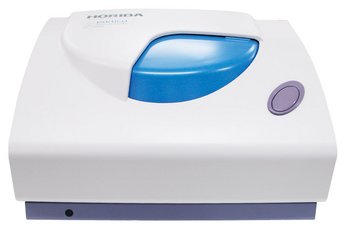
  • HORIBA Nanoparticle Analyzer

Dynamic Light Scattering Technology

Particle size can be determined by measuring the random changes in the intensity of light scattered from a suspension or solution. This technique is commonly known as dynamic light scattering (DLS), but is also called photon correlation spectroscopy (PCS) and quasi-elastic light scattering (QELS). The latter terms are more common in older literature.

After a few comments on the applications of dynamic light scattering, this page explains the technique beginning the actual phenomena under study (particle motion, not particle size). The nature of the measurement and data interpretation is then discussed. Finally, there are some concluding comments.

Applications for Dynamic Light Scattering

DLS is most commonly used to analyze nanoparticles. Examples include determining nanogold size, protein size, latex size, and colloid size. In general, the technique is best used for submicron particles and can be used to measure particle with sizes less than a nanometer. In this size regime (microns to nanometers) and for the purposes of size measurement (but not thermodynamics!) the distinction between a molecule (such as a protein or macromolecule) and a particle (such as nanogold) and even a second liquid phase (such as in an emulsion) becomes blurred. Dynamic light scattering can also be used as a probe of complex fluids such as concentrated solutions. However, this application is much less common than particle sizing.

Stokes Einstein: Relating Particle Size to Particle Motion

The Stokes-Einstein relation that connects diffusion coefficient measured by dynamic light scattering to particle size.

Small particles in suspension undergo random thermal motion known as Brownian motion. This random motion is modeled by the Stokes-Einstein equation. Below the equation is given in the form most often used for particle size analysis.

where

  • Dh is the hydrodynamic diameter (this is the goal: particle size!)
  • Dt is the translational diffusion coefficient (we find this by dynamic light scattering)
  • kB is Boltzmann’s constant (we know this)
  • T is thermodynamic temperature (we control this)
  • η is dynamic viscosity (we know this)  

The calculations are handled by instrument software. However, the equation does serve as important reminder about a few points. The first is that sample temperature is important, at it appears directly in the equation. Temperature is even more important due to the viscosity term since viscosity is a stiff function of temperature. Finally, and most importantly, it reminds the analyst that the particle size determined by dynamic light scattering is the hydrodynamic size. That is, the determined particle size is the size of a sphere that diffuses the way as your particle.

For those who work with protein sizing and other areas where hydrodynamic radius is more commonly used, note that the development here is around diameter. Radius calculations are the same except for a factor of two. 

Also, a note to those interested in polymer size. The hydrodynamic radius is not the same as the radius of gyration. Hydrodynamic sizes are more easily measured than radii of gyration and can be measured over a wider range of sizes. The conversion from hydrodynamic radius to radius of gyration is a function of chain architecture (including questions of random coil vs. hard sphere, globular, dendrimer, chain stiffness, and degree of branching).

How to Measure Particle Motion I: Dynamic Light Scattering Optical Setup

Optical setup for dynamic light scattering (DLS) nanoparticle size analyer

A top view of the optical setup for DLS is shown above.

Light from the laser light source illuminates the sample in the cell. The scattered light signal is collected with one of two detectors, either at a 90 degree (right angle) or 173 degree (back angle) scattering angle. The provision of both detectors allows more flexibility in choosing measurement conditions.  Particles can be dispersed in a variety of liquids. Only liquid refractive index and viscosity needs to be known for interpreting the measurement results.

The obtained optical signal shows random changes due to the randomly changing relative position of the particles. This is shown schematically in the graph below. 

Optical signal from a nanoparticle sample on a microsecond timescale.

The “noise” is actually due to particle motion and will be used to extract the particle size. In contrast to laser diffraction, DLS measurements are typically made at a single angle, although data obtained at several angles can be useful. In addition, the technique is completely noninvasive; the particle motion continues whether or not it is being probed by DLS.

The variations in the signal arise due to the random Brownian motion of the particles. Treating this random signal is discussed in the next section on extracting particle motion.

How to Extract Particle Diffusion Coefficient: Dynamic Light Scattering Data Interpretation

Autocorrelation Function from dynamic light scattering. The decay of this function is used to extract particle size. Faster decays correspond to smaller particles.

The signal can be interpreted in terms of an autocorrelation function. Incoming data is processed in real time with a digital signal processing device known as a correlator and the autocorrelation function as a function of delay time, τ, is extracted.

Exponential decay of autocorrelation function. The decay constant is proportional to the diffusion coefficient.

For a sample where all of the particles are the same size, the baseline subtracted autocorrelation function, C, is simply an exponential decay of the following form:

Γ is readily derived from experimental data by a curve fit. The diffusion coefficient is obtained from the relation Γ=Dtq2 where q is the scattering vector, given by q=(4πn/λ)sin(θ/2). The refractive index of the liquid is n. The wavelength of the laser light is λ, and scattering angle, θ. Inserting Dt into the Stokes-Einstein equation above and solving for particle size is the final step. 

Analyzing Real Particle Size Distributions I: The Method of Cumulants and Z-average

Exponential decay of autocorrelation function. The linear decay constant is proportional to the average diffusion coefficient and is used to extract average particle size.

The discussion above can be extended to real nanoparticle samples that contain a distribution of particle sizes. The exponential decay is rewritten as a power series:

Once again, a decay constant is extracted and interpreted to obtain particle size. However, in this case, the obtained particle size, known as the z-average size, is a weighted mean size. Unfortunately, the weighting is somewhat convoluted. Recall that the decay constant is proportional to the diffusion coefficient. So, by dynamic light scattering one has determined the intensity weighted diffusion coefficient. The diffusion coefficient is inversely proportional to size. So, in truth, the “z-average size” is the intensity weighted harmonic mean size. This definition differs substantially from that of the z-average radius of gyration encountered in the light scattering study of polymers.

Despite the convoluted meaning, the z-average size increases as the particle size increases. And, it is extremely easy to measure reliably. For these reasons, the z-average size has become the accepted norm for particle sizing by dynamic light scattering. 

Analyzing Real Particle Size Distributions II: Size Distribution Data

Electric field autocorrelation function as a sum of exponential decays. The decay constants are inversely proportional to the particle size.

While a detailed discussion is beyond the scope of this work, it is possible to extract size distribution data from DLS data. One can convert the measured autocorrelation function into what is known as an electric field autocorrelation function, g1(τ). Then use the following relationship between g1(τ) and the scattered intensity, S, for each possible decay constant, Γ. The overall electric field autocorrelation function is the intensity weighted sum of the decays due to every particle in the system.

Inversion of this equation, that is using experimentally determined values of g1(τ) to find values of S(Γ), will lead to information about the size distribution. Unlike the cumulants analysis discussed above, this is an ill-posed mathematical problem. Even so, the technique remains useful for interpreting DLS data.

Concluding Comments and Additional Thoughts

The underlying theory of measurement by dynamic light scattering was discussed. Many of the points on this web page are starting points for further investigation depending on the reader’s analytic needs and interests. All of these equations and the analysis are handled automatically in the HORIBA software. As such, dynamic light scattering has found application for determining protein size, nanoparticle size, and colloid size.


For more information about acquiring an instrument, click here.

Back to top

Technical Notes

PDF
0.3 MB
thumbnail
DLS of Size Standards
Dynamic light scattering provides fast, accurate, and repeatable nanoparticle size information. Applications include metal and oxide powders, latexes, drug delivery vehicles, and dozens other materials.
open
PDF
0.46 MB
thumbnail
Preparing Polystyrene Latex Standards for DLS
Latex is an important application for dynamic light scattering. In addition, monodisperse latex standards are often used to evaluate instrument performance. Frequently these materials are polystyrene and called “PSL standards” where PSL stands for polystyrene latex.
open

Browse Products

nanoPartica SZ-100V2 Series

Nanoparticle Analyzer

Request for Information

Do you have any questions or requests? Use this form to contact our specialists.

* These fields are mandatory.

  • Products
    • All Products (A-Z)
    • Mobility
    • Energy and Environment
    • Life Science
    • Healthcare
    • Materials
    • Semiconductor
  • Applications
    • Drinking Water Utilities
    • Automotive Manufacturing
    • Semiconductor Manufacturing Process
    • Research and Testing Laboratories
  • Technology
    • Glow Discharge Spectroscopy
    • Pressure-based Flowmetry
    • Quadrupole Mass Spectrometry
    • Raman Spectroscopy
  • Service
    • On-Site Support
    • Spare Parts and Consumables
  • Company
    • News
    • Events
    • Career
    • History
    • Corporate Culture
  • Contact
    • Career Contact
    • Contact Form
    • Worldwide Locations
    • Investor Relations Contact

Terms and Conditions Privacy Notice HORIBA Group Social Media