Fluorescence

Fluorescence Microscopy

Key Takeaways

  • Resolving micro-scale structural heterogeneity without damaging sensitive samples requires non-destructive fluorescence microscopy for precise molecular characterization.
  • Mapping localized chemical defects in non-uniform materials relies on high spatial resolution steady-state photoluminescence analysis.
  • Overcoming concentration-dependent imaging artifacts is achieved using Fluorescence Lifetime Imaging Microscopy (FLIM) to quantify microenvironmental variables.
  • Tracking dynamic molecular interactions in real time depends on integrating time-resolved emission decay measurements with spatial mapping.


Introduction

Fluorescence microscopy integrates high-sensitivity optical detection with spatial micro-mapping to investigate the structural and dynamical properties of heterogeneous materials. By isolating specific fluorescent markers or intrinsic photoluminescence, this analytical technique allows researchers to map chemical composition, molecular binding events, and local physical microenvironments at micro- and nano-scale spatial resolutions.

Modern micro-fluorescence instrumentation merges steady-state photoluminescence with time-resolved measurements. This integration provides multidimensional datasets essential for advanced research across cell biology, biophysics, semiconductor development, and photovoltaics.

Frequently Asked Questions (FAQ)

Fluorescence microscopy is an optical analytical technique that captures light emitted by a sample following photoexcitation at specific wavelengths. It operates by isolating weak photoluminescence (PL) signals from excitation light using specialized optical filters and high-sensitivity detectors like Photomultiplier Tubes (PMTs) or Charge-Coupled Devices (CCDs), yielding high-contrast spatial mapping of chemical composition, structural defects, and molecular interactions.

Fluorescence Lifetime Imaging Microscopy (FLIM) measures the temporal decay rate of fluorophores rather than relying solely on emission intensity. Because lifetime measurements are independent of fluorophore concentration and excitation intensity, FLIM provides direct quantitative data on local environmental factors such as pH, viscosity, refractive index, and conformational changes caused by Förster Resonance Energy Transfer (FRET).

In material science, micro-photoluminescence spectroscopy evaluates local electronic band structures, carrier dynamics, and lattice defects in semiconductors, 2D materials, and photovoltaics. This non-destructive technique delivers high spatial resolution, allowing researchers to correlate physical structural defects with optical properties, carrier recombination efficiency, and chemical heterogeneity across heterogeneous thin films and nanostructures without altering sample state.

Steady-state fluorescence microscopy records emission intensity spectra under continuous illumination, serving primary needs in spatial localization and spectral identification. Time-resolved fluorescence microscopy measures emission kinetics following pulsed excitation, providing deeper insights into molecular dynamics, environmental quenching mechanisms, energy transfer efficiency, and fluorophore populations that share identical steady-state spectral overlaps.

FLIM Microscope Solutions

Modular Solutions

Confocal Laser Scanning FLIM
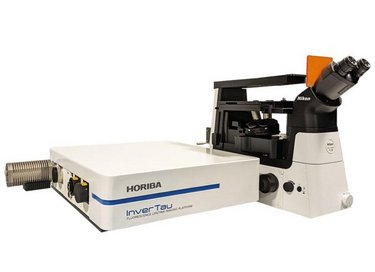
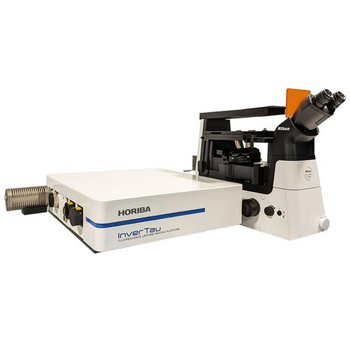
InverTau™ is our new confocal laser scanning FLIM platform. InverTau is fully software controlled and designed to fit on the side port of an inverted fluorescence microscope. You can build your own microscope system around the InverTau platform, or buy a complete microscope system from HORIBA. InverTau can be enhanced to acquire real-time wide field video rate FLIM up to 30 frames per second with the addition of FLIMera. Versatile solutions are always available with local support.

  • Affordable laser scanning unit for FLIM studies
  • Fully computer-controlled confocal optics, with the intuitive EzTime™ Image software, minimizes set up time and increases productivity
  • Simply switch from confocal laser scanning to widefield imaging with the addition of FLIMera
  • Real time video display up to 6 fps with InverTau, and up to 30 fps with FLIMera
  • Intuitive software and automated optics minimize setup time and increase productivity
Wide Field Video Rate FLIM Dynamics

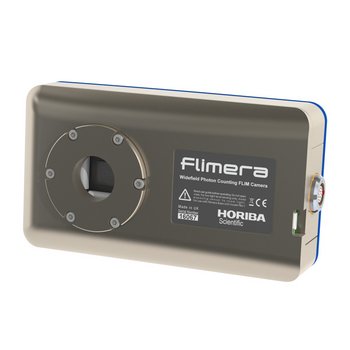
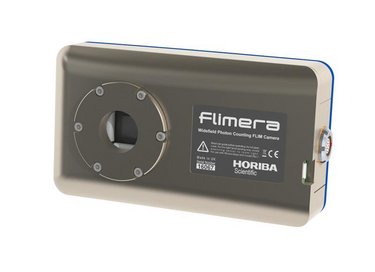
The HORIBA FLIMera camera is a new concept in FLIM technology. It is a wide field imaging camera, rather than a confocal point scanning system, with the intrinsic benefit of being able to study FLIM dynamics at video rates with a SPAD array camera technology that is very simple to implement. Each of the 24,576 pixels has its own TCSPC architecture, acquiring simultaneous decays for all pixels at up to 30 frames per second.

  • Fluorescence Lifetime Mapping (FLIM)

Steady State and Time Resolved Modular Fluorometer Microscopes

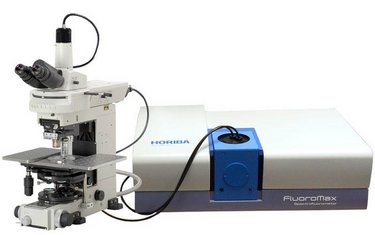
HORIBA fluorescence spectroscopy solutions can be added to an inverted or upright fluorescence microscope. Many of the steady state and time-resolved experiments that are performed macroscopically in our various fluorometers, can also be performed on the microscopic scale with the addition of the appropriate optical coupling to a fluorescence microscope.

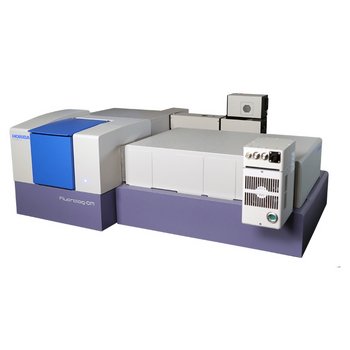
  • Nanolog: Single point UV-Vis-NIR spectra and decays, plus spectral mapping with CCD
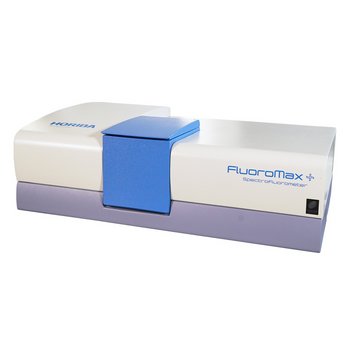
  • Fluoromax Plus: Single point UV-Vis spectra and decays, plus spectral mapping
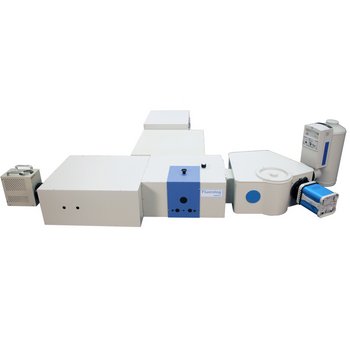
  • Fluorolog-QM: Single point UV-Vis-NIR spectra and decays

Fluorescence microfluorimetry is used for intra- and intercellular biochemistry, PV efficiency analysis, crystal structure of geological specimens, nanotechnology and nanoparticles, materials science, textiles, quality-control of pharmaceuticals, even detection of anomalous features on counterfeit banknotes.

A-TEEM Spectroscopy
Science in Action
Spectroscopy Matters
Nobel Laureate Connections

Browse Products

InverTau
InverTau

Fluorescence Lifetime Imaging Platform

FLIMera
FLIMera

SPAD array imaging camera for dynamic FLIM studies at real time video rates

FluoroMax Plus
FluoroMax Plus

Steady State and Lifetime Benchtop Spectrofluorometer

Fluorolog-QM
Fluorolog-QM

Modular Research Fluorometer for Lifetime and Steady State Measurements

Nanolog
Nanolog

Steady State and Lifetime Nanotechnology EEM Spectrofluorometer

Запросить информацию

У вас есть вопросы или пожелания? Используйте эту форму, чтобы связаться с нашими специалистами.

* Эти поля обязательны для заполнения.

Corporate