The MARPOL Convention is the primary international agreement aimed at preventing pollution of the marine environment caused by ships, whether from routine operations or accidental events. Governed by the International Maritime Organization (IMO), MARPOL includes six annexes that regulate different pollution sources ranging from oil and sewage to garbage and air emissions.
MARPOL Annex VI specifically addresses air pollution from ships and continues to evolve alongside the industry’s decarbonization goals. It establishes emission limits for key pollutants including sulfur oxides (SOx), nitrogen oxides (NOx), and particulate matter, while also promoting energy efficiency measures and providing guidelines for exhaust gas cleaning systems (EGCS).
As regulatory frameworks expand to support greenhouse gas reduction, Annex VI is also expected to provide the foundation for integrating emerging technologies such as Onboard Carbon Capture & Storage.
Explore how advanced gas analysis supports OCCS performance and compliance. Contact our experts today.
The IMO ratified its Strategy on the Reduction of GHG Emissions from Ships, setting a clear ambition to achieve net-zero emissions by 2050 and a 40% reduction in carbon intensity by 2030 compared to 2008 reference levels.
Meeting these ambitious targets will require a combination of strategies—from continued advancements in exhaust gas treatment technologies to the large-scale deployment of zero- and near-zero-carbon fuels.
A major step toward this transition came with the approval of IMO's Net-Zero Framework. Although its formal adoption was postponed in October 2025 due to ongoing discussions around carbon pricing mechanisms, governance of a net-zero fund, and the availability of alternative fuels, the framework remains a central pillar of the industry’s decarbonization roadmap. Once adopted, it will be incorporated as Chapter 5 of MARPOL Annex VI and will establish a regulatory basis for Onboard Carbon Capture & Storage (OCCS) technologies.
Onboard Carbon Capture & Storage is gaining significant attention as a practical pathway to comply with tightening emission regulations without requiring the immediate replacement of existing propulsion and fuel systems.
By capturing CO2 emissions directly on board, OCCS can:
Although OCCS is still in the early stages of commercial development, momentum is growing rapidly. More than 50 vessels worldwide have already been equipped or retrofitted with onboard carbon capture technologies, including chemical looping systems, limestone and seawater reactor concepts, membrane separation technologies or conventional amine-based absorption systems, often enhanced with rotating packed beds to reduce system footprint and improve gas–liquid mass transfer efficiency.
Across the industry, innovative startups and major maritime players are collaborating with measurement technology providers to evaluate next-generation capture systems. These partnerships aim to develop integrated solutions that interface seamlessly with ship operations while maintaining high safety standards and minimizing energy penalties.
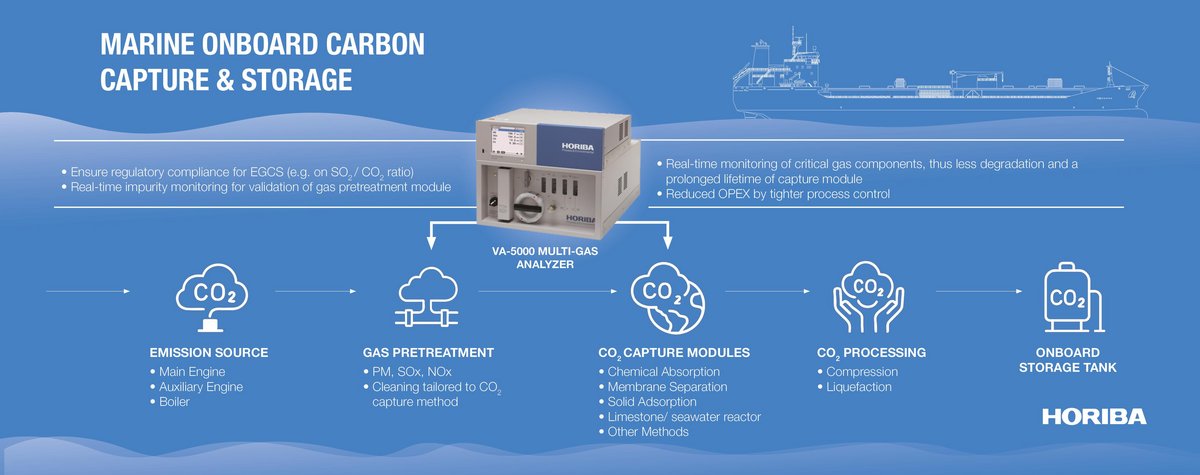
Reliable emissions monitoring is essential for validating the performance and efficiency of OCCS systems. This is where HORIBA’s expertise plays a critical role.
The HORIBA VA-5000 Series multi-gas analyzer is specifically engineered to support the testing and optimization of onboard carbon capture technologies. Utilizing HORIBA’s proprietary sensor technologies, the system enables precise measurement of key maritime pollutants, including SO2, CO2 (and SO2/CO2 ratios), NOx, and O2 across a wide concentration range—from trace ppm levels up to 100 vol.%.
VA-5000 Series continuously measures gas concentrations with high sensitivity.
Combining high analytical accuracy with robust gas sampling and conditioning, HORIBA’s solution delivers:
With HORIBA’s advanced gas analysis solutions, you’re not just measuring emissions—you’re enabling accurate validation, optimized performance, and confident compliance for next-generation onboard carbon capture systems.
Contact us today to learn how HORIBA supports your OCCS development and compliance goals.
Você tem alguma dúvida ou solicitação? Utilize este formulário para entrar em contato com nossos especialistas.