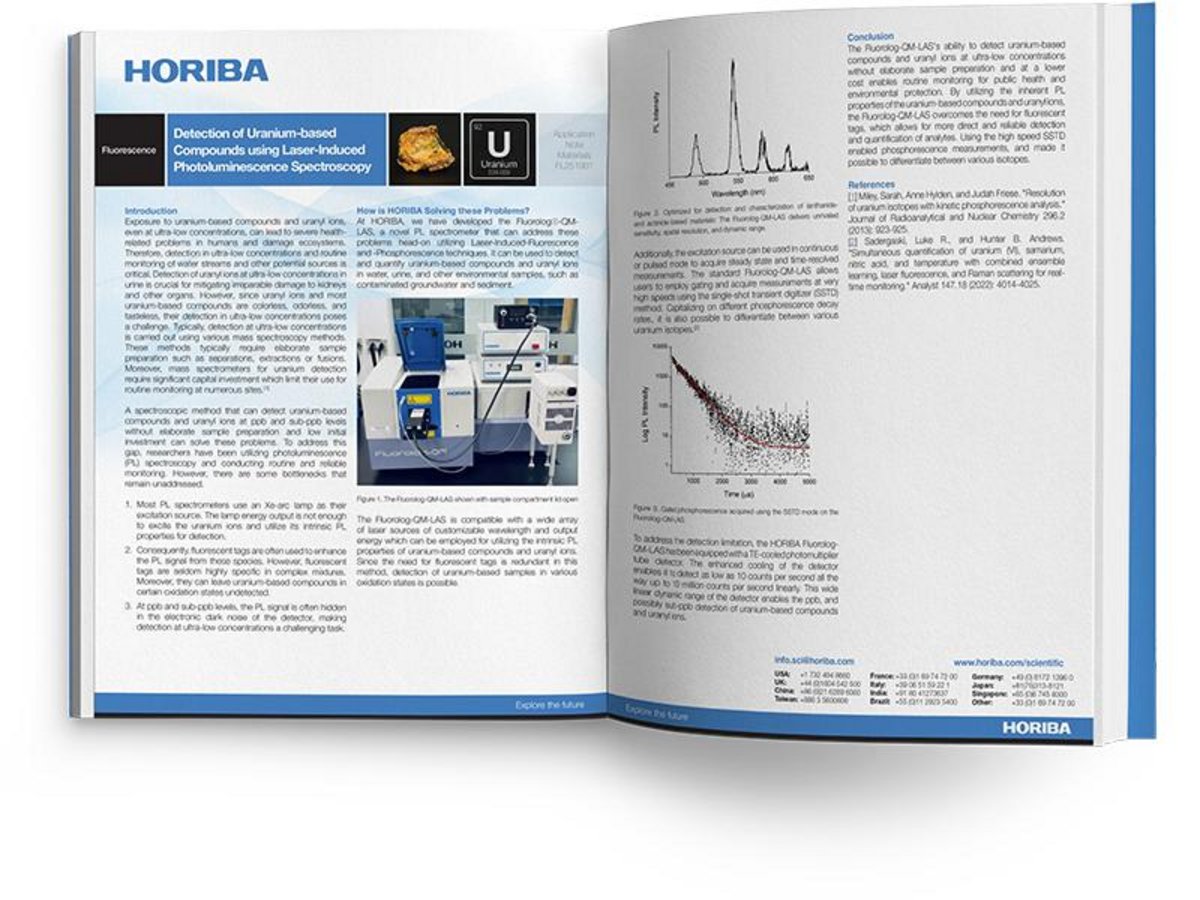
Detection of Uranium-based Compounds using Laser-Induced Photoluminescence Spectroscopy

Exposure to uranium-based compounds and uranyl ions, even at ultra-low concentrations, can lead to severe health-related problems in humans and damage ecosystems. Therefore, detection in ultra-low concentrations and routine monitoring of water streams and other potential sources is critical. Detection of uranyl ions at ultra-low concentrations in urine is crucial for mitigating irreparable damage to kidneys and other organs. However, since uranyl ions and most uranium-based compounds are colorless, odorless, and tasteless, their detection in ultra-low concentrations poses a challenge. Typically, detection at ultra-low concentrations is carried out using various mass spectroscopy methods. These methods typically require elaborate sample preparation such as separations, extractions or fusions. Moreover, mass spectrometers for uranium detection require significant capital investment which limit their use for routine monitoring at numerous sites.

A spectroscopic method that can detect uranium-based compounds and uranyl ions at ppb and sub-ppb levels without elaborate sample preparation and low initial investment can solve these problems. To address this gap, researchers have been utilizing photoluminescence (PL) spectroscopy and conducting routine and reliable monitoring. However, there are some bottlenecks that remain unaddressed.

Application Downloads

Related Products

Fluorolog-QM
Fluorolog-QM

模块化科研级稳瞬态荧光光谱

留言咨询

如您有任何疑问,请在此留下详细需求信息,我们将竭诚为您服务。

* 这些字段为必填项。

Corporate