显微荧光

荧光微区测试和成像

显微荧光测试方法结合了显微镜的空间分辨率与荧光光谱法的分析能力。与传统的荧光显微镜在一个或几个波长波段提供图像不同,我们的显微荧光测量可以获得图像任何一点完整的稳态光谱或寿命

我们的显微荧光系统可以基于您的显微镜,也可提供完整的显微荧光测试系统。显微荧光可完成某个点的光谱和寿命采集,或者通过精密显微镜台对样品进行x和y方向扫描,完成某个区域内每个点光谱或寿命的采集。

显微荧光测试方法可用于细胞内和细胞间生物化学研究、PV效率分析、地质样品的晶体结构研究、纳米技术和纳米粒子研究、材料科学研究、纺织品研究、药品质量控制等领域,甚至可检测假钞上的异常特征。

Frequently Asked Questions (FAQ)

Fluorescence microscopy is an optical analytical technique that captures light emitted by a sample following photoexcitation at specific wavelengths. It operates by isolating weak photoluminescence (PL) signals from excitation light using specialized optical filters and high-sensitivity detectors like Photomultiplier Tubes (PMTs) or Charge-Coupled Devices (CCDs), yielding high-contrast spatial mapping of chemical composition, structural defects, and molecular interactions.

Fluorescence Lifetime Imaging Microscopy (FLIM) measures the temporal decay rate of fluorophores rather than relying solely on emission intensity. Because lifetime measurements are independent of fluorophore concentration and excitation intensity, FLIM provides direct quantitative data on local environmental factors such as pH, viscosity, refractive index, and conformational changes caused by Förster Resonance Energy Transfer (FRET).

In material science, micro-photoluminescence spectroscopy evaluates local electronic band structures, carrier dynamics, and lattice defects in semiconductors, 2D materials, and photovoltaics. This non-destructive technique delivers high spatial resolution, allowing researchers to correlate physical structural defects with optical properties, carrier recombination efficiency, and chemical heterogeneity across heterogeneous thin films and nanostructures without altering sample state.

Steady-state fluorescence microscopy records emission intensity spectra under continuous illumination, serving primary needs in spatial localization and spectral identification. Time-resolved fluorescence microscopy measures emission kinetics following pulsed excitation, providing deeper insights into molecular dynamics, environmental quenching mechanisms, energy transfer efficiency, and fluorophore populations that share identical steady-state spectral overlaps.

FLIM 荧光寿命成像解决方案

模块化解决方案

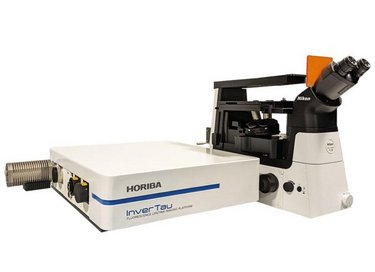
激光共聚焦荧光寿命成像系统

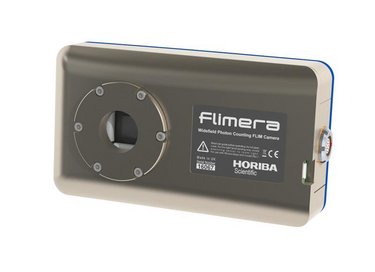
InverTau™ 是 HORIBA 的新型共聚焦激光扫描 FLIM 平台。InverTau 完全由软件控制,设计用于安装在倒置荧光显微镜的侧端口上。您可以围绕 InverTau 平台构建自己的显微镜系统,或从 HORIBA 购买完整的显微镜系统。通过添加 FLIMera,InverTau 可升级为实时宽场视频级 FLIM,帧率高达每秒 30 帧。本地支持始终提供灵活的解决方案。

  • 经济实惠的激光扫描单元,适用于 FLIM 研究
  • 全计算机控制的共聚焦光学系统,配合直观的 EzTime™ Image 软件,可最大限度缩短设置时间并提高生产率
  • 只需添加 FLIMera,即可从共聚焦激光扫描轻松切换至宽场成像
  • 使用 InverTau 可实现高达 6 fps 的实时视频显示,使用 FLIMera 则可实现高达 30 fps 的实时视频显示
  • 直观的软件和自动化光学系统可最大限度地缩短设置时间并提高生产率

视频速率的宽场荧光寿命成像

HORIBA FLIMera 相机是 FLIM 技术领域的一项新技术。它是一款宽场成像相机,而非共聚焦点扫描系统,其固有优势在于能够利用非常易于实现的 SPAD 阵列相机技术,以视频速率研究 FLIM 动力学。该相机的 24,576 个像素均拥有独立的 TCSPC 架构,能够以高达每秒 30 帧的速度同时采集所有像素的衰减数据。

  • 荧光寿命成像(FLIM)

稳瞬态模块化荧光显微镜

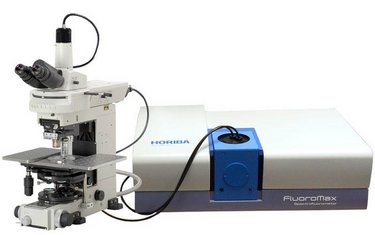
HORIBA 荧光光谱解决方案可集成至倒置或正置荧光显微镜中。许多在各类荧光计中宏观进行的稳态及时间分辨实验,通过为荧光显微镜加装适当的光学耦合装置,同样可在微观尺度上实现。

  • Nanolog: 单点紫外-可见-近红外(UV-Vis-NIR)光谱及衰减曲线,并配备CCD进行光谱成像
  • Fluoromax Plus: 单点紫外-可见(UV-Vis)光谱及衰减曲线,并具备光谱成像功能
  • Fluorolog-QM: 单点紫外-可见-近红外(UV-Vis-NIR)光谱及衰减曲线

显微荧光技术应用于细胞内及细胞间生物化学分析、光伏效率评估、地质样本晶体结构研究、纳米技术与纳米颗粒、材料科学、纺织品、药品质量控制,甚至用于检测假钞上的异常特征。

A-TEEM Spectroscopy
Science in Action
Spectroscopy Matters
Nobel Laureate Connections

留言咨询

如您有任何疑问,请在此留下详细需求信息,我们将竭诚为您服务。

* 这些字段为必填项。

Corporate